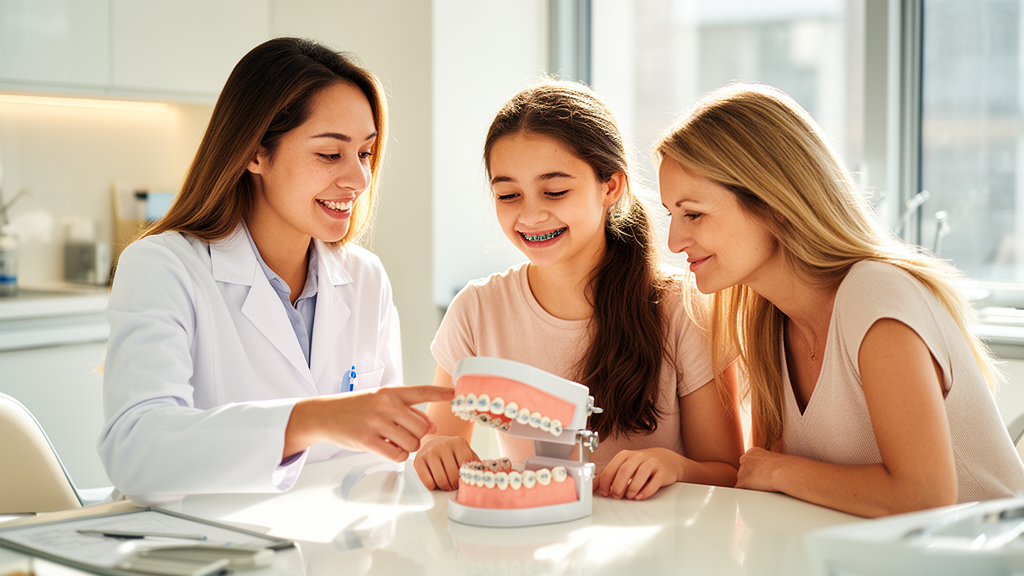
A parent-targeted oral health education program significantly improved periodontal health and orthodontic compliance among adolescents undergoing fixed orthodontic therapy, according to findings from a randomized controlled trial published in BMC Public Health. Orthodontic outcomes depend heavily not only on professional clinical procedures but also on parental oversight, knowledge, and daily support. The trial evaluated an educational framework specifically designed to address common gaps in parental understanding, non-standardized supervision habits, and biased perceptions that frequently exacerbate plaque accumulation and gingival inflammation during treatment.
To establish an effective intervention, researchers developed a standardized curriculum guided by the knowledge, attitude, and practice theoretical framework. The development phase combined a systematic literature review with a two-round Delphi consultation involving twenty-two multidisciplinary experts to ensure the curriculum adequately addressed parental behavioral barriers and clinical supervision needs.
Following intervention development, investigators conducted a single-center, assessor-blinded, parallel-group randomized controlled trial enrolling 212 parent-adolescent dyads. Participants were assigned in an equal one-to-one ratio to either the intervention group or a control group. The intervention cohort received the newly established educational curriculum combined with standard orthodontic care, while control participants received routine clinical care alone. The educational protocol spanned seven months, integrating offline face-to-face instruction with continuous online follow-up support.
Secondary endpoints comprised the Plaque Index, parental knowledge, attitude, and practice evaluation scores, and adolescent treatment compliance. An initial a priori power calculation indicated that fifty-five parent-adolescent pairs per group were necessary to evaluate the primary outcome, accounting for an anticipated twenty percent dropout rate. However, researchers pragmatically enrolled 106 dyads per trial arm to increase analytical precision for secondary endpoints.
Statistical evaluation followed the intention-to-treat principle, employing analysis of covariance with baseline values entered as covariates to assess seven-month differences between trial groups. Adolescents whose parents completed the educational intervention demonstrated a statistically significant reduction in gingival inflammation compared to controls, showing an adjusted mean difference in the Gingival Index of negative 0.58. Plaque accumulation was similarly reduced in the intervention arm, yielding an adjusted mean difference in the Plaque Index of negative 0.62.
Parental behavioral outcomes also improved markedly across all measured dimensions, with parental knowledge, attitude, and practice metrics achieving statistically significant gains compared to routine care. Concurrently, adolescent treatment compliance demonstrated significant enhancement, reflected in an adjusted mean difference of negative 9.15 on the total compliance scoring instrument. Throughout the seven-month evaluation window, attendance remained above ninety-five percent across both digital follow-ups and in-person meetings, indicating high participant adherence and operational feasibility.
Economic observations during the trial revealed that the structured educational curriculum was associated with lower observed costs alongside its clinical benefits over the seven-month duration. The research team noted that the combined online and offline structure offers an adaptable design that may be incorporated into standard orthodontic workflows and broader public health initiatives.
The authors reported several methodological parameters, including the single-center trial setting and a retrospective trial registration submitted to the Chinese Clinical Trial Registry under submission identifier 345914, which was undergoing audit at the time of study publication. Overall, the findings indicate that structured parental engagement provides a measurable clinical contribution to controlling plaque and preserving periodontal stability in adolescents undergoing fixed orthodontic correction.
The researchers underscored that treatment success is not solely a product of technical appliance adjustments and clinical expertise. Instead, daily oral hygiene compliance is mediated by the home environment, where parental literacy, attitudes toward preventive dental practices, and routine supervision exert considerable influence over clinical trajectories and therapeutic outcomes.
The study emphasized that inadequate parental knowledge, coupled with biased perceptions and unstructured home monitoring routines, frequently contributes to suboptimal patient compliance. In fixed appliance therapy, poor adherence commonly leads to elevated plaque accumulation, aggravated gingival inflammation, and higher rates of orthodontic complications. By grounding the two-phase curriculum development in Delphi consensus procedures and integrating continuous online touchpoints with face-to-face sessions, the educational model systematically targeted these behavioral deficiencies.
From a broader implementation perspective, the authors concluded that theory-guided, family-centered education establishes a scalable paradigm for adolescent periodontal care during specialized orthodontic therapy. Beyond immediate clinical improvements, the online-offline hybrid format demonstrated high operational feasibility, maintaining consistent participation across digital and in-person components.
Subject of Research: Parent-targeted health education intervention for adolescent fixed orthodontic treatment
Article Title: Knowledge, Attitude, and Practice (KAP)-based health education programme for parents of adolescent fixed orthodontic patients: a two-phase intervention development and assessor-blinded randomized controlled trial
Article References: Sui, X., Zhang, W., Zhai, S., Zhu, J., & Liu, X. (2026). Knowledge, Attitude, and Practice (KAP)-based health education programme for parents of adolescent fixed orthodontic patients: a two-phase intervention development and assessor-blinded randomized controlled trial. BMC Public Health. https://doi.org/10.1186/s12889-026-30319-7
Image Credits: AI Generated
DOI: 10.1186/s12889-026-30319-7
Keywords: adolescent health, fixed orthodontics, health education, KAP model, parental supervision, oral health literacy, Gingival Index, Plaque Index, treatment compliance, randomized controlled trial, assessor blinded, periodontal health, malocclusion, Delphi consultation, oral hygiene, public health, orthodontic care
News Source: Courtney Benton. (November 13, 2026). Parent Education Program Improves Adolescent Orthodontic Outcomes in Randomized Trial. Scienmag.