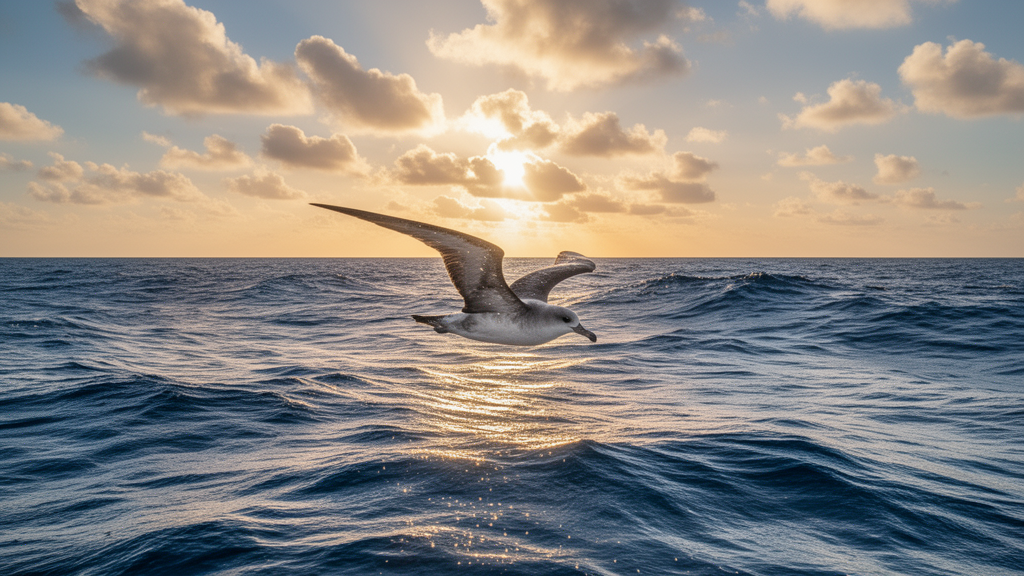
Rapid travel across longitudes can induce a form of jet lag in wild seabirds that causes them to veer off course while navigating by the Sun, according to a study by Patrick Lewin and colleagues published in Science. By analyzing GPS tracking data from 1,045 wild Manx shearwaters (Puffinus puffinus), the researchers demonstrated that rapid eastward or westward movement directly disrupts the birds’ internal biological clocks and induces predictable directional errors in their Sun-compass orientation, even when alternative navigational cues are accessible.
Wild animals rely on a suite of environmental compass cues to guide their migrations and foraging flights, including stars, Earth’s magnetic field, and the Sun. Because the Sun continuously traverses the sky throughout the day, any animal employing it as a reliable compass reference must actively compensate for this solar movement. This continuous adjustment is maintained by an internal biological clock that is synchronized and calibrated primarily by the local daily light-dark cycle.
When animals travel rapidly across lines of longitude, their internal biological clocks can fall out of synchronization with local solar time, producing predictable steering errors. For example, eastward travel is expected to produce a clockwise deviation from the intended direction, while westward travel should cause a counterclockwise deviation.
While earlier studies examining Arctic migratory bird species provided preliminary support for these directional deviations, confirming that such flight errors stem directly from internal clock shifts requires ruling out alternative explanations. In particular, researchers must distinguish clock-mediated solar orientation errors from potential course deviations caused by geographic variations in Earth’s magnetic field along migratory corridors.
To test these navigational mechanisms in natural flight conditions, Lewin and colleagues analyzed tracking data from wild Manx shearwaters that routinely travel upwards of 1,000 kilometers between feeding grounds in the Northeast Atlantic and breeding colonies in the United Kingdom. The GPS records revealed that the seabirds experienced predictable navigational skew following rapid longitudinal travel, with directional shifts closely matching the theoretical deviations expected from Sun-compass errors.
Furthermore, the birds continued relying on their disrupted Sun compass even when alternative orientation cues, including recognizable coastlines, were available to guide their return.
Subject of Research: Longitudinal jet lag and Sun-compass navigation errors in wild Manx shearwaters
Article Title: Traveling seabirds experience “jet lag” during long flights, causing navigational errors
Article References: Traveling seabirds experience “jet lag” during long flights, causing navigational errors. Original publication (Bibliographic details unavailable.)
Image Credits: AI Generated
DOI: Not provided
Keywords: Manx shearwaters, seabird migration, sun compass, animal navigation, circadian biology, jet lag, ornithology, GPS tracking, Traveling, seabirds, experience, during
News Source: Drew Townsend. (November 12, 2026). Rapid Longitudinal Flights Disrupt Sun Compass Navigation in Wild Seabirds. Scienmag.