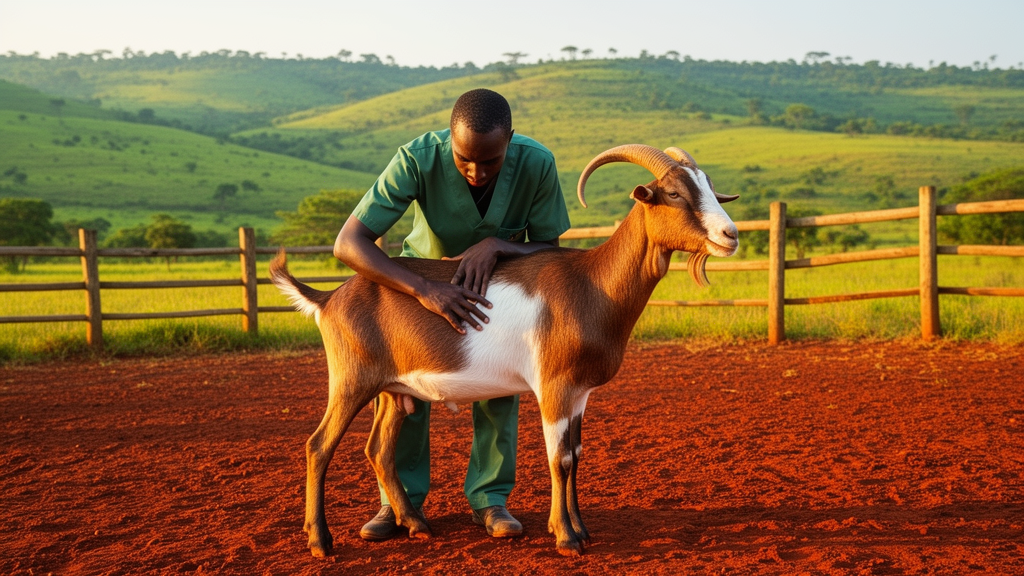
In an observational study of smallholder herds across Uganda, an analysis of five machine learning algorithms identified pre-mating body condition score as the primary predictor associated with pregnancy success in indigenous Small East African goats. The research examined nine hundred doe-mating events recorded across two hundred and forty smallholder farms in four agro-ecological zones. Rather than presenting a validated clinical forecasting tool, the multi-model framework established associative patterns across twenty-five biological, health, environmental, and management variables. Overall algorithmic discrimination remained modest, with regularized logistic regression achieving the highest receiver operating characteristic area under the curve at 0.691 on a held-out test set. Across four of the five analytical models, physical condition at mating consistently secured the top relative importance ranking. While tree-based algorithms highlighted the secondary influence of satellite-derived rainfall and vegetation indices, the authors emphasized that these observational relationships do not demonstrate direct causality.
Smallholder goat production across Sub-Saharan Africa faces persistent challenges related to low reproductive efficiency, directly constraining rural household nutrition and farm productivity in resource-limited agricultural systems. In Uganda, annual kidding rates in smallholder herds typically range between 60 percent and 72 percent, remaining far below the biological potential of 140 to 180 percent achievable under optimal management supporting two annual kidding cycles. Previous investigations into small ruminant fertility frequently relied on standard linear regressions or expert scoring frameworks. However, those traditional techniques struggle to capture non-linear relationships, multi-collinearity, and environmental interactions typical of smallholder pastoral settings. To overcome these constraints, the researchers applied a comparative machine learning workflow to isolate consistent signals across diverse algorithmic structures. The study evaluated which measurable animal, health, management, and ecological variables display the most consistent predictive associations with conception outcomes under real-world Ugandan farming conditions.
The dataset comprised nine hundred doe-mating events recorded across two hundred and forty smallholder farms located in four agro-ecological districts in Uganda: Nakaseke with seventy farms, Sembabule with fifty-eight farms, Soroti with fifty-eight farms, and Kabale with fifty-four farms. Field personnel collected reproductive and husbandry data using standardized Farm Reproductive Record Form instruments, numbered FRRF-01 through FRRF-08, ensuring systematic field recording. The analysis incorporated twenty-five candidate predictors categorized into animal-level traits, health and management variables, and environmental factors. Geographic coordinates recorded at each farm allowed the team to extract satellite data matched to specific properties rather than broad administrative averages. Across the full sample of nine hundred mating events, six hundred and twelve resulted in confirmed pregnancy while two hundred and eighty-eight were non-pregnant. This 68.0 percent conception rate established a moderate class imbalance that guided downstream statistical model training and cross-validation procedures.
Pregnancy verification relied on a composite diagnostic methodology combining observational monitoring with clinical veterinary confirmation. Initial assessments classified does showing no return to oestrus within twenty-one days after breeding as provisionally pregnant. Final pregnancy outcomes were subsequently verified through recorded kidding at term across four hundred and eighty-nine records, or through manual palpation by trained field veterinary officers between sixty and ninety days post-mating across one hundred and twenty-three records. Body condition score was determined within twenty-four hours of breeding using the standard five-point scale in half-point increments by assessing lumbar vertebrae, transverse processes, and sternal and tail-head fat deposits. An inter-observer reliability evaluation on a ten percent sub-sample showed an intra-class correlation coefficient of 0.83. The study calculated an events-per-variable ratio of 11.52 based on the two hundred and eighty-eight non-pregnant cases, exceeding the recognized benchmark of ten required for stable model estimation.
To compare feature rankings across distinct computational paradigms, the authors trained five supervised machine learning models: L2-regularized logistic regression, random forest with three hundred trees, extreme gradient boosting with two hundred estimators, a support vector machine using a radial basis function kernel, and an artificial neural network structured with three hidden layers of 128, 64, and 32 neurons. To avoid farm-level data leakage, the workflow applied an 80/20 farm-stratified split, ensuring no farm appeared in both the training set and the held-out test set of one hundred and eighty records. Missing observations were imputed using training set medians and modes, continuous features underwent Z-score standardization, and class imbalance was handled via synthetic minority over-sampling applied solely within training folds. Hyperparameters were tuned through 10-fold cross-validation on training data before evaluating final models on the test set. The authors noted that neural network architectures may be overparameterized for nine hundred records, warranting caution during interpretation.
On the independent held-out test cohort of one hundred and eighty records, model performance varied noticeably, demonstrating that overall discriminatory capacity remained modest. Regularized logistic regression attained the highest discrimination with a receiver operating characteristic area under the curve of 0.691 and a 95 percent confidence interval between 0.617 and 0.764, alongside the best calibration indicated by a Brier score of 0.221. The tree-based ensembles, random forest and extreme gradient boosting, produced high sensitivities of 0.910 and 0.869 but exhibited poor specificities of 0.241 and 0.293, reflecting a pronounced tendency to over-predict the majority pregnant class. The support vector machine and artificial neural network performed near chance, posting test areas under the curve of 0.540 and 0.519. Ten-fold cross-validation on the training data showed consistent results, yielding mean areas under the curve of 0.632 for logistic regression, 0.613 for random forest, 0.605 for gradient boosting, 0.572 for support vector machines, and 0.580 for neural networks.
Feature importance evaluation highlighted clear cross-algorithm agreement across the twenty-five candidate variables, demonstrated by a Kendall’s concordance coefficient of 0.48. Body condition score at mating emerged as the primary predictor, capturing the top normalized rank of 1.00 in logistic regression, random forest, gradient boosting, and support vector machines. In the logistic regression model, each standard deviation increase in standardized body condition score yielded an odds ratio of 1.40, with a 95 percent confidence interval from 1.32 to 1.49. This indicates that a one standard deviation improvement corresponds to approximately 40 percent higher odds of conception, elevating the estimated conception probability from the dataset mean of 68 percent to approximately 74 percent. Buck age also demonstrated a positive association with an odds ratio of 1.15. Conversely, in the neural network, body condition ranked lower at 0.41, while peste des petits ruminants vaccination and mating season showed greater relative importance.
Environmental variables displayed pronounced importance that varied according to model structure, illustrating key differences between linear and non-linear predictive frameworks. Precipitation during the thirty days before mating, derived from daily CHIRPS satellite observations at 0.05-degree resolution, and pasture greenness, obtained from MODIS 250-meter 16-day composite vegetation index data, ranked as the second and third most important features in random forest and gradient boosting models. In contrast, precipitation dropped to ninth position in logistic regression. The researchers noted a moderate correlation of r equals 0.31 between thirty-day rainfall and body condition score at mating. Because satellite vegetation and rainfall measurements reflect broad environmental conditions rather than direct forage intake or digestibility, the tree-based models likely captured non-linear ecological pathways that influence animal nutrition indirectly. The authors noted that these satellite-derived environmental predictors provide useful proxies for forage availability in smallholder production settings where local weather stations are entirely absent.
Beyond nutrition and climate, animal health indicators emerged as critical negative determinants of reproductive success. Clinical disease events occurring within thirty days prior to mating and elevated FAMACHA scores, which evaluate conjunctival pallor indicative of Haemonchus contortus endoparasite infection, showed stable negative associations with conception across all algorithms. Elevated Temperature-Humidity Index values calculated from ERA5-Land reanalysis and advancing parity also showed negative associations in logistic regression. Domain-level analysis across logistic regression, random forest, and gradient boosting revealed that animal-level predictors accounted for 51.2 to 58.6 percent of total model importance. Environmental covariates contributed 22.3 to 30.7 percent, while health and management predictors represented 11.4 to 21.8 percent. On a per-variable basis, however, environmental factors contributed between 4.5 and 6.1 percent each, matching or slightly exceeding animal-level variables, which averaged 4.4 to 4.9 percent per predictor, partly adjusting the broader domain-level interpretation.
The authors emphasized that several methodological constraints must guide the interpretation of these results. The observational dataset lacked direct measurements of forage nutrient composition, grazing duration, browse selectivity, mineral supplementation, or water access, leaving body condition score to integrate these unmeasured pathways. Additional limitations included the composite approach to pregnancy confirmation, a temporal imprecision of up to sixteen days in MODIS vegetation composites, and an events-per-variable ratio near the lower acceptable threshold. Because the study design was observational, identified associations cannot establish causal relationships. Within these constraints, the findings highlight pre-mating nutritional supplementation, strategic deworming timed four to six weeks prior to breeding, and synchronizing mating with peak pasture greenness as priority areas for future investigation. The researchers concluded that controlled intervention trials and external validation across independent farming populations remain essential prerequisites before incorporating these data-driven insights into operational livestock extension guidelines.
Subject of Research: Machine learning analysis of predictors associated with conception success in indigenous Ugandan goats
Article Title: Data-driven insights into priority predictors associated with conception success in indigenous goats in Uganda
Article References: Tuyishime, K., & Ahakundire, P. (2026). Data-driven insights into priority predictors associated with conception success in indigenous goats in Uganda. Discover Computing, 29(1), Article 878. https://doi.org/10.1007/s10791-026-10797-4
Image Credits: AI Generated
DOI: 10.1007/s10791-026-10797-4
Keywords: Small East African goats, conception success, body condition score, smallholder livestock, Uganda agriculture, machine learning, logistic regression, random forest, XGBoost, support vector machines, artificial neural networks, CHIRPS rainfall, MODIS NDVI, Temperature-Humidity Index, FAMACHA score, Haemonchus contortus, parity, veterinary epidemiology
News Source: William Thompson. (November 12, 2026). Body Condition Score Predicts Conception Success in Ugandan Indigenous Goat Study. Scienmag.