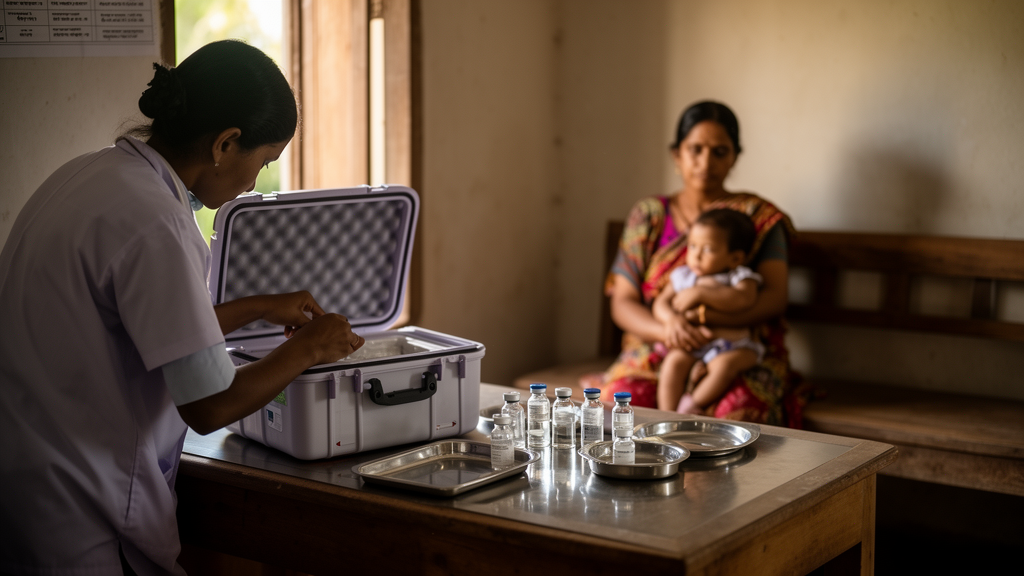
A perspective analysis published in Discover Public Health reports that Bangladesh has confronted its most severe measles outbreak in decades during 2026, documenting more than 50,500 suspected cases and at least 415 confirmed or suspected measles-related deaths between mid-March and mid-May. The analysis, authored by Md. Abdus Salam, characterizes this widespread public health crisis not as an unavoidable biological occurrence, but as a preventable systems failure that reversed years of hard-won progress toward disease elimination. Historically recognized as an international benchmark for immunization programming in resource-constrained environments, the country experienced an erosion of protective herd immunity when systemic administrative disruptions, nationwide vaccine supply shortages, and prolonged intervals between supplemental vaccination campaigns converged to expose expanding cohorts of unprotected children.
The historical trajectory of measles control in Bangladesh highlights the scale of the recent setback. In the early 2000s, measles persisted as a major cause of pediatric mortality across the country, with national coverage for the first dose of measles-containing vaccine stagnating at or below 75 percent and zero administrative districts reaching the 95 percent coverage threshold necessary to interrupt transmission. Sustained national investments in the Expanded Programme on Immunization, combined with integrated child health days, routine vitamin A distribution, and recurring nationwide supplementary immunization activities, gradually lifted first-dose administrative coverage from approximately 74 to 89 percent in 2000 to between 94 and 118 percent by 2016. In parallel, the introduction of a routine second measles-containing vaccine dose in 2012 expanded second-dose coverage from roughly one-third of eligible children to more than 90 percent by the mid-2010s, driving laboratory-confirmed measles incidence down by more than 80 percent from approximately 40 cases per million population to 6 per million.
Despite these extensive historical gains, national surveillance data compiled by domestic health agencies and international monitoring bodies revealed an underlying accumulation of susceptible individuals starting after 2019. National coverage estimates for both the first and second doses of the combined measles-rubella vaccine plateaued and subsequently exhibited modest declines. First-dose coverage slipped from approximately 88 to 89 percent down to 86 percent, while second-dose coverage dropped from roughly 89 percent to 80.7 percent by the 2023 to 2024 monitoring period, leaving an estimated 20 million children partially or entirely unprotected against infection. Compounding these gradual routine reductions, Bangladesh failed to conduct any nationwide measles-rubella supplementary immunization activities following its 2020 campaign, departing from its historical schedule of four-yearly catch-up exercises due to operational disruptions caused by the COVID-19 pandemic and subsequent domestic political instability.
The vulnerability deepened considerably between 2024 and 2025 following a nationwide stockout of the measles-rubella vaccine, which the perspective links to procedural shifts in procurement arrangements and administrative delays that accompanied a broader political transition. A planned nationwide supplementary campaign originally scheduled for 2024 was postponed, remained unimplemented throughout 2025, and was ultimately cancelled altogether. While international evaluations by the World Health Organization and UNICEF recorded routine coverage figures of 97 percent for the first dose and 93 percent for the second dose in 2023, certain internal national reports cited an acute drop to approximately 56 to 59 percent coverage by 2025. Although the author notes that discrepancies between administrative datasets and independent field surveys preclude an absolute causal determination, the accumulated evidence indicates that these procurement disruptions expanded the pool of susceptible hosts precisely when routine delivery systems were operating under strain.
When transmission expanded rapidly in early 2026, the infectious pathogen exploited these accumulated immunity gaps with severe clinical consequences. The National International Health Regulations Focal Point formally notified the World Health Organization of an accelerating nationwide increase in measles cases on April 4, 2026. Directorate General of Health Services data recorded 50,500 suspected cases and 415 deaths by May 11, reflecting a crude reported death-to-suspected-case ratio of approximately 0.82 percent. Epidemiological tracking between April 22 and May 4 documented cumulative suspected cases surging from 27,164 to 41,793, laboratory-confirmed infections rising from 3,934 to 5,467, and reported deaths increasing from 190 to 311. Approximately 79 to 80 percent of all reported infections occurred among children under five years of age, with 66 percent concentrated in children under two years and roughly one-third occurring in infants younger than nine months who were not yet eligible for standard routine measles immunization.
The spatial distribution of cases revealed severe localized burdens, with the outbreak reaching 58 of Bangladesh’s 64 administrative districts across all eight divisions while concentrating heavily within specific urban slums, peripheral settlements, and humanitarian zones. In the capital division of Dhaka alone, situation reports documented more than 18,000 to 19,000 cases, heavily clustering within densely populated informal settlements including Demra, Jatrabari, Kamrangirchar, Korail, Mirpur, and Tejgaon. Within these crowded urban environments, high population density, economic precarity, and geographic mobility presented substantial barriers to routine healthcare delivery. Outside municipal centers, field monitoring in Gopalganj identified zero-dose children among highly mobile floating families who had been bypassed by both standard clinic-based schedules and targeted door-to-door immunization initiatives.
Humanitarian settings presented another critical vulnerability during the 2026 resurgence, particularly within the congested Rohingya refugee camps established across Cox’s Bazar. Transmission within the camp complex escalated from 19 suspected cases in January to 199 in February, reaching 76 suspected cases with 8 confirmed infections by March. By mid-May, diagnostic testing confirmed 60 cases alongside 239 suspected cases and 5 attributable deaths, expanding to a cumulative total of 595 suspected cases and 60 laboratory-confirmed cases by May 20. The extreme transmissibility of the measles virus within these humanitarian enclaves was exacerbated by constrained baseline access to clinical services, widespread dependence on external humanitarian assistance, high rates of background malnutrition, and persistent cohorts of completely unvaccinated zero-dose infants residing in close quarters.
The perspective emphasizes that the clinical severity of the outbreak was compounded by frequent secondary complications, most notably acute pneumonia, persistent diarrhea, and severe metabolic wasting linked directly to pre-existing childhood undernutrition and vitamin A deficiencies. Surging patient volumes placed severe operational strain on secondary and tertiary clinical centers, with daily hospital admissions frequently surpassing 1,200 to 1,300 patients. This influx rapidly overwhelmed pediatric wards and exposed structural deficits in facility-based isolation units, available health personnel, and laboratory diagnostic reagents. Clinical observations indicated that severe disease and fatal outcomes remained heavily concentrated among under-vaccinated or unvaccinated young children, demonstrating how nutritional deficits and immunization lapses synergistically worsen pediatric outcomes during large-scale community transmission.
Bangladesh’s domestic outbreak mirrors a broader post-pandemic deterioration of measles control observed internationally. According to World Health Organization global monitoring figures, 59 countries experienced large or disruptive measles outbreaks in 2024—nearly three times the total recorded in 2021—including several jurisdictions that had previously attained verified elimination status. Worldwide, estimated coverage for the first vaccine dose reached approximately 84 to 86 percent in 2024, with second-dose uptake estimated at 76 percent, leaving global coverage well beneath the 95 percent threshold necessary to maintain community herd protection. Regionally, concurrent case increases and localized outbreaks were documented across India, Nepal, Thailand, and the Maldives, prompting public health authorities in neighboring Myanmar to reinforce cross-border surveillance and clinical preparedness along its frontier to mitigate potential cross-border transmission.
In response to the crisis, the Government of Bangladesh joined with international partners, including the World Health Organization, UNICEF, and Gavi, to mount an emergency response campaign starting on April 5, 2026. Initially deployed across 30 high-risk upazilas in 18 districts, the intervention expanded into four city corporations before rolling out nationwide on April 20, strategically lowering the eligibility age to six months to shield vulnerable infants. Responders distributed more than 20 million vaccine doses, trained over 26,000 frontline health workers, and integrated vitamin A supplementation into clinical case management. Although administrative tracking recorded more than 18.3 million children vaccinated by May 19—surpassing initial national targets—an independent assessment published by the International Federation of Red Cross and Red Crescent Societies on May 5 reported national administrative coverage at only 60.57 percent, noting that multiple districts had reached fewer than half of their target populations while active transmission continued.
Concluding his evaluation, Salam argues that the 2026 epidemic serves as a clear indicator of structural fragility in primary health systems, illustrating that high national coverage metrics often obscure dangerous localized pockets of susceptibility. Rebuilding long-term resilience will require immediate stabilization of the national vaccine pipeline through secured buffer inventories, independent supplier verification mechanisms, and statutory protections that isolate essential medicine procurement from administrative or political transitions. Over the longer horizon, the perspective calls for institutionalizing regular supplementary catch-up campaigns, modernizing disease surveillance with real-time laboratory reporting, and prioritizing micro-planning in urban informal settlements and humanitarian camps to ensure sustained protection for marginalized and zero-dose populations before explosive outbreaks can emerge.
Subject of Research: Systemic and operational drivers of the 2026 measles resurgence in Bangladesh
Article Title: Measles resurgence in Bangladesh 2026 undermines elimination gains and requires urgent policy action
Article References: Salam, M. A. (2026). Measles resurgence in Bangladesh 2026 undermines elimination gains and requires urgent policy action. Discover Public Health, 23(1), Article 1790. https://doi.org/10.1186/s12982-026-03198-x
Image Credits: AI Generated
DOI: 10.1186/s12982-026-03198-x
Keywords: Bangladesh, measles outbreak, Discover Public Health, routine immunization, measles-rubella vaccine, vaccine stockout, supplementary immunization activities, zero-dose children, World Health Organization, UNICEF, public health surveillance, Rohingya refugee camps, Dhaka informal settlements, vaccine procurement, childhood mortality, vitamin A supplementation, expanded programme on immunization
News Source: Ophelia Keating. (November 12, 2026). Preventable Systems Failures Driven by Supply Gaps Trigger Bangladesh Measles Resurgence. Scienmag.