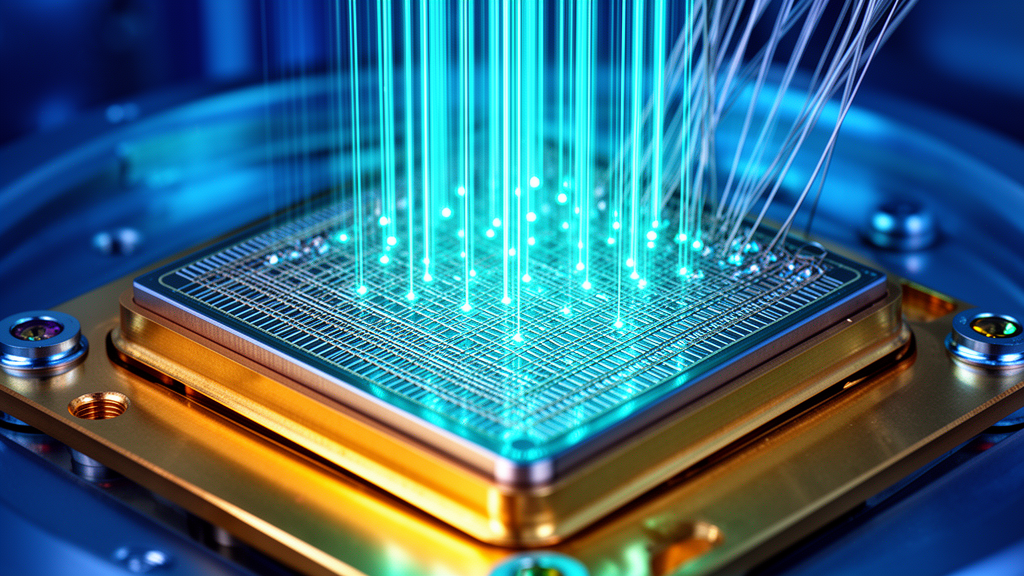
Researchers have developed a detection platform capable of precisely counting from zero to more than 9,000 individual photons in optical pulses, bridging a long-standing operational divide between single-photon counters and standard optical power meters. The experimental work, reported in Optica by a team from Paderborn University in Germany, pairs superconducting nanowire single-photon detectors with an optical multiplexing architecture to expand the scale of precise photon-number measurements. By establishing 1,024 discrete detection bins coupled to an accurate model of detector behavior, the scientists demonstrated an approach that significantly extends the measurable volume of optical pulses.
Scaling up optical detection systems has presented substantial obstacles as the size and complexity of photonic quantum platforms continue to grow. Conventional single-photon detectors, including widely used avalanche photodiodes, typically register only binary information regarding whether light is present or absent rather than quantifying the exact number of arriving photons. Conversely, conventional photodiodes and related detectors engineered to record high-intensity light pulses suffer from electrical noise that obscures single-photon fluctuations, preventing fine photon-number resolution at low to intermediate photon levels.
Superconducting nanowire single-photon detectors, known as SNSPDs, provide an alternative mechanism due to their intrinsic low noise characteristics, exceptional timing resolution, and high detection efficiency. While earlier studies revealed that individual SNSPDs can resolve a restricted number of arriving photons when paired with high-precision timing electronics, pushing counting capabilities to much larger photon populations required an expanded architecture. To address this limitation, the Paderborn team investigated whether the intrinsic photon-number resolution of SNSPDs could be merged with multiplexing on a scale an order of magnitude larger than previous counting systems.
The experimental detection architecture uses multiplexing to divide an incoming light pulse into 128 smaller pulses distributed sequentially in time. These temporal segments are subsequently directed across eight distinct superconducting detectors, creating a total of 1,024 separate detection bins that share the original photon payload.
By integrating model-informed characterization with the multi-channel hardware, the researchers were able to extract precise photon counts without needing the massive hardware footprints typical of purely discrete multiplexed systems.
To evaluate the system under controlled conditions, the investigators interrogated the array using laser pulses calibrated to deliver average photon numbers ranging between 1 and 15,000 photons per pulse. By recording the response across diverse pulse energies, the team determined the measurement uncertainty and dynamic range of the detector assembly. The calibrated instrument demonstrated successful photon counting for pulses containing up to 276 photons while maintaining an uncertainty of less than one single photon.
The efficiency of the combined model and multiplexing framework allowed the researchers to attain sub-photon precision with significantly fewer physical detector elements than would normally be required. According to the research team, a conventional multiplexed device operating without their model-informed architecture would require approximately 37,000 individual detector units to deliver equivalent precision, contrasted with the 1,024 bins deployed in their experimental apparatus.
Having established the macroscopic counting technique using laser pulses, the researchers plan to extend the multiplexed detector platform to bright quantum states of light to study quantum physical effects at larger scales. As superconducting nanowire technology matures, the macroscopic photon-counting approach offers practical avenues for scaling photonic quantum computing architectures and advancing high-sensitivity cameras and optical sensors.
The ability to resolve macroscopic photon numbers addresses longstanding measurement challenges across optical physics. As quantum systems scale up, researchers require detection methods capable of distinguishing large populations of individual photons, an objective that remains challenging with conventional technologies. Tim Bartley of Paderborn University highlighted that large-scale measurement of individual photons represents an essential foundation for single-photon-level imaging and photonic quantum computing, noting that the new macroscopic counting framework provides direct insights into scaling quantum processors and ultrasensitive cameras.
Timon Schapeler explained that counting accuracy degrades as the volume of photons increases, making the combination of multiplexing and intrinsic photon-number resolution necessary to bridge the gap toward high-sensitivity optical power meters. In addition to measuring discrete photon statistics, the detectors generate arrival-time histograms that map out the photon-number resolution of the system. While this initial investigation focused on characterizing classical laser pulses, applying the technology to brighter states of light could uncover quantum phenomena at macroscopic scales and broaden capabilities in sensitive optical measurement.
Subject of Research: Multiplexed superconducting nanowire detector system for photon-number-resolving optical measurements
Article Title: Researchers extend photon counting beyond single photons
Article References: Researchers extend photon counting beyond single photons. Original publication (Bibliographic details unavailable.)
Image Credits: AI Generated
DOI: Not provided
Keywords: photon counting, superconducting nanowire single-photon detectors, quantum optics, multiplexed detectors, photon-number resolution, optical power meters, photonic quantum computing, laser pulses, quantum light, sub-photon precision, arrival-time histograms, Paderborn University, detector modeling, single-photon detection, quantum technology, optical measurements
News Source: Denise Maddox. (November 12, 2026). Multiplexed Superconducting Detectors Precisely Count More Than 9,000 Individual Photons. Scienmag.