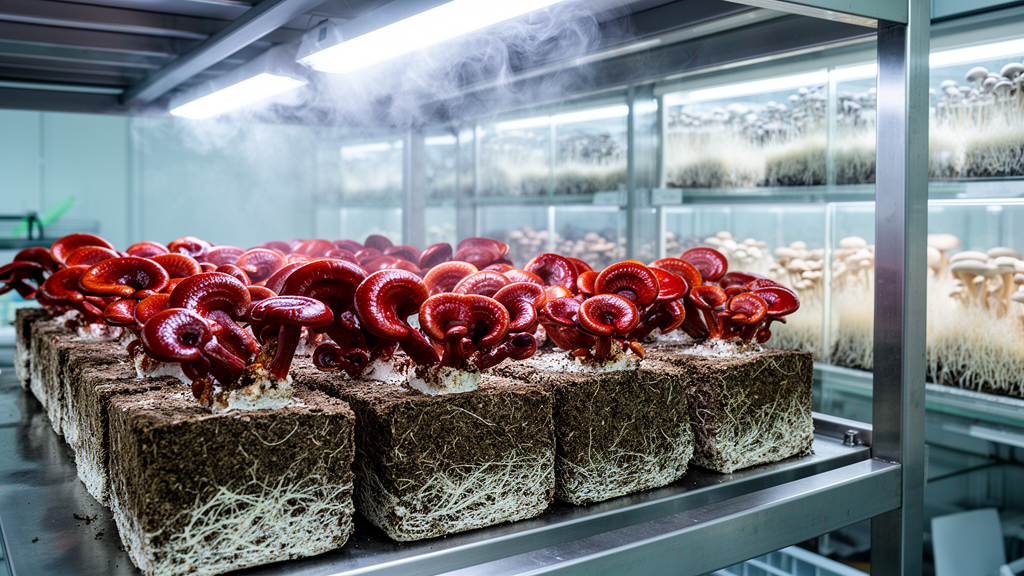
A comprehensive two-cycle screening of 69 Ganoderma strains evaluated under standardized cultivation conditions revealed that multi-trait optimization can successfully distinguish elite, highly productive strains from slow-colonizing varieties while substantially lowering estimated operational resource intensity. In controlled evaluations conducted at the ICAR-Directorate of Mushroom Research in Solan, India, researchers demonstrated that selecting mushroom strains based solely on peak fresh yield overlooks crucial production factors such as substrate colonization speed and yield repeatability. By tracking developmental intervals, biological efficiency, and crop-to-crop performance across successive harvests, the investigation established that rapid mycelial colonization strongly correlates with elevated crop yields. The study provides an empirical selection framework showing that elite strains can simultaneously reduce production-cycle occupancy and reduce estimated duration-dependent costs per kilogram of harvested mushroom.
Cultivation of the medicinal mushroom genus Ganoderma is widely pursued due to the commercial value of its fruiting bodies, spores, and mycelial extracts, which are rich in bioactive triterpenoids and polysaccharides used across functional-food, nutraceutical, and pharmaceutical markets. Commercial mushroom cultivation facilities operating under controlled environmental chambers face significant operational expenditure driven by electricity, environmental regulation, and facility labor over time. Longer cultivation cycles hold growing space hostage, accumulating duration-dependent overheads that reduce the annual turnover of growing rooms. Standard selection procedures have traditionally prioritized absolute harvest weight or isolated agronomic traits, often failing to account for interrelated developmental schedules, fruiting responsiveness, or repeatability across independent production cycles. To resolve these production bottlenecks, researchers sought to determine whether developmental earliness directly correlates with higher biological yields and whether systematic multi-objective selection algorithms could reliably isolate robust cultivation ideotypes.
The experimental trial assessed pure cultures of 69 Ganoderma strains obtained from the culture collection of the ICAR-Directorate of Mushroom Research. Grain spawn for all strains was prepared identically using boiled wheat grains supplemented with 0.5 percent calcium carbonate and 0.5 percent calcium sulphate, packaged in polypropylene bags, and sterilized at 126.5 degrees Celsius for 90 minutes before inoculation and incubation at 25 degrees Celsius for 20 to 25 days. The standardized cropping substrate comprised an 80:19:1 dry weight ratio of sawdust, wheat bran, and calcium carbonate hydrated to an initial moisture level between 60 and 65 percent. Hydrated substrate was packed into 1.0-kilogram polypropylene bags, providing an assumed standardized dry substrate weight of 400 grams per bag, and sterilized at 126.5 degrees Celsius for two hours. Inoculation was performed using 2 to 4 percent grain spawn by substrate weight, with ten biological bag replicates maintained per strain across two complete, consecutive cropping cycles under identical chamber conditions without bag rotation.
Initial vegetative incubation took place at 30 to 32 degrees Celsius and 70 to 75 percent relative humidity until complete colonization, after which bags were transferred into a dedicated fruiting room maintained at 34 degrees Celsius plus or minus 2 degrees, 85 to 90 percent relative humidity, and a 12-hour photoperiod under 500 to 1000 lux illumination. Bags were opened at the top without application of a casing layer or chemical induction treatments. Strains failing to produce pinheads within 60 days following complete colonization were categorized as non-responsive under the tested regime. Across the 69 screened strains, exactly 36 strains initiated normal fruiting, representing an overall fruiting competence of 52.2 percent with a 95 percent Wilson score confidence interval spanning 40.6 to 63.5 percent. A two-sided exact binomial test confirmed that this fruiting proportion did not differ significantly from an equal 0.50 probability. The remaining 33 strains remained vegetative, highlighting that fructification capability in Ganoderma is strongly constrained by specific environmental and substrate compatibility rather than an absolute biological inability to fruit.
Detailed phenotypic profiling across the 36 responsive strains revealed extensive variation in developmental rates and productivity metrics. Total fresh yield per 1.0-kilogram bag averaged 92.0 grams with a standard deviation of 40.54 grams, ranging widely from 22.1 grams to a maximum of 177.2 grams, yielding a coefficient of variation of 44.0 percent. Biological efficiency, defined as harvested fresh mushroom weight divided by the nominal 400-gram dry substrate weight, similarly varied from 5.5 to 44.3 percent with an identical coefficient of variation of 44.0 percent. Spawn-run duration, measured from substrate inoculation to the emergence of visible pinheads, averaged 39.9 days and ranged between 27.0 and 57.5 days with a coefficient of variation of 27.1 percent. The interval between visible pinning and first mature harvest spanned 14.5 to 35.5 days with a mean of 24.4 days, whereas the interval between the first and second flush exhibited lower relative variability, averaging 29.9 days with a coefficient of variation of only 12.2 percent.
Performance repeatability between the two cropping cycles proved remarkably high for major productivity and early developmental traits, confirming strong strain-level stability under controlled conditions. Paired comparisons between crops revealed no systematic differences for spawn-run duration, pinning-to-first-harvest duration, or total fresh yield. Spawn-run duration exhibited an absolute agreement intraclass correlation coefficient of 0.972 and Lin’s concordance correlation coefficient of 0.971, while total yield demonstrated near-perfect consistency across crops, recording a Pearson correlation of 0.989, a Spearman rank correlation of 0.992, an intraclass correlation coefficient of 0.989, and a concordance correlation coefficient of 0.989. Bland-Altman agreement analysis revealed an average yield difference between crops of only 0.45 grams, bounded by 95 percent limits of agreement from negative 11.26 to positive 12.15 grams. Conversely, the interval between first and second harvests showed negative cross-crop correlation and poor agreement, demonstrating that strain rankings for inter-harvest duration shifted inconsistently between cycles and making it unsuitable as a primary selection criterion.
Statistical association analyses uncovered a pronounced relationship between developmental speed and biological output. Spawn-run duration exhibited a strong inverse correlation with mean fresh yield, displaying a Spearman rank correlation coefficient of negative 0.712 with a bootstrap 95 percent confidence interval between negative 0.832 and negative 0.509. In contrast, pinning-to-first-harvest duration showed a weaker correlation of negative 0.351 that ceased to be statistically significant following Benjamini-Hochberg false discovery rate adjustment, while the inter-harvest interval showed no correlation with yield. Partial correlation analysis controlling for other developmental intervals confirmed that the relationship between rapid spawn running and high productivity remained robust at negative 0.672. Furthermore, a multivariable linear regression model incorporating the three developmental traits accounted for 45.8 percent of the total variation in fresh yield, indicating that each additional day required for spawn-run was associated with an estimated decrease of 2.425 grams of fresh mushrooms per bag.
Principal component analysis and hierarchical clustering mapped the multivariate phenotypic architecture of the fruiting strains based on spawn-run duration, pinning-to-first-harvest duration, and total yield. The first two principal components accounted for 89.1 percent of total standardized phenotypic variance, with the primary component explaining 61.8 percent and reflecting an earliness-productivity gradient characterized by strong positive yield loadings and negative loadings for spawn-run duration. Ward agglomerative hierarchical clustering classified the 36 strains into three distinct phenotypic clusters, maximizing the mean silhouette coefficient at 0.465. Cluster 1 gathered 18 early-colonizing, high-yielding strains characterized by an average spawn run of 31.7 days and a mean yield of 123.6 grams. Cluster 2 comprised three strains with moderate yields but prolonged post-pinning maturation periods averaging 34.8 days, whereas Cluster 3 contained 15 slow-colonizing, low-productivity strains requiring an average of 50.6 days for spawn running and yielding only 59.2 grams per bag.
To select superior cultivars without arbitrarily prioritizing a single trait, researchers applied multi-objective Pareto optimization across four simultaneous parameters: maximizing mean total yield, minimizing spawn-run duration, minimizing pinning-to-first-harvest duration, and minimizing crop-to-crop yield variation. Ten strains achieved Pareto-optimal status by remaining non-dominated across all four traits: DMRO-45, DMRO-395, DMRO-404, DMRO-456, DMRO-396, DMRO-399, DMRO-362, DMRO-370, DMRO-400, and DMRO-357. Independent three-objective Pareto analyses conducted separately on each crop cycle identified a cross-crop core set of six strains—DMRO-45, DMRO-357, DMRO-395, DMRO-399, DMRO-400, and DMRO-456—that remained strictly non-dominated across consecutive seasons. Incorporating two-cycle yield variation into the overarching four-objective model preserved these leaders while also selecting DMRO-396 and DMRO-362, which exhibited remarkable crop-to-crop yield differences of just 0.21 percent and 1.27 percent, respectively.
Complementary ranking via the Technique for Order Preference by Similarity to Ideal Solution evaluated strain closeness to an idealized multi-trait target across eight divergent weighting scenarios, including equal weighting, yield priority, earliness priority, stability priority, and leave-one-trait-out configurations. Across these scenarios, a robust multi-trait core comprising seven strains—DMRO-395, DMRO-396, DMRO-362, DMRO-456, DMRO-45, DMRO-400, and DMRO-392—consistently placed within the top 20 percent in at least six of the eight weighting evaluations. DMRO-395 demonstrated the greatest ranking robustness with a mean rank of 1.12 across all weighting models. These elite strains exemplified distinct, complementary cultivation ideotypes: DMRO-45 functioned as a maximum-productivity ideotype yielding 177.2 grams with 44.3 percent biological efficiency; DMRO-395 and DMRO-456 represented balanced multi-trait ideotypes combining rapid growth with high yield; DMRO-396 and DMRO-362 delivered exceptional yield stability; and DMRO-400 represented an extreme earliness ideotype completing first harvest in just 14.5 days.
Operational efficiency modeling revealed that the phenotypic advantages of the robust elite core translated into substantial space-time productivity gains and lower resource intensities under standardized production assumptions. Production-cycle duration across all strains ranged from 74.5 to 121.0 days, while yield productivity varied tenfold from 0.201 to 2.203 grams per bag per day. Assuming a standardized facility electricity allocation of 0.0185 kilowatt-hours per bag per day and a uniform costing framework of 8 rupees per kilowatt-hour, 0.20 rupees per bag daily for labor, and 14 rupees for bag materials, the elite core showed a 56.5 percent lower median estimated energy intensity and a 52.3 percent lower estimated production-cost intensity per kilogram of mushrooms.
The study authors emphasize that these operational metrics reflect comparative mathematical allocations and standardized planning assumptions rather than empirical measurements of whole-facility electrical consumption or comprehensive commercial profit margins. Because biological efficiency was computed from a uniform nominal dry weight denominator of 400 grams rather than individually dried substrate bags, variations in moisture content could influence absolute efficiency estimates. Furthermore, the observational association between rapid spawn-run duration and increased productivity does not prove that artificially accelerating vegetative growth will causally elevate yield. Testing was restricted to two crop cycles within a single facility, meaning performance consistency demonstrates short-term repeatability rather than broad environmental stability. The identified elite strains represent prioritized candidates requiring validation across diverse agricultural substrates, commercial facility schedules, molecular authentication, and biochemical profiling of medicinal polysaccharides and triterpenoids before commercial deployment.
Subject of Research: Integrative phenotypic screening and multi-trait optimization of Ganoderma lucidum strains
Article Title: Integrative phenotypic screening and multi-trait optimization to identify productive and operationally efficient elite Ganoderma lucidum strains
Article References: Pramesh, D., Nath, M., Kumar, S., Chittaragi, A., Srivastava, A., Patil, B., Prasannakumar, M. K., Manjunatha, C., Kamal, S., & Attri, B. L. (2026). Integrative phenotypic screening and multi-trait optimization to identify productive and operationally efficient elite Ganoderma lucidum strains. Journal of Agriculture and Food Research, 32, Article 103439. https://doi.org/10.1016/j.jafr.2026.103439
Image Credits: AI Generated
DOI: 10.1016/j.jafr.2026.103439
Keywords: Ganoderma lucidum, mushroom cultivation, phenotypic screening, biological efficiency, spawn run duration, TOPSIS analysis, Pareto optimization, crop repeatability, operational efficiency, fungal breeding, medicinal mushrooms, yield stability, mycelial colonization, space time productivity, resource intensity, ICAR DMR
News Source: Alan Morgan. (November 12, 2026). Multi-Trait Screening Identifies Productive Ganoderma Strains with Lower Resource Intensity. Scienmag.