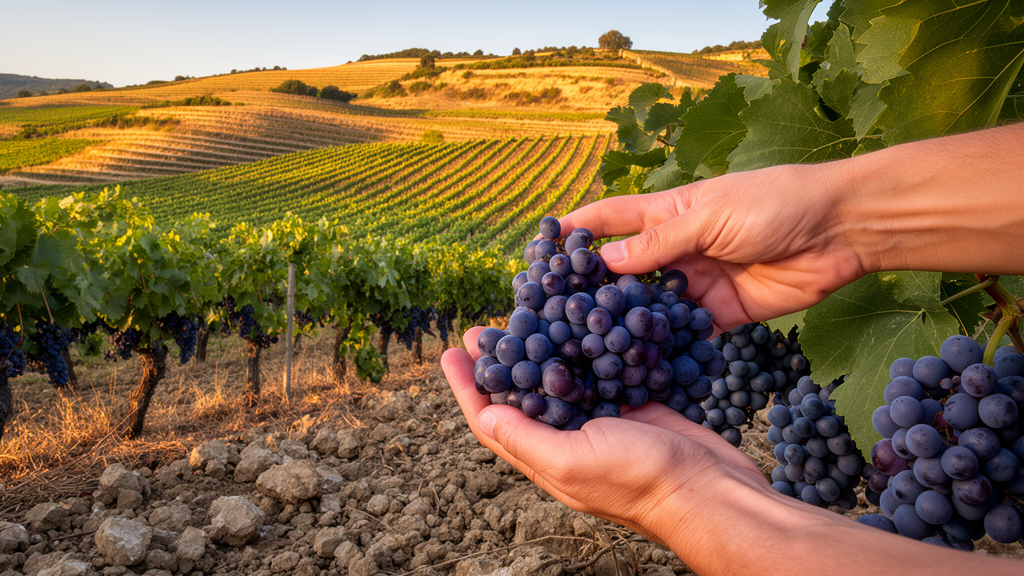
Differences across neighboring plots within a single commercial vineyard can significantly influence grape berry phenolic composition and the resulting wine color, according to an observational study conducted across two consecutive vintages in Changli County, Hebei Province, China. Evaluating four adjacent Cabernet Sauvignon vineyard plots across the 2020 and 2021 growing seasons, researchers observed that despite close geographical proximity and shared macroscopic climate conditions, the distinct plots yielded wines with divergent chromatic profiles and distinct concentrations of individual polyphenols. Rather than relying solely on total monomeric anthocyanin concentrations, wine color expression and stability were strongly tied to the abundance of derived pigments, particularly pyranoanthocyanins and polymeric pigments, along with copigmentation interactions involving flavonols and flavan-3-ols.
Terroir studies have historically examined regional or subregional contrasts to identify how climate, soil composition, and topography shape grape and wine phenotypes. Within commercial viticulture, however, micro-scale variation among adjacent vineyard blocks managed under uniform viticultural frameworks has remained comparatively undercharacterized, especially regarding the evolution of anthocyanin-derived pigments during fermentation. In young red wines, color is primarily governed by grape-derived monomeric anthocyanins that undergo structural transformations during alcoholic and malolactic fermentation. These processes yield pyranoanthocyanins and polymeric complexes that provide sustained color stability and visual intensity. To address these micro-terroir dynamics, the study monitored four specific plots designated CS1, CS2, CS3, and CS4, examining how localized environmental heterogeneity directly impacts phenolic biosynthesis in grape berries and carries through vinification.
The experimental site was situated along a uniform, gentle slope of approximately 0.3 percent, with plots differing in land area, relative position, and vine age. CS1 occupied the northwestern upper slope across 8.54 hectares planted in 2001; CS2 spanned 5.69 hectares on the northeastern and eastern lower slope planted in 2004; CS3 encompassed 4.94 hectares in a central position planted in 2006; and CS4 covered 7.14 hectares on the eastern section planted in 2011. All vines were trained on a vertical shoot-positioning system with north-to-south rows spaced at 2 meters by 1 meter, receiving no supplemental irrigation during the growing seasons. Although accumulated thermal conditions from April to September and during the final ripening month remained comparable between the two study years, annual rainfall differed markedly. The 2021 growing season experienced substantially greater precipitation than 2020, with September rainfall reaching approximately 2.7 times the level recorded during the same month in 2020.
Grapes across all four plots were harvested simultaneously within each vintage, on October 6, 2020, and October 2, 2021. Sampling was standardized across three independent biological replicate zones per plot using a five-point protocol that collected clusters from both sun-exposed and shaded canopy orientations, gathering 600 total berries per plot. Basic physicochemical measurements showed that total soluble solids did not differ significantly among plots within either year, establishing comparable technological sugar ripeness at harvest. However, minor plot-associated differences emerged in hundred-berry weight, must titratable acidity, and juice pH, with berries from CS1 and CS4 exhibiting generally higher pH values than those harvested from CS2 and CS3. For each plot, grapes were vinified in two independent 240-kilogram stainless-steel fermenters under standardized yeast and malolactic bacterial inoculation protocols, followed by transfer to glass vessels, with complete malic acid degradation confirmed by Fourier-transform infrared wine analysis.
Analysis of wine color using CIELAB coordinates revealed pronounced vintage and plot effects, whereas the operational transition from alcoholic fermentation to malolactic fermentation caused comparatively minor shifts. The 2020 wines exhibited deeper red hues, higher chroma, and lower hue angles, whereas the 2021 wines displayed a distinct shift toward lighter, yellower tones characterized by elevated b-star and hue angle values. Intra-vintage divergence was similarly distinct. In 2020, wines from CS1 and CS3 were characterized by elevated a-star and chroma values reflecting heightened red saturation, whereas CS2 and CS4 produced wines with greater lightness and higher hue angles. In 2021, the spatial pattern shifted: wines from CS3 and CS4 showed superior red color saturation and higher a-star values, while CS1 and CS2 were characterized by elevated b-star coordinates, demonstrating that localized plot influences interact directly with overarching seasonal weather conditions.
Partial least squares regression demonstrated that wine visual attributes were decoupled from total monomeric anthocyanin concentration alone. In 2021, wines actually contained higher overall levels of monomeric anthocyanins than in 2020, yet they appeared markedly yellower because polymeric pigments were barely detectable in the wetter year. Across both vintages, a-star and chroma clustered closely with anthocyanin-derived pigments such as vitisin A, vitisin B, and acetaldehyde-mediated adducts, while b-star and hue angle were primarily associated with flavonols. The structural stability of pyranoanthocyanins—derived from an added pyran ring protecting the chromophore against hydration, sulfur dioxide bleaching, and pH-dependent loss of color—proved critical. In both vintages, plot CS3 maintained consistently higher pyranoanthocyanin concentrations and achieved superior color intensity and chroma, illustrating that stable derived pigments preserve color expression across variable climatic conditions.
Profiling of grape skin phenolics by liquid chromatography-tandem mass spectrometry consistently tracked 15 monomeric anthocyanins, 8 flavonols, and 3 flavan-3-ols across both vintages. Partial least squares discriminant analysis established that flavonols served as the primary contributors distinguishing the four vineyard plots in berry skins, with myricetin-galactoside, kaempferol-galactoside, and quercetin-glucoside showing high variable importance in projection scores across both seasons. All five p-coumaroylated anthocyanins showed significant sensitivity to plot and vintage interactions. Furthermore, the flavan-3-ol epicatechin, acylated anthocyanins including malvidin-(6-O-acetyl)-glucoside, and malvidin-3-O-glucoside contributed significantly to plot separation. In 2021, grapes from plot CS2 showed the highest relative accumulation of nearly all key discriminating compounds, underscoring that micro-scale spatial variation alters both quantitative pigment pools and broad phenolic class distribution.
Co-variation network analysis demonstrated that individual phenolic markers exhibited distinct preservation pathways from berries through alcoholic and malolactic fermentation. Flavan-3-ols demonstrated the highest structural persistence, with epicatechin exhibiting strong, uninterrupted correlations from grape berries to finished wines across both years, establishing it as a durable chemical signature of plot identity. In contrast, monomeric anthocyanins underwent extensive chemical transformation, with malvidin-3-O-glucoside in berries linking directly to derived pyranoanthocyanins and polymeric structures in finished wines rather than surviving intact. The 2020 network exhibited an extensive, complex web connecting berry anthocyanins to diverse derived pigments, whereas the 2021 network displayed a simpler structure dominated by direct continuity of epicatechin and kaempferol-glucoside. Across both contrasting seasons, epicatechin, malvidin-(6-O-acetyl)-glucoside, and malvidin-(6-O-coumaroyl)-glucoside consistently recurred as robust candidate markers reflecting plot identity.
Exploratory analyses of soil profiles down to 90 centimeters revealed consistent correlations between edaphic properties and key grape phenolics across both years. Soil organic matter across topsoil, intermediate, and deep layers, alongside total nitrogen and available phosphorus, potassium, and iron, correlated positively with malvidin-derived anthocyanins, epicatechin, catechin, and specific flavonols. Conversely, soil pH, electrical conductivity, and cation exchange capacity showed predominantly negative relationships with these phenolic concentrations. The authors noted that soil organic matter likely influences phenolic accumulation through indirect pathways—such as buffering moisture availability, supporting root nutrient assimilation, and balancing vine canopy microclimate—rather than direct biochemical uptake, while elevated soil pH may restrict the bioavailability of divalent iron required by key flavonoid oxygenases.
The researchers emphasized that these observational findings reflect four neighboring commercial plots monitored over two consecutive vintages, meaning identified statistical relationships and co-variation network links describe associations rather than direct physiological mechanisms or biochemical causality. Analytical quantification of pigments lacking commercial standards was performed using structurally related analogues, such as malvidin-3-O-glucoside equivalents for anthocyanin-derived pigments, which provides robust relative comparisons across samples but introduces uncertainty in absolute mass quantification due to ionization efficiency differences. Minor variations in berry weight and titratable acidity at harvest may have also contributed to observed differences. The authors concluded that the identified candidate markers require validation across larger geographic scales, multi-year monitoring, and controlled manipulative trials to clarify how micro-scale soil heterogeneity governs vineyard phenolic expression.
Subject of Research: Plot-scale vineyard variation and its influence on Cabernet Sauvignon grape phenolics and wine color
Article Title: Micro-scale vineyard variation influences phenolic composition and color expression in ‘cabernet sauvignon’ wines
Article References: Meng, X., Zhang, H., Yao, X., Lan, Y., Shi, T., Cui, Y., Duan, C., Wu, G., & Pan, Q. (2026). Micro-scale vineyard variation influences phenolic composition and color expression in ‘cabernet sauvignon’ wines. Food Chemistry: X, 40, Article 104751. https://doi.org/10.1016/j.fochx.2026.104751
Image Credits: AI Generated
DOI: 10.1016/j.fochx.2026.104751
Keywords: Cabernet Sauvignon, wine color, anthocyanins, phenolic composition, pyranoanthocyanins, polymeric pigments, terroir, vineyard heterogeneity, epicatechin, flavonols, flavan-3-ols, CIELAB color space, malolactic fermentation, alcoholic fermentation, soil organic matter, viticulture
News Source: Bethany Barker. (November 12, 2026). Micro-Scale Vineyard Variations Alter Cabernet Sauvignon Phenolic Profiles and Color. Scienmag.