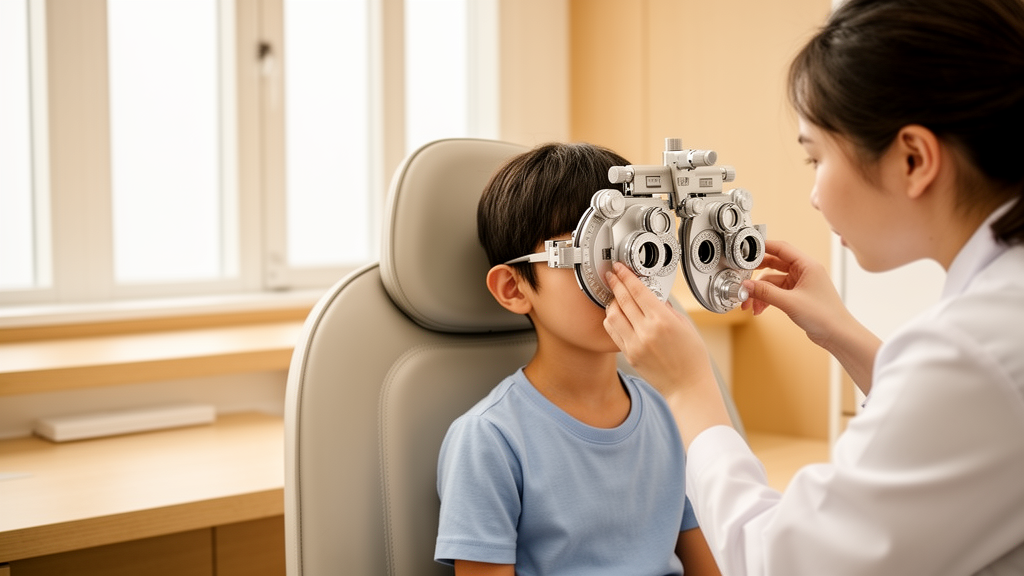
A cross-sectional screening study conducted among 1,415 students aged 6 to 12 years at an urban primary school in Chengdu, China, has detailed the prevalence of myopia, anisometropia, and binocular vision dysfunction, while identifying notable correlations among these refractive and functional conditions. The investigation, carried out in May 2023 by researchers Bingjie Chen, Xiaoyi Hou, and Yongchuan Liao, examined students’ refractive status alongside binocular visual functions, specifically focusing on perceptual eye position and foveal suppression to clarify how visual abnormalities interact in school-aged children.
Across the examined cohort, the overall prevalence of myopia was measured at 41.70 percent, while anisometropia, defined as a refractive disparity of at least one diopter between the eyes, occurred in 15.83 percent of participants. The researchers observed that the prevalence rates of both myopia and anisometropia increased significantly with participant age (p < 0.001). In contrast, statistical evaluations indicated no significant differences between genders for either condition, with recorded p-values of 0.187 for myopia and 0.316 for anisometropia.
The study demonstrated substantial mutual associations between nearsightedness and interocular refractive differences. Children diagnosed with myopia exhibited a significantly higher prevalence and a greater magnitude of anisometropia compared to non-myopic individuals (p < 0.001 in both comparisons). Conversely, students categorized within the anisometropic group showed a higher prevalence of myopia than those without significant refractive disparity between eyes (p < 0.001).
To evaluate these associations more precisely, the investigators conducted binary logistic regression analyses on the clinical data. The statistical model confirmed that myopia was significantly associated with both the general prevalence of anisometropia, yielding an odds ratio of 2.896 with a 95 percent confidence interval ranging from 2.087 to 4.018, and with the degree of anisometropia, showing an odds ratio of 2.529 with a 95 percent confidence interval between 1.992 and 3.210.
Assessments of binocular visual functions revealed distinct and contrasting patterns regarding eye alignment and sensory processing. When examining perceptual eye position, researchers documented an abnormal status in 58.31 percent of myopic children. However, the prevalence of abnormal perceptual eye position was significantly higher among non-myopic children, reaching 69.70 percent (p < 0.001). This divergence indicates that non-myopic students had a higher rate of eye position irregularities than myopic peers within the screened school setting.
Conversely, evaluations of binocular sensory suppression showed that foveal suppression was significantly more prevalent among myopic participants than non-myopic children. Specifically, 47.29 percent of myopic individuals exhibited foveal suppression compared to 29.21 percent of non-myopic participants (p < 0.001). The researchers noted that this elevated occurrence of foveal suppression in myopic school children is potentially linked to accommodative dysfunction, which is characterized by interocular retinal disparities and cortical imbalance and appears to coexist with compromised eye position control.
In evaluating the clinical scope and limits of the findings, the study authors concluded that the positive correlation identified between anisometropia and myopia suggests anisometropia may represent a potential associated factor in myopia development. Additionally, because abnormal perceptual eye position occurred at a significantly higher prevalence in non-myopic students, the researchers highlighted that the relationship between refractive status and perceptual eye position warrants further investigation.
Subject of Research: Prevalence and associations of myopia, anisometropia, and binocular vision dysfunction in Chinese school-aged children
Article Title: Prevalence of binocular dysfunction, myopia and anisometropia in urban school-aged children in Chengdu, China: a cross-sectional screening study
Article References: Chen, B., Hou, X., & Liao, Y. (2026). Prevalence of binocular dysfunction, myopia and anisometropia in urban school-aged children in Chengdu, China: a cross-sectional screening study. BMC Ophthalmology. https://doi.org/10.1186/s12886-026-05511-3
Image Credits: AI Generated
DOI: 10.1186/s12886-026-05511-3
Keywords: myopia, anisometropia, binocular vision dysfunction, foveal suppression, perceptual eye position, pediatric ophthalmology, refractive errors, cross-sectional study, school screening, Chengdu, vision science, ocular development, accommodative dysfunction, visual function, refractive status, interocular disparity
News Source: Ophelia Keating. (November 12, 2026). Study Links Myopia, Anisometropia, and Binocular Dysfunction in Urban Primary School Students. Scienmag.