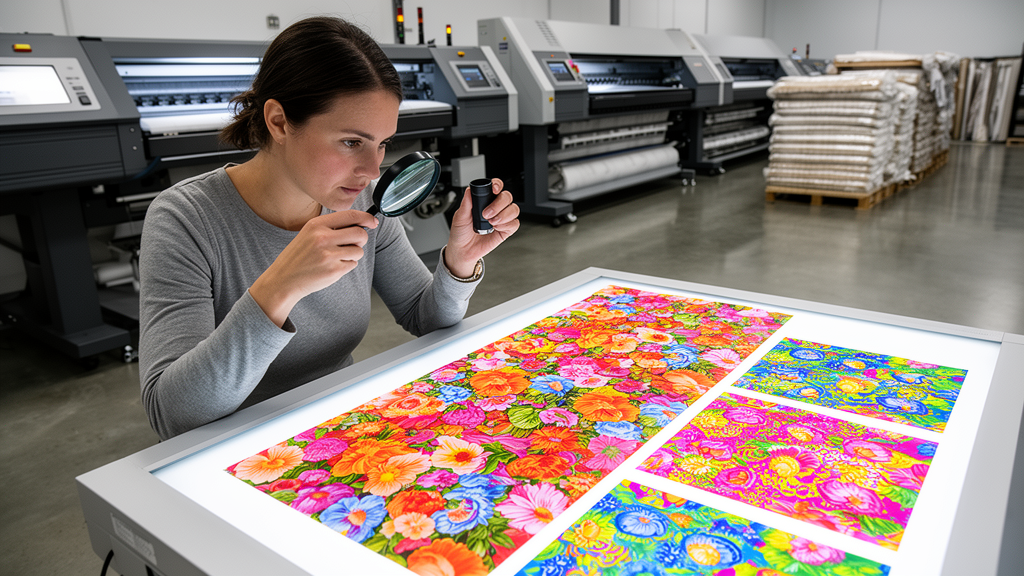
Commercial digital textile printing operations face an unexpected operational bottleneck when adopting artificial intelligence for motif generation, requiring an average of approximately 53 minutes of manual pre-press correction per incoming design file despite delivering print quality comparable to conventional computer-aided design files once adjusted. A field investigation conducted across three industrial printing facilities in India by researchers Tripti Singh, Durgesh Singh, and Abhishek examined how generative image synthesis enters commercial production lines. The researchers discovered that while digital printing drastically curtails resource consumption relative to legacy rotary screen methods, the integration of generative artificial intelligence introduces substantial labour friction. Unprepared files arriving from contemporary generative models regularly feature screen-resolution pixel densities, non-repeating boundaries, and out-of-gamut color spaces that digital printers cannot reproduce directly without human intervention. This empirical finding challenges the prevailing industrial assumption that generative design seamlessly accelerates the end-to-end manufacturing workflow, demonstrating that front-end artistic compression is partly offset by technical remediation on the factory floor.
The environmental motivation for modernising textile coloration is driven by the enormous resource footprint of conventional manufacturing, which consumes an estimated 93 billion cubic metres of water globally each year across pretreatment, dyeing, printing, and finishing. Conventional rotary screen printing requires dedicated metal screens for each individual colourway, consuming substantial volumes of water for screen washing and utilizing viscous print pastes loaded with chemical thickeners such as sodium alginate. Published industrial data from Creditex S.A.A. in Peru, cited by the investigators, demonstrated that printing a sixteen-colour design on one thousand metres of reactive-dyed cotton twill digitally consumed 36 percent less water, 35 percent less electricity, 28 percent fewer chemicals, and produced 41 percent less wastewater effluent alongside 70 percent less fabric scrap compared with rotary screen printing. These targeted digital deposition capabilities form the cornerstone of cleaner-production gains across global apparel supply chains.
To evaluate whether these operational and environmental advantages persist when artificial intelligence produces the print files, the research team conducted comprehensive on-site assessments during March 2026 across three purposively selected Indian manufacturing plants representing distinct technological configurations. Facility R1 operates as a medium-scale hybrid plant combining rotary screen printing and reactive digital inkjet technology primarily on cotton and poly-cotton textiles. Facility R2 functions as a large-scale polyester specialist located in Surat, running exclusively disperse-sublimation digital inkjet printing lines for polyester knits and Lycra blends. Facility R3 operates as a small-to-medium enterprise utilizing digital-only reactive inkjet systems focused predominantly on cotton substrates. Across the three sites, on-demand custom production already accounted for 80 to 92 percent of digital printing output. Sampling across these distinct substrate classes, ink chemistries, and workflow maturity levels enabled the investigators to conduct multiple-case exploratory triangulation, isolating specific equipment configurations, operational conventions, and technical pre-press procedures without attempting ungrounded population-wide statistical generalizations.
Analysis of primary environmental metrics across the three commercial plants revealed that resource intensity varies fundamentally with ink chemistry rather than digital printing technology in the abstract. At facility R1, production managers reported digital water consumption of 2.9 litres per metre compared to 12 to 16 litres per metre on its rotary screen lines, representing an operational water reduction of 76 to 82 percent. At facility R2, disperse sublimation printing on polyester eliminated wet post-print washing and steaming entirely, slashing water requirements down to 0.175 litres per metre. Conversely, facility R3 recorded reactive digital water consumption of 3.5 litres per metre, demonstrating a twenty-fold disparity across digital processes that cautions against uncontextualized marketing claims of universal water savings. Electricity consumption remained relatively consistent, averaging 223.3 kilowatt-hours per thousand metres across all sites with a sample standard deviation of 33.7 kilowatt-hours. Carbon emissions per kilogram of fabric reflected localized energy boundaries, spanning 1.49 kilograms at facility R2 under pure Scope 2 electric heat fixation to 13.5 kilograms at facility R1 under blended Scope 1 and 2 operations involving liquefied petroleum gas combustion.
Before any generated motif could reach the digital press, technicians across all three facilities processed the artwork through an identical five-stage pre-press pipeline designed to catch structural flaws. Stage one verified incoming file resolution against an absolute operational baseline of 300 dots per inch for raster image processor compilation, with 600 dots per inch preferred for fine linework. Stage two evaluated pattern repeat structures, inspecting edge continuity either visually or through automated tiling algorithms to ensure designs could tile seamlessly across fabric widths without seam artifacts. Stage three performed colour-space conversion from standard display spaces, such as sRGB IEC61966-2.1, into facility-specific International Color Consortium profiles, flagging unprintable out-of-gamut hues like saturated blues and magentas for manual re-formulation. Stage four applied bicubic interpolation or model regeneration to scale dimensions to production requirements, while stage five managed final raster image processor compilation and press-side physical proofing. This uniform pipeline operated identically regardless of which underlying generative tool generated the digital artwork.
The field survey documented that raw files produced by generative artificial intelligence models systematically failed to meet industrial production thresholds, imposing measurable labor overheads. Across the facilities, between 68 and 82 percent of incoming AI-generated files required resolution upscaling, while 48 to 60 percent necessitated manual seamless-repeat corrections. Correcting deficient resolution required an average of 27.5 minutes per affected file, ranging from 22.5 minutes at facility R2 to 35.0 minutes at facility R1. Remediating non-tiling composition demanded a mean of 57.5 minutes, spanning 45.0 minutes at facilities R2 and R3 up to 82.5 minutes at facility R1. When weighted across all incoming artificial intelligence orders, expected pre-press correction time reached 74 minutes per file at facility R1, 37 minutes at facility R2, and 48 minutes at facility R3, establishing an overall cross-facility mean of 53 minutes. In contrast, standard computer-aided design files prepared by textile professionals required only 15 to 20 minutes of routine formatting before entering the raster queue.
Operational observations revealed an inverse correlation between the volume of artificial intelligence artwork processed and the pre-press time required per file. Facility R2 received the largest proportion of artificial intelligence designs, with such orders expanding from under 5 percent in 2023 to between 30 and 35 percent by early 2026. This extensive operational exposure coincided with the lowest observed correction time of 37 minutes per incoming file, as pre-press staff developed streamlined remediation protocols and leveraged the natural compatibility between continuous-tone generative imagery and disperse sublimation on polyester knitwear. Facility R2 also achieved 45 design changeovers per day and delivered first physical samples within half a working day. In contrast, facility R1 handled an artificial intelligence order share of only 5 to 8 percent, recording the highest correction time of 74 minutes, 23 daily changeovers, and a sample turnaround of 1.0 day. Facility R3 occupied an intermediate position, handling 10 to 25 percent AI orders with a 48-minute correction overhead.
To rigorously determine whether pre-press intervention yielded commercially acceptable fabric output, the researchers conducted a paired print test using standardized artworks synthesized via StyleGAN2 and Stable Diffusion models alongside reference production CAD motifs. Printing both design categories under identical machine parameters, ink lots, substrate rolls, and fixation cycles demonstrated that finished print quality diverged negligibly. The facility-reported CIEDE2000 colour difference between artificial intelligence prints and conventional designs differed by no more than 0.05 units at any facility, recording values of 2.15 versus 2.10 at facility R1, 1.40 versus 1.35 at facility R2, and 1.75 versus 1.80 at facility R3. First-pass production yield differences remained within 0.5 percentage points, yielding 92.5 percent versus 93.0 percent at facility R1, 97.0 percent versus 97.5 percent at facility R2, and 95.0 percent versus 95.5 percent at facility R3. Wash fastness ratings under ISO 105-C06 testing registered identical grade 4 to 5 scores across both design classes, confirming that chemical fixation rather than artistic origin dictates textile durability.
These empirical findings fundamentally reframe the perceived causal relationship between artificial intelligence and environmental sustainability in textile printing. The study detected no mechanism by which substituting conventional design with artificial intelligence altered the physical resource demands or wastewater generation of an operating digital printing line. Instead, generative artificial intelligence functions primarily as a design-space accelerator and workflow agility enhancer, enabling rapid motif derivation, compressed prototyping schedules, and frequent digital changeovers. However, this artistic agility carries an operational tax in the form of substantial pre-press technical labor. When industry marketing conflates the resource-saving virtues of digital machinery with the algorithmic novelty of generative design, it obscures where environmental levers actually reside and misattributes physical manufacturing efficiencies to computational image synthesis.
The researchers explicitly bounded their conclusions by identifying notable methodological constraints and setting priorities for future industrial research. Because data collection relied on verbal interviews and facility-maintained records without independent multi-site spectrophotometric calibration, differences smaller than one color unit cannot be definitively verified. Furthermore, the paired print trials evaluated one comparison per facility without statistical replication, and environmental metrics excluded Scope 3 life-cycle emissions from yarn spinning, dyestuff synthesis, and hardware logistics. To eliminate front-end labor burdens without sacrificing digital printing efficiencies, the authors proposed a four-stage implementation framework and called for the development of native textile machine learning models. Moving these geometric and chromatic requirements upstream into the image synthesis algorithm itself would eradicate repetitive pre-press manual repairs, finally aligning generative software with modern cleaner-production manufacturing systems.
Subject of Research: Prepress labor overhead and cleaner-production performance of AI-generated digital textile printing
Article Title: Cleaner-production performance of digital textile printing and the pre-press cost of AI-generated designs: a field investigation at three Indian commercial facilities
Article References: Singh, T., Singh, D., & Abhishek (2026). Cleaner-production performance of digital textile printing and the pre-press cost of AI-generated designs: a field investigation at three Indian commercial facilities. Cleaner Engineering and Technology, 35, Article 101356. https://doi.org/10.1016/j.clet.2026.101356
Image Credits: AI Generated
DOI: 10.1016/j.clet.2026.101356
Keywords: digital textile printing, generative artificial intelligence, rotary screen printing, pre-press workflow, cleaner production, textile manufacturing, reactive dye printing, disperse sublimation, color accuracy, CIEDE2000, first-pass yield, water consumption, seamless repeat, raster image processor, mass customization, fabric waste, industrial case study
News Source: Denise Maddox. (November 12, 2026). AI Textile Designs Require Substantial Prepress Work Across Commercial Print Facilities. Scienmag.