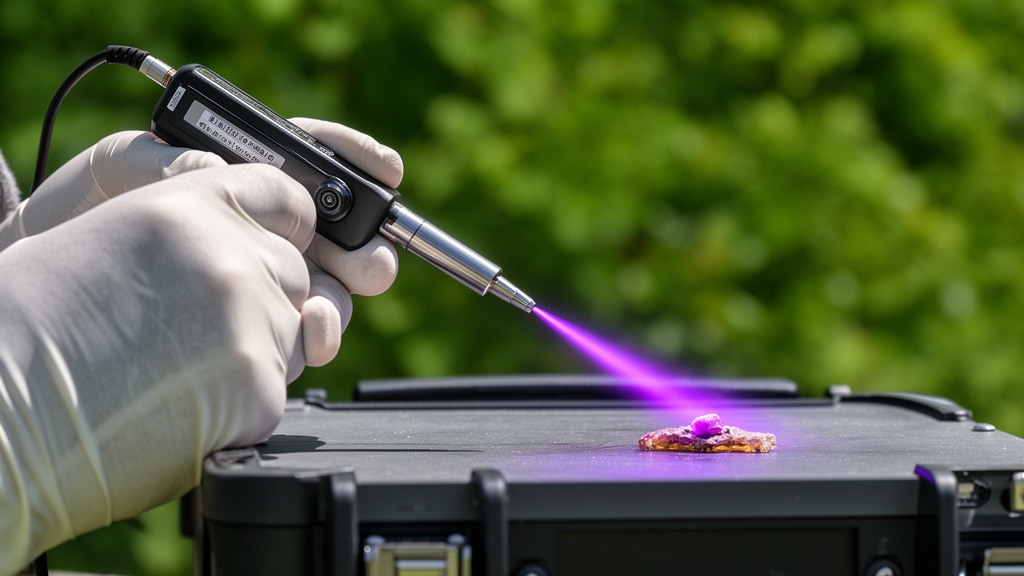
A research team has designed and openly released PenPlasma, a battery-powered point-discharge microplasma excitation source fabricated from commodity off-the-shelf electronics and everyday ballpoint pen tips for an overall material cost of approximately six dollars. The development addresses a persistent bottleneck in field-ready analytical chemistry, where conventional gold-standard elemental quantification methods remain inaccessible outside centralized facilities. Established techniques such as inductively coupled plasma optical emission spectroscopy, inductively coupled plasma mass spectrometry, and atomic absorption spectroscopy deliver exceptional analytical sensitivity, but their adoption in remote environments is hindered by acquisition costs typically spanning fifty thousand to two hundred thousand dollars, substantial electrical power demands between two and five kilowatts, specialized laboratory infrastructure, and high consumable requirements such as continuous argon flows of ten to twenty liters per minute. Because heavy metal hazards, notably lead exposure affecting an estimated eight hundred million children globally, disproportionately burden resource-constrained communities, replacing massive radio-frequency generators and compressed gas lines with miniature, battery-driven atmospheric-pressure excitation stages represents a vital step toward decentralizing environmental screening.
Atmospheric-pressure microplasmas have established themselves as an attractive technological foundation for portable optical emission instruments because their defining physical dimensions fall within the sub-millimeter to millimeter scale. This geometric confinement allows them to sustain non-thermal discharges under ambient atmospheric conditions without bulky vacuum equipment, keep operating temperatures close to ambient levels, consume under ten watts of power, and interface directly with miniaturized optical collection systems. Within this domain, point-discharge geometries offer distinct electrical benefits because the high geometric curvature of sharp conductive tips produces pronounced localized electric field enhancement. This concentrated field initiates gaseous breakdown at substantially lower driving potentials than planar configurations while creating localized optical emission that couples efficiently into compact optical fibers. The newly introduced PenPlasma architecture integrates this discharge concept into an openly licensed handheld instrument under the CERN Open Hardware Licence version two, accompanied by documentation and characterization datasets licensed under Creative Commons Attribution 4.0, providing all design files, simulation models, and raw measurements required for exact reproduction.
The physical construction of the PenPlasma generator relies on three core functional subsystems housed inside a custom enclosure additively manufactured from polylactic acid filament. The primary high-voltage generation block consists of a standard commercial HV-1 flyback inverter module that operates as a self-oscillating blocking oscillator, stepping up a low direct-current supply into a high-voltage, high-frequency output. Power is delivered autonomously by a single rechargeable 18650 lithium-ion cell with a nominal rating of 3.7 volts and a capacity of 2000 milliampere-hours. One pen tip retains its original intact ball assembly to act as a focused point electrode, whereas the opposing tip has its sphere extracted to form an open hollow electrode that doubles as an internal gas delivery channel. This 3D-printed mounting platform permits fine manual spacing adjustments across an electrode gap range of 0.5 to 2.5 millimeters.
A rigorous accounting of the bill of materials demonstrates that an operational PenPlasma prototype can be assembled for precisely 6.03 dollars based on component pricing recorded in September 2026. The prorated cost of the twenty-five grams of polylactic acid filament needed for the enclosure totals fifty-two cents from a commercial spool, while the HV-1 flyback printed circuit assembly constitutes the single largest expenditure at 2.75 dollars. The remaining expenses encompass two stainless steel pen tips at twenty-six cents combined, a dedicated single-cell battery holder at twenty-two cents, a primary power toggle switch at twenty cents, an alligator clip test lead at sixty-six cents, and the 18650 rechargeable lithium-ion battery at 1.42 dollars. The HV-1 module itself integrates key supporting discrete components, including a D880 NPN switching transistor, a step-up transformer, a 330-ohm base current limiting resistor, a 1N4007 reverse-bias protective diode, and a 470-microfarad electrolytic capacitor that suppresses voltage transients across the power rail. Even when factoring in shipping overhead, consumable electricity, and printer depreciation, total unit fabrication remains below ten dollars.
To establish the theoretical foundation of the generator, the researchers constructed a transient circuit model in LTspice, mapping the primary, secondary, and auxiliary feedback windings of the HV-1 step-up transformer alongside the driving transistor and equivalent gap impedances. In a baseline simulation representing nominal cell conditions, the self-oscillating driver model produced positive voltage spikes with a mean peak of 3.43 kilovolts, an undershoot of negative 0.32 kilovolts, a total peak-to-peak swing of 3.75 kilovolts, a mean pulse amplitude of 3.41 kilovolts, and an oscillation frequency of 51.5 kilohertz with a period of 19.43 microseconds. Recognizing that real lithium-ion cells experience substantial terminal voltage drops under operating loads, the investigators performed parametric simulation sweeps across supply levels ranging from 3.0 to 4.2 volts. Across this working discharge span, the predicted positive peak voltage scaled from 2.86 kilovolts to 3.81 kilovolts while operating frequency remained stable between 51.2 and 51.8 kilohertz, establishing that supply voltage fluctuations directly dictate pulse output amplitude.
Empirical electrical characterization was conducted by capturing secondary winding waveforms across five independent acquisitions using a high-voltage probe with one-thousand-to-one attenuation and three picofarads input capacitance coupled to a digital oscilloscope. The measured hardware produced positive peak voltages of 2.94 kilovolts, negative undershoots of negative 1.92 kilovolts, and an aggregate peak-to-peak voltage of 4.86 kilovolts, operating at an oscillation frequency of 58.4 kilohertz with a period of 17.15 microseconds. Comparing these experimental records to the simulation revealed that the measured positive peak matched the simulated range when evaluated at the actual loaded battery voltage of 3.18 volts, where simulated peaks span 2.86 to 3.40 kilovolts.
Crucially, oscilloscope measurements across differing electrode separations demonstrated that changing the physical gap between 0.5 and 2.5 millimeters caused minimal variation in the output potential delivered by the flyback circuit. Across five test configurations, the measured peak positive voltage remained between 2.48 and 3.12 kilovolts, exhibiting a low coefficient of variation of 9.1 percent that was smaller than the pulse-to-pulse fluctuation seen within individual acquisitions. Because the transformer turns ratio and loaded cell voltage constrain circuit amplitude, the generator essentially functions as an ideal fixed-voltage source. Consequently, altering the electrode spacing predominantly shifts the average macroscopic electric field established between the tips. As the separation widens from 0.5 to 2.5 millimeters under a constant 2.94-kilovolt potential, this electric field drops by a factor of five, falling from approximately 5.9 kilovolts per millimeter down to 1.2 kilovolts per millimeter, which strongly governs local gas ionization efficiency.
To evaluate how electrode spacing influences operational behavior, the team executed twenty-five randomized discharge trials spanning five distinct gap distances: 0.5, 1.0, 1.5, 2.0, and 2.5 millimeters. While the point discharge successfully ignited in all twenty-five attempts, operational longevity displayed a pronounced non-monotonic profile. At a 0.5-millimeter gap, the continuous discharge duration averaged 147.0 seconds with a coefficient of variation of 22.5 percent. Increasing the spacing to 1.0 millimeter caused the mean duration to drop slightly to 120.8 seconds with 14.1 percent variation, before rising to a maximum continuous duration of 163.4 seconds at 1.5 millimeters with an improved coefficient of variation of 11.3 percent. Beyond this threshold, discharge stability collapsed abruptly, yielding run durations of only 51.8 seconds at 2.0 millimeters with a high variation of 50.6 percent, and dropping further to 24.4 seconds at 2.5 millimeters, where individual high-voltage pulses frequently failed to satisfy dielectric breakdown criteria.
In contrast to the non-linear response of operational lifetime, optical emission intensity decreased monotonically as the electrode spacing expanded. Image analysis of the visible discharge zone showed normalized optical emission falling steadily from 2.06 arbitrary units at 0.5 millimeters to 1.75 units at 1.0 millimeter, 1.76 units at 1.5 millimeters, 1.44 units at 2.0 millimeters, and 1.26 units at 2.5 millimeters. The trial-to-trial intensity remained remarkably consistent across all gap distances, exhibiting coefficients of variation between 5.2 and 12.7 percent. This steady decay in optical brightness aligns directly with the five-fold reduction in average electric field strength, which limits mean electron acceleration energies and downstream collision-induced excitation rates. Evaluating these paired trends identified the 1.5-millimeter gap as the optimal operational setting for open-air analysis, as it achieves the longest continuous burn time and highest reproducibility while retaining eighty-six percent of the peak optical emission generated at the narrowest 0.5-millimeter setting.
Optical emission spectroscopy performed with a compact fiber-coupled spectrometer spanning 185 to 878 nanometers validated the non-thermal plasma chemistry generated at the pen tip. When operated in ambient air, the optical emission spectrum was dominated by molecular nitrogen bands, highlighting the Second Positive System band heads at 337.1, 357.7, 380.5, and 405.9 nanometers alongside First Negative System signatures of ionized nitrogen at 391.4 and 427.8 nanometers, with secondary peaks indicating hydroxyl radicals near 309 nanometers and atomic emissions of hydrogen and oxygen. When pure argon gas was introduced through the modified hollow pen tip, overall emission intensity roughly doubled, and intense atomic argon lines emerged across the previously featureless near-infrared region between 690 and 830 nanometers. This spectral transition verified that the hollow pen tip functions effectively as an integrated gas conduit, successfully entraining external gases directly into the high-voltage microplasma channel.
Real-time power measurements utilizing an INA219 current and bus voltage monitor sampled by an external microcontroller revealed that the active microplasma drew a mean current of 1144 milliamperes at a loaded cell voltage of 3.18 volts, translating to an average active power dissipation of 3.38 watts. Baseline current logging with an open circuit identified an instrument offset of 196 milliamperes, meaning the 3.38-watt measurement serves as a conservative upper boundary that would adjust downward to approximately 3.0 watts upon zero-subtraction. Taking eighty percent of the nominal battery capacity as usable stored energy yields 5920 milliwatt-hours, which provides an estimated continuous operating autonomy between 1.40 hours under charge-based calculations and 1.75 hours under direct power calculations. In practical intermittent operation, a single 120.8-second discharge consumes 113.4 milliwatt-hours, representing only 1.9 percent of available battery capacity and permitting roughly fifty-two discrete analytical firings from a single charge, confirming that observed discharge self-extinction is driven by gap dynamics rather than battery exhaustion.
Benchmarking PenPlasma against prior portable microplasmas highlights significant functional advantages, as its 3.4-watt operating consumption remains far below the 24.3 watts drawn by earlier point-discharge spectrometers while matching the sub-five-watt profile of miniature pens. More importantly, while earlier literature focused on isolated electrical parameters without evaluating component costs or systematically logging electrode gap influences, PenPlasma supplies complete circuit models, diagnostic oscilloscope traces, and fabrication plans for an empirically validated six-dollar prototype. The researchers caution, however, that all findings stem from a single hardware unit, leaving inter-device reproducibility to be validated across independently built iterations, and note that formal analytical limits of detection, sensitivity, and calibration linearity remain unmeasured because chemical analytes were not introduced in this fundamental validation.
Subject of Research: Open-source portable point-discharge microplasma excitation source for low-cost elemental screening
Article Title: PenPlasma: an open-source pen-tip microplasma excitation source towards portable elemental analysis in resource-limited settings
Article References: Abuzairi, T., Annaafi, M. R., & Khainama, M. L. (2026). PenPlasma: an open-source pen-tip microplasma excitation source towards portable elemental analysis in resource-limited settings. HardwareX, 28, Article e00858. https://doi.org/10.1016/j.ohx.2026.e00858
Image Credits: AI Generated
DOI: 10.1016/j.ohx.2026.e00858
Keywords: microplasma generator, point-discharge microplasma, optical emission spectroscopy, portable elemental analysis, open-source hardware, PenPlasma, HV-1 flyback module, blocking oscillator, pen-tip electrodes, electrode gap, Paschen law, atmospheric-pressure plasma, heavy metal screening, LTspice circuit simulation, Ocean Optics USB2000+, argon optical emission, INA219 power monitoring
News Source: Russell Cooper. (November 12, 2026). Open-Source Six-Dollar Pen-Tip Generator Powers Portable Atmospheric Microplasma for Field Analysis. Scienmag.