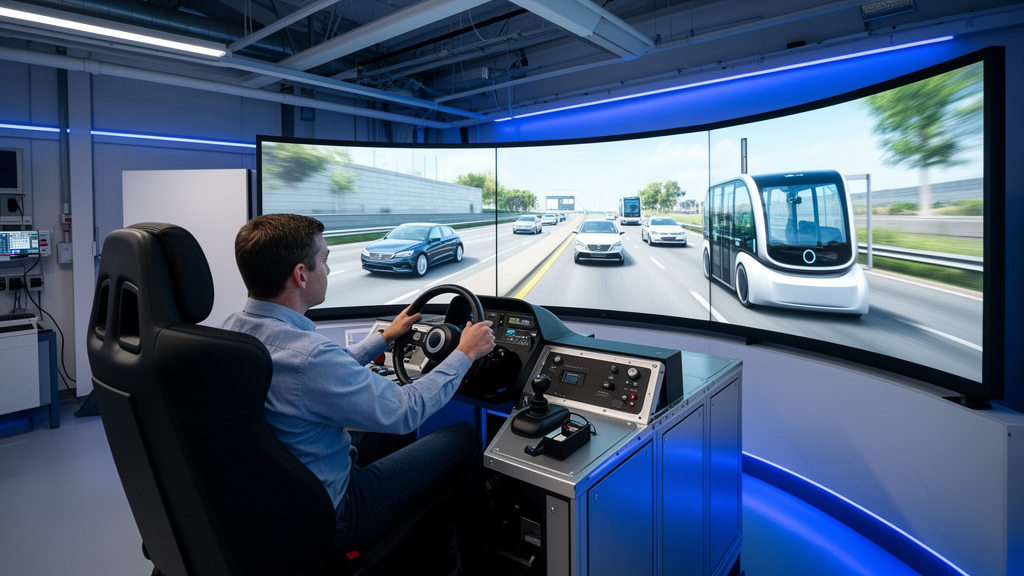
A research team from the University of Queensland has validated an open design-to-implementation framework that resolves reproducibility deficits in driving-simulator investigations of mixed traffic. Driving simulators offer a controlled environment to study how motorists interact with connected and automated vehicles, yet experimental pipelines frequently depend on proprietary software, undocumented scene edits, and bespoke configurations. Published in the European Transport Research Review, the new framework integrates parameterised experiment specifications, automated scenario generation, programmatic controller assignments, structured event logging, documented pretesting, and benchmark-based feasibility checks into a unified workflow. Demonstrated using the open-source SimCCAD platform with the Webots simulation engine, the methodology transforms simulator experimentation into an auditable computational science. By linking theoretical research questions directly to executable simulation files, the system ensures that candidate virtual experiments can be systematically generated, evaluated, and independently reconstructed by external laboratories before deploying human participants.
The initiative directly confronts an acute reproducibility crisis undermining transportation research, where empirical models imported from other disciplines grapple with multifaceted human behaviours and unobserved heterogeneities. In theoretical mathematics or computational fields, reproducibility is typically achieved through transparent algorithm descriptions, explicit derivations, and standard benchmarks. Empirical transportation studies, by contrast, demand complete documentation of data processing, modelling assumptions, initial values, and parameter thresholds, where minor omissions can distort replication attempts. Recent assessments reveal the severity of this issue: across an investigation of 11,879 simulation studies and 672 public repositories, fewer than two percent supplied supplementary research materials, and deposited repositories proved largely inadequate for complete replication. This pervasive lack of transparency severely hampers the cumulative development of traffic science, leaving researchers unable to verify whether published results represent robust empirical phenomena or artefacts of unrecorded implementation choices and undocumented calibrations.
Establishing rigorous reproducibility standards is especially urgent in connected and automated vehicle research, where public policy and engineering deployment confront an intractable catch-22. Accelerating the safe integration of automated driving systems requires dependable evidence detailing how automated vehicles operate in real traffic streams, yet that evidence accumulates slowly because high-level automation, such as driverless Level 4 technology, remains constrained by regulations. Physical road tests of commercial adaptive cruise control systems have revealed that commercial controllers frequently amplify traffic disturbances through string instability, producing shockwaves that propagate upstream while increasing tractive energy expenditure under specific driving regimes. Because real-world automated deployments remain at an early developmental stage, high-fidelity empirical experiments are indispensable for establishing how mixed traffic will genuinely function during the transition toward automation.
Mixed-traffic interactions introduce further operational volatility because overall safety and flow characteristics depend heavily on bidirectional behavioural feedbacks between human drivers and automated algorithms. Controlled driving-simulator studies consistently document degraded human performance during control takeover transitions, marked by delayed reaction times, abrupt or excessive braking manoeuvres, erratic steering inputs, and prolonged vehicle stabilisation periods. Evaluating these multifaceted human factors requires research methodologies capable of balancing ecological validity with absolute experimental safety. Field trials involving physical automated fleets offer authentic driving dynamics but entail substantial financial expenses, severe safety hazards, and minimal capacity to repeat complex interaction scenarios under identical conditions. Conversely, purely numerical traffic simulations represent human motorists through rigid car-following rules and simplified gap-acceptance algorithms, eliminating the behavioural richness and cognitive delays of real motorists. Human-in-the-loop driving simulators uniquely bridge this divide, combining programmable vehicle logic with authentic human reactions, provided the underlying experimental architecture is sufficiently auditable and computationally robust.
To unlock the underutilised potential of simulator research, the researchers established a taxonomy dividing the experimental lifecycle into thirteen distinct reproducibility components and codified six operational layers. Rather than treating reproducibility as a retrospective reporting task, the proposed framework embeds reproducibility throughout the design process. The first layer defines parameterised experiment specifications, encoding geometric road layouts, traffic volumes, and vehicle allocations in structured configuration files. The second layer uses automated scripting to generate executable 3D road networks, eliminating manual scene editing inside graphical interfaces. The third layer assigns deterministic and responsive control logic to all virtual traffic actors, while the fourth layer integrates structured event metadata, participant inputs, and vehicle trajectories into standardised logs. The fifth layer provides an auditable protocol for recording pretesting observations and design adjustments, and the sixth layer applies automated benchmarking routines to verify simulation feasibility before recruiting human participants.
The research team operationalised these methodological principles within SimCCAD, a simulation platform for conventional, connected, and automated driving developed at the University of Queensland’s School of Civil Engineering. The broader SimCCAD architecture synthesises three simulation engines to capture the multi-layered mechanics of mixed traffic: Webots provides high-fidelity visual rendering, rigid-body physics, and human-in-the-loop peripheral interfaces; SUMO supplies scalable macroscopic traffic demand generation; and OMNeT++ models vehicle-to-everything telecommunications protocols. In the motorway case study evaluated for this research, the investigators deliberately decoupled the external network modules, keeping SUMO and OMNeT++ inactive while executing all participant dynamics and surrounding automated vehicles directly within the Webots simulation engine. This platform configuration demonstrated how an open-source visual simulator can independently manage vehicle physics, sensing routines, and autonomous control algorithms, allowing laboratories worldwide to inspect, modify, and regenerate intricate mixed-traffic scenarios without relying on expensive, opaque commercial driving simulators that prevent external scrutiny.
A central contribution of the framework is framing simulator experiment development as a constrained design-search problem governed by temporal execution feasibility. When designing mixed-traffic driving scenarios, researchers must incorporate enough surrounding automated vehicles to ensure that planned interactive encounters—such as merging conflicts, headway compressions, or cooperative lane changes—reliably occur despite natural variations in human speed choice and gap acceptance. However, every additional automated agent simulated within Webots introduces computational overhead, requiring dedicated vehicle dynamics calculations, sensor ray-casting, controller computations, graphic rendering, and continuous state logging. If computational burden overwhelms host hardware, the simulator falls behind wall-clock time, distorting the participant’s perception of velocity, acceleration, and headway spacing. The authors quantify this constraint using the real-time factor, defined as the ratio of elapsed simulated time to elapsed wall-clock time. In human-in-the-loop driving experiments, maintaining a real-time factor near unity is an essential prerequisite for valid behavioural measurements.
The experimental case study implemented a multi-phase motorway driving corridor designed to evaluate human interactions across a sequence of demanding traffic situations. The route begins with an on-ramp entry where the participant merges onto the mainline, continues through steady-state car-following and stop-and-go congestion waves, navigates sudden automation-induced traffic disturbances, confronts cooperative lane-changing pressure, and concludes with an off-ramp diverging manoeuvre. All simulated vehicles in the virtual environment utilised identical BMW X5 physical prototypes equipped with integrated detection suites, with vehicle behaviours governed by transparent Python control scripts. The participant cockpit utilised a screen-based display running at sixty frames per second without motion platform feedback or virtual reality headwear, decoupling display refresh from the underlying simulation update rate. The internal Webots physics solver and vehicle state logging routines were configured to execute at a fixed timestep of fifty milliseconds, corresponding to a consistent twenty-hertz simulation update frequency.
To demonstrate automated feasibility evaluation, the researchers executed a systematic benchmarking routine across thirty distinct scenario configurations, varying the number of responsive surrounding automated vehicles from 10 to 39 while holding road geometry, signal timing, and route parameters constant. An automated Python pipeline generated each Webots world file, launched the simulator in Run mode, recorded execution metrics across discrete timesteps, and compiled scenario summary profiles. To eliminate transient start-up spikes associated with scene loading, execution measurements were captured across a thirty-second observation window following an initial warm-up phase, generating 600 discrete time-step performance samples for each candidate scenario. Because Webots Run mode allows the simulation engine to advance at the computational rate permitted by host hardware rather than locking to an artificial clock, the measured real-time factor provided an authentic evaluation of whether candidate scenarios would execute stably during real human-in-the-loop experiments.
The benchmark results revealed a continuous inverse relationship between automated traffic density and simulation processing speed, establishing an empirical boundary for scenario feasibility. In sparse configurations featuring 10 surrounding automated vehicles, the simulation executed substantially faster than real time, recording a mean real-time factor of 1.603 and a median of 1.612. As additional automated agents were added across the motorway lanes, the increased computational burden systematically slowed execution toward real time. Configurations containing 21 and 22 automated vehicles matched the targeted near-real-time tolerance band of 0.9 to 1.1: the 21-vehicle setup achieved a mean real-time factor of 1.040 with a median of 1.010, while the 22-vehicle scenario generated a mean of 0.946 and a median of 0.941. Beyond this threshold, processing delays accumulated rapidly; with 39 automated vehicles, the mean real-time factor collapsed to 0.667 and the median to 0.672, demonstrating severe computational lagging that would distort human driving immersion.
The authors emphasise that while the specific 21-to-22 vehicle operating threshold reflects their local workstation hardware and vehicle control scripts, the programmatic evaluation methodology itself provides a universally applicable blueprint for transport simulation laboratories. By releasing the complete codebase, scenario generators, controller logic, configuration files, and raw benchmark data through an open-access GitHub repository, the research team enables independent investigators to audit, replicate, and adapt the entire motorway experiment. Looking forward, the team at the University of Queensland is extending this reproducible architecture to encompass complex urban road networks, active vehicle-to-everything communications, and multimodal mixed-reality testing environments incorporating vulnerable road users, e-scooters, and micromobility devices. By formalising experiment construction as an auditable discipline, this framework provides a foundation for transparent autonomous vehicle research.
Subject of Research: Reproducible driving-simulator experiment framework for mixed connected and automated vehicle research
Article Title: A framework for reproducible design, implementation, and evaluation of driving-simulator experiments in SimCCAD for mixed traffic research
Article References: Mohammadian, S., Zheng, Z., Jia, D., Yildirimoglu, M., Rakotonirainy, A., & Haque, M. M. S. (2026). A framework for reproducible design, implementation, and evaluation of driving-simulator experiments in SimCCAD for mixed traffic research. European Transport Research Review, 18(1), Article 106. https://doi.org/10.1186/s12544-026-00861-x
Image Credits: AI Generated
DOI: 10.1186/s12544-026-00861-x
Keywords: driving simulators, connected and automated vehicles, traffic simulation, SimCCAD, Webots, computational reproducibility, mixed traffic research, real-time factor, human-in-the-loop simulation, motorway driving experiments, driver takeover, vehicle controllers, scenario generation, benchmark feasibility, traffic safety research, University of Queensland
News Source: Denise Maddox. (November 12, 2026). New Framework Standardises Driving Simulator Tests for Mixed Connected Automated Vehicle Traffic. Scienmag.