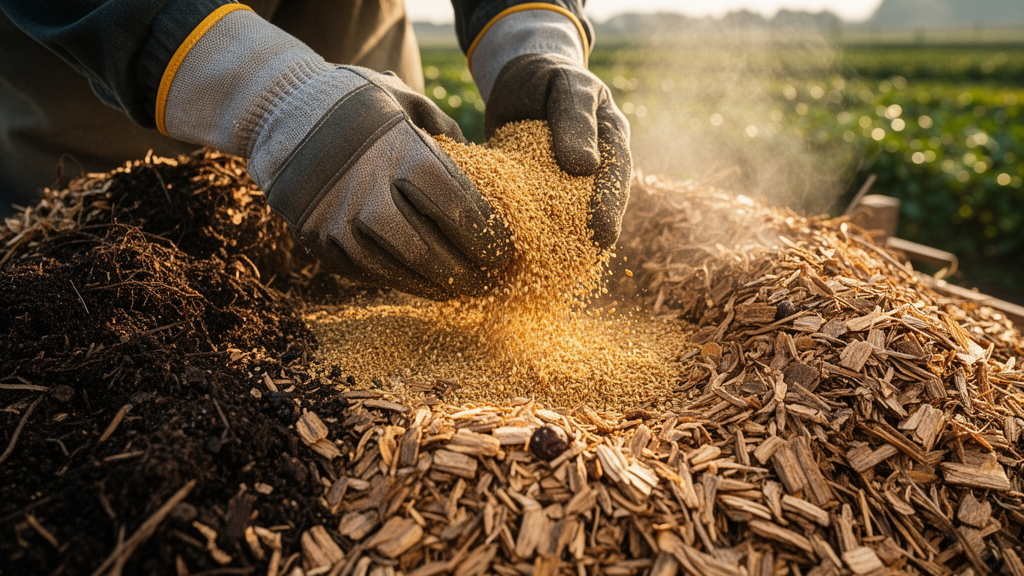
Agricultural researchers investigating the recycling of Camellia oleifera processing residues found that combining urea with organic co-substrates produced distinct decomposition trajectories, nitrogen preservation rates, and microbial community shifts compared to urea alone over a seventy-seven-day composting trial. In the comparative evaluation conducted in insulated composting bins, a formulation combining crushed Camellia oleifera shells, urea, and rice bran achieved the highest nitrogen retention at 91.64 ± 0.96 percent, significantly exceeding the performance of formulations amended with goat dung, seed meal, or urea as the sole nitrogen source. The urea-only control treatment, which relied exclusively on chemical nitrogen to adjust initial pile stoichiometry, yielded the lowest measured inorganic nitrogen concentrations and retained only 65.65 ± 1.83 percent of its initial nitrogen mass. While supplementing urea with organic materials prolonged high-temperature conditions and stimulated bacterial diversity alongside earlier fungal succession toward saprotrophic guilds, no single formulation emerged as superior across every measured maturity, nutrient, and stabilization criterion. Furthermore, because the rice bran formulation concluded the trial with a final total nutrient content below standard commercial thresholds and hygiene attributes remained unverified, the study highlights how co-substrate properties govern waste transformation while underscoring that practical agricultural deployment demands comprehensive downstream testing.
The extensive processing of Camellia oleifera fruit produces substantial quantities of hard, lignocellulosic shell that present major disposal challenges across producing regions. Industrial processing operations generate approximately 0.54 tonnes of shell for every tonne of fruit processed, contributing to an annual production in China that was historically estimated at 3.6 million tonnes in 2017, an estimate illustrating the physical scale of the residue without implying identical output in subsequent years. Traditionally, these bulky residues have often been discarded or burned in the open, though alternative utilization pathways include chemical extraction, the manufacture of bio-based materials, and thermal pyrolysis. Composting represents an accessible valorization strategy when the intended end product is a soil amendment or plant cultivation substrate, as it recycles organic matter alongside locally accessible residues and diverts raw wastes from landfilling. Nonetheless, raw Camellia oleifera shell possesses a naturally high carbon-to-nitrogen ratio and contains substantial amounts of recalcitrant lignocellulose, alongside antimicrobial tannins and saponins. These biochemical characteristics restrict the nitrogen available for microbial assimilation, typically causing sluggish temperature increases, impaired degradation rates, and prolonged maturation times that require supplemental additives and process optimization.
Adjusting the stoichiometric balance of high-carbon crop residues frequently involves adding nitrogenous compounds, yet the specific chemical form and biological source of added nitrogen profoundly affect conservation efficiency. Synthetic urea provides a convenient means of reducing the initial carbon-to-nitrogen ratio, but it rapidly hydrolyzes into ammonium nitrogen upon hydration and microbial action. When ammonium accumulates faster than microbial populations can assimilate it into cellular biomass, substantial quantities of nitrogen escape into the atmosphere through ammonia volatilization, especially during high-temperature thermophilic phases when compost mixtures maintain weakly alkaline conditions. Additional nitrogen losses occur through the sequential nitrification of ammonium to nitrate followed by anaerobic denitrification, which releases nitrous oxide and dinitrogen gas, or through liquid leaching when pile moisture is improperly maintained. Mitigation strategies include matching nitrogen mineralization rates to microbial assimilation through feedstock selection, managing aeration and pile moisture, retaining ammonium via physical sorption, and avoiding unbalanced nitrification that redirects losses toward greenhouse gases. Because changes in inorganic nitrogen pools cannot distinguish between volatilization, denitrification, and biomass incorporation without direct gaseous and leachate measurements, assessing formulation efficacy requires tracking comprehensive mass balances.
To evaluate how co-substrate origin influences composting dynamics under identical initial stoichiometry, researchers established four distinct experimental treatments at the Chinese Academy of Forestry’s Research Institute of Subtropical Forestry in Hangzhou, Zhejiang Province. Composting was carried out from February to April 2024 using twelve 220-liter insulated BIOLAN composting bins arranged in a randomized layout with three independent replicates per treatment. The experimental formulations compared a control group containing Camellia oleifera shells supplemented solely with urea against three mixed-amendment treatments that blended shells with goat dung, Camellia oleifera seed meal, or rice bran at a dry weight ratio of four to one. All four treatments were adjusted to an identical initial carbon-to-nitrogen ratio of 30:1 by adding specific quantities of urea, ensuring comparable initial elemental stoichiometry. Camellia oleifera shells were crushed to particle sizes of 10 millimeters or less, while the seed meal and rice bran were sieved to 3 millimeters or less. Every bin received one liter of an activated commercial microbial inoculum solution containing Bacillus, lactic acid bacteria, Bifidobacterium, yeast, photosynthetic bacteria, and actinomycetes at an initial viable count of at least twenty billion colony-forming units per gram, while moisture was maintained at sixty percent throughout weekly turnings.
Temperature monitoring revealed that while all four formulations entered the thermophilic stage above 50 degrees Celsius on the second day of composting, their subsequent thermal curves and cumulative heat durations differed substantially across treatments. The cumulative thermophilic duration, defined as the total number of days registering core temperatures of at least 50 degrees Celsius across non-consecutive episodes, reached 20 days in the urea-only control, 24 days in the goat dung formulation, 24 days in the seed meal mixture, and 18 days in the rice bran treatment. The goat dung and seed meal treatments maintained higher sustained heat profiles, with seed meal reaching the highest observed peak temperature and goat dung demonstrating extended thermophilic longevity. In contrast, the rice bran formulation exhibited rapid early temperature escalation but entered the cooling phase earlier than the manure-amended pile. Manual pile turning conducted at seven-day intervals repeatedly introduced ambient air and mechanical agitation, which briefly dropped pile temperatures before enhanced aeration stimulated microbial activity, leading to subsequent reheating and producing multiple distinct temperature peaks along the longitudinal heating curves.
Mass-balance calculations that accounted for compost mass removed during destructive sampling events demonstrated marked differences in carbon and nitrogen conservation among the tested formulations. Nitrogen retention differed significantly at the conclusion of the seventy-seven-day composting process, with the rice bran treatment preserving 91.64 ± 0.96 percent of its starting nitrogen, a performance significantly higher than that observed in all other treatments. The goat dung treatment achieved an intermediate nitrogen retention rate of 72.71 ± 1.18 percent, which was significantly higher than the 65.65 ± 1.83 percent recorded in the urea-only control, but not significantly different from the seed meal formulation at 66.97 ± 1.65 percent. For carbon conservation, the rice bran and goat dung treatments retained 45.83 ± 1.17 percent and 44.56 ± 1.01 percent of initial carbon, respectively, both significantly surpassing the seed meal treatment at 39.03 ± 0.74 percent, which in turn retained significantly more carbon than the control at 28.56 ± 1.36 percent. The poor nitrogen retention of the seed meal mixture, despite its nitrogenous composition, suggested that homologous recycling of Camellia seed cake introduced antimicrobial tea saponins that may have hindered microbial immobilization.
Tracking inorganic nitrogen pools provided descriptive insights into the biochemical transformations taking place within the compost piles across distinct decomposition phases. At the commencement of composting on day zero, ammonium nitrogen concentrations followed a decreasing hierarchy from goat dung at 2324.13 ± 88.03 milligrams per kilogram, through seed meal at 1797.35 ± 71.03 milligrams per kilogram and rice bran at 1623.94 ± 81.05 milligrams per kilogram, to the urea-only control at 1178.87 ± 94.14 milligrams per kilogram. Initial nitrate concentrations remained low, ranging from 0.20 ± 0.01 milligrams per kilogram in rice bran to 0.36 ± 0.01 milligrams per kilogram in goat dung and seed meal. Over the seventy-seven days, ammonium concentrations steadily declined while nitrate concentrations accumulated, consistent with microbial nitrification pathways, although nitrification enzyme activities and nitrifier gene abundances were not directly quantified. By day seventy-seven, the rice bran formulation retained the highest residual ammonium at 777.92 ± 46.10 milligrams per kilogram alongside 53.45 ± 9.50 milligrams per kilogram of nitrate, whereas the goat dung treatment accumulated the highest final nitrate concentration at 142.63 ± 12.10 milligrams per kilogram, and the control retained the lowest combined inorganic nitrogen pool.
Maturity indices and chemical quality parameters exhibited significant treatment-by-time interactions across the sampling timeline, demonstrating that amendment selection governed pile stabilization rates. The carbon-to-nitrogen ratio declined across all mixtures, concluding at 13.09 ± 0.29 in the urea control, 15.02 ± 1.04 in rice bran, 16.95 ± 0.99 in goat dung, and 18.95 ± 0.77 in seed meal. Electrical conductivity decreased over time to final values ranging from 63.40 ± 4.06 microsiemens per centimeter in seed meal to 91.26 ± 3.03 microsiemens per centimeter in rice bran, while pH stabilized between 7.07 ± 0.06 and 7.24 ± 0.03. Optical absorbance ratios of compost extracts, measured at 465 and 665 nanometers as the E4/E6 ratio, concluded at 0.63 ± 0.15 in control, 0.64 ± 0.12 in seed meal, 1.14 ± 0.30 in goat dung, and 1.75 ± 0.31 in rice bran. The seed germination index assessed using Pak Choi seeds increased in all groups after day twenty-one, indicating diminishing phytotoxicity. However, final total nutrient contents, representing combined nitrogen, phosphorus pentoxide, and potassium oxide, reached 5.20 ± 0.22 percent in goat dung, 4.30 ± 0.34 percent in control, and 4.27 ± 0.24 percent in seed meal, while rice bran achieved only 3.66 ± 0.18 percent, remaining below the cited 4.0 percent agricultural criterion.
High-throughput amplicon sequencing targeting the bacterial 16S ribosomal RNA gene and fungal internal transcribed spacer region documented dynamic taxonomic successions across composting stages. Bacterial communities transitioned from early dominance by Firmicutes, which constituted 55 to 75 percent of sequences during the initial twenty-one days, to a diversified assemblage co-dominated by Proteobacteria, Bacteroidetes, Chloroflexi, and Actinobacteria by day seventy-seven. Thermophilic genera such as Thermobispora and Thermobacillus predominated during early high-temperature heating, whereas Streptomyces and Flavobacterium expanded as piles cooled, alongside a notable rise in Pseudomonas to approximately 22 percent in the late-stage rice bran treatment. In fungal communities, Ascomycota dominated early composting with relative abundances exceeding 88 percent, characterized by high abundances of the thermotolerant genus Thermomyces. During the middle stage between days forty-two and sixty-three, Basidiomycota expanded markedly in seed meal and goat dung before Ascomycota regained dominance by day seventy-seven, where Penicillium surged to approximately 70 percent relative abundance in the rice bran treatment. Functional predictions using FUNGuild suggested an earlier transition toward saprotrophic guilds in amended treatments compared to the control, though predicted profiles represent inferred ecological potential rather than direct enzymatic activity.
Redundancy analysis indicated that bacterial community structure was most strongly associated with variations in carbon-to-nitrogen ratio, electrical conductivity, and the E4/E6 optical index, whereas fungal communities aligned along an environmental gradient defined by ammonium nitrogen, electrical conductivity, and carbon-to-nitrogen ratio. While repeated-measures correlation identified twenty-one significant fungal genus-environment associations after false discovery rate correction, including strong positive correlations between carbon retention and the genera Cladosporium and Penicillium, no bacterial associations survived adjustment. Crucially, the authors emphasized several methodological constraints: sequencing relied on single pooled profiles per treatment-time combination rather than independent biological replicates, multivariate dispersion was unassessed, and gaseous emissions, functional gene abundances, and enzyme activities were not directly quantified. Furthermore, heavy metal evaluations were restricted to raw Camellia shells without assessing potential contaminants introduced by co-substrates or verifying final-product chemical and biological safety. Consequently, while organic co-substrates provide practical means to modulate heat and nitrogen retention, establishing viable agricultural amendments requires expanded field-scale verification and rigorous post-maturation safety testing.
Subject of Research: Composting performance, nitrogen retention, and microbial community succession in Camellia oleifera shell formulations
Article Title: Composting performance, nitrogen retention, and microbial succession differ among urea-only and organic co-substrate-amended Camellia oleifera shell formulations
Article References: Sun, K., Zhang, J., Chu, X., Xu, H., Zhou, B., & Rao, Y. (2026). Composting performance, nitrogen retention, and microbial succession differ among urea-only and organic co-substrate-amended Camellia oleifera shell formulations. Bioresources and Bioprocessing, 13(1), Article 165. https://doi.org/10.1186/s40643-026-01161-x
Image Credits: AI Generated
DOI: 10.1186/s40643-026-01161-x
Keywords: Camellia oleifera shell, composting, nitrogen retention, rice bran, goat dung, seed meal, microbial succession, organic waste recycling, lignocellulose degradation, thermophilic composting, ammonium nitrogen, nitrate nitrogen, germination index, bacterial diversity, fungal succession, agricultural by-products, redundancy analysis
News Source: Alan Morgan. (November 12, 2026). Rice Bran Amendment Boosts Nitrogen Retention in Camellia Shell Composting. Scienmag.