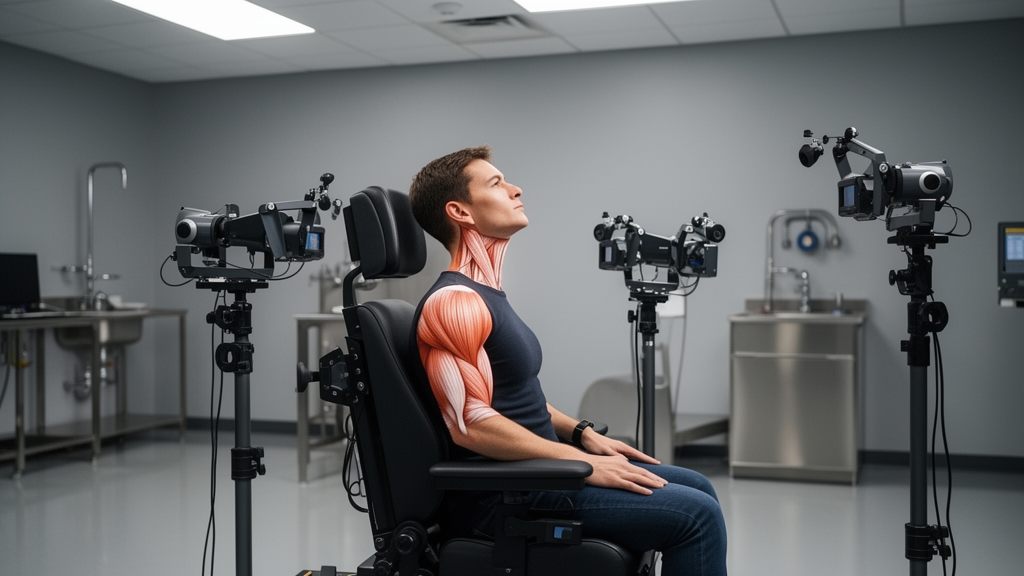
Muscle co-contraction significantly decreases peak head displacement and relative head–torso motion during controlled lateral impacts, according to an investigation analyzing high-speed video tracking data. Concurrently, the relative excursion between the head and torso was reduced by more than a third, and the timing lag between their respective peak velocities shortened. However, the researchers observed that peak head linear acceleration did not differ significantly between the contracted and passive conditions, demonstrating that muscle bracing influences kinematic displacement patterns without necessarily dampening peak linear acceleration values.
The study, published in the Annals of Biomedical Engineering by Pawel Kudzia, Gabrielle R. Booth, Kristen Reynier, Matthew Panzer, and Peter A. Cripton, focused on characterizing the physical coupling between anatomical segments during an applied load. To evaluate this mechanical relationship directly, the research team designed an analytical framework to quantify head and torso kinematics under two distinct states of voluntary muscular activation, directly comparing completely relaxed musculature against intentional, maximal muscle co-contraction.
To carry out this investigation, the authors analyzed high-speed optical recordings originally collected by Reynier and colleagues in 2020.
The testing protocol delivered controlled lateral impacts using a padded impactor weighing 3.7 kilograms that struck subjects at an incoming velocity of 2.0 meters per second. Each participant experienced these uniform impacts under two designated experimental states: a passive condition where muscles remained relaxed, and a maximally co-contracted condition where subjects pre-activated their musculature prior to impact. Using frame-by-frame coordinate tracking of the head and torso, the researchers extracted primary outcome metrics encompassing absolute peak displacement, overall spatial path length, relative excursion between the head and torso segments, velocity time lag, and peak linear kinematics.
Kinematic calculations revealed pronounced reductions in segmental displacement when participants contracted their muscles before the blow. Peak head displacement decreased by 30 percent in the co-contracted state compared to the passive state, reaching high statistical significance (p < 0.001). Notably, this reduction was not merely an aggregate statistical trend; smaller head displacements were explicitly documented in all nineteen individual male participants. Furthermore, peak relative excursion between the head and torso dropped by 36 percent under co-contraction (p < 0.001), indicating that muscular tension restricted how far the head moved relative to the upper body during the impact event.
Muscle co-contraction also altered the timing dynamics of the impact response between anatomical segments. The magnitude of the velocity time lag between the head and torso shortened substantially, dropping from an average of 88 milliseconds in relaxed trials down to 66 milliseconds when muscles were co-contracted, a statistically significant difference (p = 0.002). In contrast to these spatial and temporal shifts, the authors observed no statistically significant difference in peak head linear acceleration between conditions (p = 0.415).
From a measurement standpoint, the use of nonstandard anatomical landmarks on the torso and an unquantified degree of tracking repeatability introduce uncertainty into relative motion estimates. Most crucially, the investigators explicitly cautioned that these observed reductions in displacement and excursion under controlled laboratory conditions do not establish clinical injury protection. While voluntary co-contraction clearly modified segmental displacement and response timing during a low-velocity lateral impact, translating these kinematic changes into actual injury prevention remains unproven.
Subject of Research: Head and torso kinematic coupling during lateral impacts under passive and co-contracted conditions
Article Title: Video-Based Analysis of Head–Torso Coupling During Lateral Impacts Under Passive and Co-contracted Conditions
Article References: Kudzia, P., Booth, G. R., Reynier, K., Panzer, M., & Cripton, P. A. (2026). Video-Based Analysis of Head–Torso Coupling During Lateral Impacts Under Passive and Co-contracted Conditions. Annals of Biomedical Engineering. https://doi.org/10.1007/s10439-026-04452-8
Image Credits: AI Generated
DOI: 10.1007/s10439-026-04452-8
Keywords: head kinematics, torso kinematics, muscle co-contraction, lateral impact, head displacement, relative excursion, velocity time lag, linear acceleration, high-speed video, motion tracking, biomechanics, impact biomechanics, passive condition, padded impactor, path length, Annals of Biomedical Engineering
News Source: Denise Maddox. (November 12, 2026). Muscle Co-contraction Reduces Head Displacement During Controlled Lateral Impacts. Scienmag.