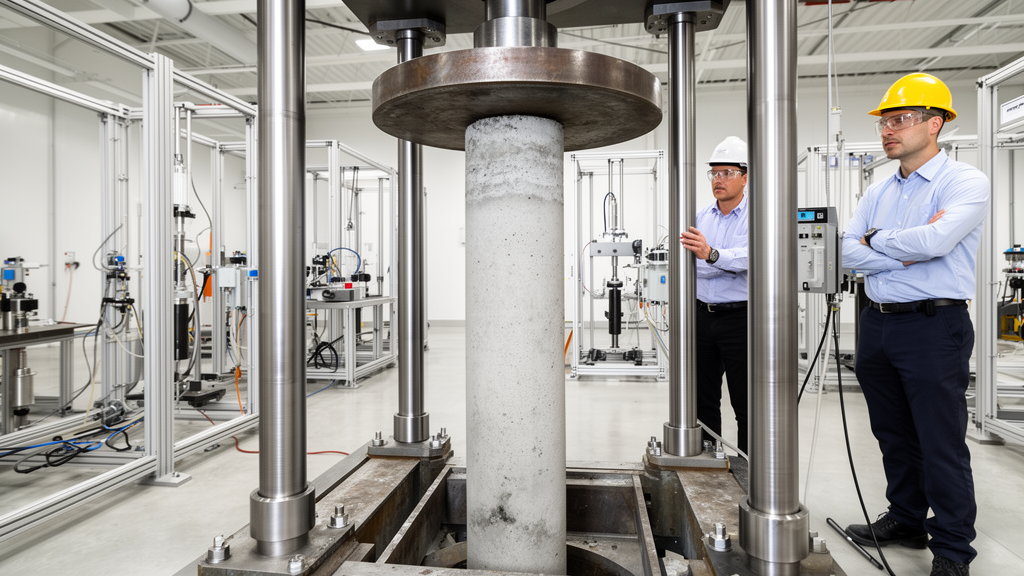
Structural engineering researchers have evaluated the structural mechanics and ultimate load-bearing capacity of composite columns composed of square aluminum alloy tubes filled with geopolymer concrete subjected to eccentric compression. Addressing the environmental footprint associated with conventional Portland cement concrete, the investigation pairs lightweight, corrosion-resistant 6063-T5 aluminum alloy tubes with an inorganic aluminosilicate geopolymer matrix derived from industrial solid waste such as fly ash and slag. Because aluminum alloy features an elastic modulus approximately one-third that of conventional structural steel and lacks a distinct yield plateau, its buckling characteristics and confinement mechanics under combined axial force and bending moment differ substantially from traditional steel-concrete members. Furthermore, existing structural design standards, such as the current Chinese code for aluminum structures, do not specify design formulations for aluminum alloy tubes confining geopolymer infill. To establish an analytical foundation, the study combined physical compression testing of hollow aluminum tubes, validation of a finite element simulation framework against ordinary concrete-filled columns, parametric numerical analyses of geopolymer-filled members, and the derivation of a preliminary design formula.
The experimental phase began with laboratory testing of eleven hollow square aluminum alloy columns fabricated from seamless 6063-T5 extrusions to isolate the buckling behavior of the outer metallic casing. Square sections were specifically chosen because flat wall plates are inherently susceptible to local buckling, providing a rigorous baseline for composite structural modeling. The physical test matrix examined medium-length columns with outer cross-sectional widths of 100 millimeters and 150 millimeters, member lengths ranging from 700 to 1050 millimeters, tube wall thicknesses of 3, 4, and 5 millimeters, and applied load eccentricities of 0, 15, and 30 millimeters. Material properties were independently established through uniaxial tensile tests on nine coupon specimens divided evenly across the three wall thicknesses in accordance with the GB/T 228.1-2010 standard. These material tests revealed consistent parameters within each thickness class, yielding mean elastic moduli of 72.47 gigapascals for 3-millimeter walls, 66.83 gigapascals for 4-millimeter walls, and 66.27 gigapascals for 5-millimeter walls, with corresponding mean 0.2 percent proof yield stresses of 162.0, 167.3, and 198.7 megapascals.
During monotonic compression testing under displacement control at a constant loading rate of 0.1 millimeter per minute, the hollow columns exhibited pronounced local plate instability that interacted with overall member deformation. Displacement transducers and twelve strain gauges placed at quarter-height, mid-height, and three-quarter-height intervals recorded the deformation history. Except for specimen FZ3E0, which featured a low width-to-thickness ratio of 18.0 and failed through material yielding and central crushing, all hollow specimens failed via typical buckling patterns governed by local plate slenderness. The observed local buckling was multimodal, typically presenting as an inward indentation on one face accompanied by outward bulging on the adjacent face. The spatial distribution of initial geometric imperfections governed the precise location of the initial local buckles, resulting in scatter between nominally identical tubes. Axially loaded specimens displayed small lateral displacements below 3 millimeters prior to local buckling, whereas eccentrically loaded specimens developed larger lateral deflections driven by the primary bending moment, which also shifted longitudinal strains on the tensile face toward positive values.
To simulate composite action accurately, the authors developed a numerical modeling framework within the ABAQUS finite element program, incorporating nonlinear material constitutive relationships. The aluminum alloy casing was modeled using a continuous Ramberg-Osgood constitutive formulation adopting Steinhardt’s assumption where the strain hardening exponent equals the 0.2 percent proof stress divided by ten, converting nominal stresses and strains into true stresses and true plastic strains. For the core concrete, the analysis implemented the Concrete Damaged Plasticity formulation to account for irreversible compressive crushing, tensile cracking, and confinement-induced strength enhancement under multiaxial stress states. The concrete model adopted a dilation angle of 30 degrees, an eccentricity of 0.1, a yield surface parameter of 0.667, and a viscosity coefficient of 0.0005. Confinement effects in square tubes were represented using Han’s confined-concrete model, capturing the lateral pressure mobilized by the outer tube and the resulting post-peak softening behavior.
Before evaluating geopolymer infill, the numerical architecture was validated against experimental results from six square ordinary Portland cement concrete-filled aluminum alloy tubular columns reported in published literature. These reference validation specimens, designated PCC-R3-L1-20 through PCC-R10-L1-40, shared an outer cross-sectional width of 160 millimeters, lengths of 1280 and 1920 millimeters, wall thicknesses of 3 and 10 millimeters, and eccentricities of 20 and 40 millimeters. Comparing finite element predictions against measured capacities produced an average experimental-to-simulated ultimate load ratio of 0.9978, with a standard deviation of 0.0285, a coefficient of variation of 0.0286, a mean absolute percentage error of 2.49 percent, and a root-mean-square error of 15.47 kilonewtons. Although the simulation slightly overestimated initial axial stiffness due to idealized end contact, uniform boundary alignment, and single-mode imperfection modeling in contrast to experimental machine compliance and end-plate seating, the close alignment in peak capacity and midspan deflection curves confirmed the validity of the modeling methodology.
The validated framework was subsequently extended to evaluate composite members containing geopolymer concrete by modifying the infill constitutive parameters while maintaining the core plastic damage formulation. Geopolymers represent inorganic three-dimensional aluminosilicate networks synthesized via the alkaline activation of industrial byproducts, in which solid aluminosilicates dissolve under hydroxide attack into silicate and aluminate species that condense into dense polymeric gels. Drawing upon synthesized mechanical property ranges from published literature, the numerical model accounted for the distinctive mechanical traits of geopolymer concrete, specifically its lower elastic modulus compared to ordinary Portland cement concrete of equivalent compressive strength. The numerical constitutive relationship adjusted the initial ascending slope downward, calibrated peak compressive stress, and incorporated a more brittle unconfined post-peak softening branch while preserving lateral confinement dependency. This permitted an isolated, comparative numerical investigation into how geopolymer material properties alter composite column mechanics under identical structural geometry.
A direct numerical comparison between six matched pairs of ordinary concrete and geopolymer concrete composite columns demonstrated comparable structural behavior with moderate capacity enhancements. Across the matched geometric configurations, substituting Portland cement concrete with geopolymer concrete increased predicted ultimate bearing capacity by 1.13 percent to 3.94 percent, producing an average capacity increase of 2.40 percent. For columns with thin 3-millimeter aluminum walls, where the core infill carries a higher proportion of the applied load, the geopolymer infill yielded ultimate capacities approximately 4.30 percent greater than ordinary concrete counterparts. Conversely, in columns featuring thick 10-millimeter walls, the outer aluminum casing contributed a dominant share of cross-sectional resistance, causing the ultimate capacity difference between the two core materials to narrow to approximately 1.13 percent. Due to the lower elastic modulus of the geopolymer matrix, geopolymer-filled members exhibited a marginally reduced initial elastic stiffness, but progressive mobilization of tube confinement ensured a gradual post-peak load decline closely matching the ductile response of ordinary concrete columns.
Detailed extraction of internal cross-sectional stress distributions revealed the synergistic load-sharing mechanism between the external square aluminum tube and the internal geopolymer concrete core under eccentric loading. During the early linear-elastic loading stage, the geopolymer core sustained the overwhelming majority of the applied axial load, carrying up to 83.76 percent of the total compressive force owing to its large cross-sectional area. As deformation progressed and the geopolymer entered its nonlinear damage regime, its relative load contribution stabilized and subsequently declined. Because the aluminum alloy tube possessed an elastic modulus roughly double that of the geopolymer infill, its internal stresses intensified rapidly, mobilizing substantial axial resistance and providing hoop confinement that restrained lateral expansion of the core. After the aluminum reached its yield threshold, its relative load share plateaued, with peak capacities of both materials occurring in close proximity. In the post-peak stage, as concrete damage accumulated, the outer tube maintained structural stability, supporting roughly 30 percent of the residual load and preventing abrupt collapse.
A comprehensive parametric finite element study analyzed thirteen square geopolymer-filled composite columns with 160-millimeter widths to quantify the influence of load eccentricity ratio, column slenderness ratio, and tube width-to-thickness ratio. Increasing the eccentricity ratio from 0.25 to 0.75 in columns with 3-millimeter walls reduced ultimate capacity from 755.24 kilonewtons to 408.93 kilonewtons, representing a 45.86 percent strength loss. Higher eccentricities generated severe cross-sectional stress gradients, accelerated tensile-side unloading, amplified midspan lateral deflections, and reduced the uniformity of passive confinement, although the post-peak descending branch flattened. Increasing the column slenderness ratio from 24 to 38 diminished ultimate capacity from 841.15 kilonewtons to 670.03 kilonewtons, a 20.34 percent reduction caused by amplified second-order bending moments. Conversely, decreasing the plate width-to-thickness ratio from 53 to 23 by increasing tube thickness from 3 to 7 millimeters elevated ultimate capacity from 755.24 kilonewtons to 1102.38 kilonewtons, a 45.97 percent gain achieved by delaying local buckling and stiffening lateral confinement restraint.
Synthesizing these numerical and theoretical observations, the researchers formulated a simplified bearing-capacity design equation based on the superposition principles and reduction factor methodologies of the CECS 28:2012 code for concrete-filled steel tubes. To account for the lower elastic modulus of aluminum relative to structural steel, a confinement calculation coefficient of 0.33 was introduced. The design formulation calculates overall capacity as the product of the cross-sectional axial strength and two independent reduction factors: an eccentricity reduction factor and a member slenderness reduction factor. Calibrated through nonlinear regression against parametric finite element results, the eccentricity factor was defined as one divided by the quantity one plus 1.152 times the eccentricity divided by the core radius. The slenderness reduction factor was adapted from steel-concrete specifications to account for geometric instability. Evaluated across nineteen finite element cases, the ratio of numerical capacity to calculated design capacity ranged from 0.931 to 1.110, yielding a mean of 1.0107, a standard deviation of 0.0547, and a coefficient of variation of 5.41 percent, demonstrating low predictive bias.
The authors emphasized that the proposed design equation and numerical findings remain subject to defined geometric and material boundaries. The preliminary formulation is strictly calibrated for square aluminum alloy tubes with outer widths of 160 millimeters, plate width-to-thickness ratios between 23 and 53, member slenderness ratios between 24 and 38, and load eccentricity ratios between 0.25 and 0.75. The researchers cautioned that these equations cannot be extrapolated to circular sections, rectangular configurations, cyclic loading conditions, elevated temperatures, or alternative geopolymer chemical precursor systems without explicit experimental verification. Because the geopolymer column behavior was assessed through a constitutive model transfer within a finite element framework rather than direct physical column testing of geopolymer-filled aluminum members, future research must incorporate physical experimental programs on geopolymer-filled tubes, direct measurement of geometric imperfections, long-term durability assessments, and life-cycle carbon analyses before practical structural implementation.
Subject of Research: Structural performance and design formulation of aluminum alloy tube-confined geopolymer concrete columns under eccentric compression
Article Title: Eccentric compression behavior and design of aluminum alloy tube-confined geopolymer concrete columns
Article References: Ding, W., Wei, S., Jia, S., Xiaozhong, Z., Hao, Y., & Xu, X. (2026). Eccentric compression behavior and design of aluminum alloy tube-confined geopolymer concrete columns. Case Studies in Construction Materials, 25, Article e06667. https://doi.org/10.1016/j.cscm.2026.e06667
Image Credits: AI Generated
DOI: 10.1016/j.cscm.2026.e06667
Keywords: structural engineering, geopolymer concrete, aluminum alloy tubes, eccentric compression, composite columns, finite element modeling, load-bearing capacity, concrete damage plasticity, Eccentric, compression, behavior, design
News Source: Denise Maddox. (November 12, 2026). Engineers Evaluate Aluminum Tubes Confining Geopolymer Concrete Under Eccentric Loading. Scienmag.