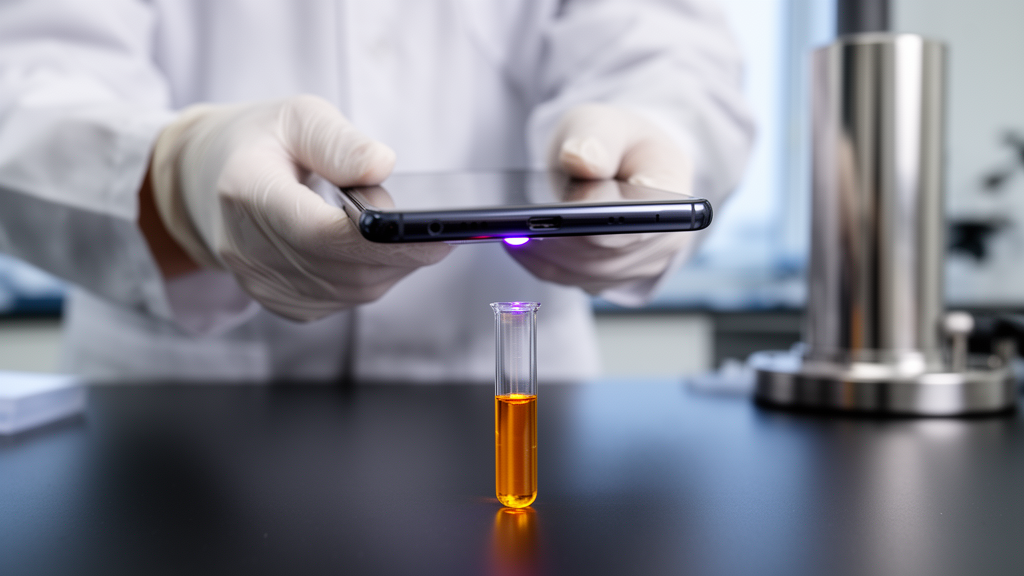
A collaborative research team from Istanbul Technical University and Recep Tayyip Erdogan University has synthesized a specialized molecular sensor that identifies trace amounts of toxic mercury ions within approximately ten seconds. The newly engineered chemical probe, designated NIR-2, transforms otherwise undetectable heavy metal contaminants into distinct optical outputs by combining an immediate visible color transition with the emission of intense near-infrared fluorescence. Reported in the peer-reviewed analytical chemistry journal Talanta, the investigation demonstrates how a single molecular platform can address the persistent difficulty of monitoring trace mercury in environmental, biological, and agricultural settings. Conventional testing frameworks for hazardous heavy metals depend almost entirely on centralized analytical facilities equipped with complex instrumentation, extensive sample preparation procedures, and highly trained technical personnel. By establishing an integrated molecular architecture that translates chemical recognition into dual-mode optical readouts, the investigators have introduced an analytical strategy designed to facilitate sensitive on-site screening while significantly lowering procedural barriers for field diagnostics.
The fundamental challenge associated with environmental mercury monitoring stems from the chemical behavior and extreme toxicity of divalent mercury ions, which remain completely unnoticeable to the naked eye even when present at hazardous concentrations. In typical environmental scenarios, a standard glass of drinking water or a commercially harvested agricultural product may seem wholesome while harboring harmful dissolved residues. The development of NIR-2 was specifically undertaken to bridge this analytical divide by generating a rapid, autonomous chemical response that instantly alerts observers to the presence of dissolved mercury without demanding immediate access to benchtop instrumentation. By producing dual optical signals directly upon contact, the probe establishes an immediate chemical bridge between laboratory-grade spectral accuracy and practical field detection.
At the structural core of the NIR-2 sensor is a sophisticated selenolactone-cyanine molecular assembly designed to operate as an exceptionally selective chemical lock. Under ordinary baseline conditions in the absence of target metal ions, the selenium-based molecular switch remains in a closed configuration that generates minimal light emission and maintains a pale yellow appearance in solution. The sensing mechanism capitalizes on the strong chemical affinity that exists between divalent mercury ions and selenium atoms integrated into the molecular architecture. This coordinated opening of the molecular framework triggers two simultaneous photophysical events: the solution undergoes a visible chromatic shift from yellow to bright green, and the molecule begins emitting strong near-infrared fluorescence.
The dual-signaling capability of NIR-2 distinguishes it from conventional mono-modal chemical probes by combining direct visual observation with sophisticated instrumental quantitation within a unified testing framework. The visible color shift from yellow to green provides an unmistakable qualitative or semi-quantitative indicator that can be recognized immediately by eye or documented with consumer-grade optical equipment. By integrating both visual and near-infrared modalities into a single selenium-switched framework, the researchers established a versatile analytical tool capable of serving distinct diagnostic tiers, ranging from rapid visual screening performed at rural contamination points to high-precision fluorescent imaging executed in advanced academic and clinical laboratories.
To rigorously establish the analytical benchmarks of NIR-2 under controlled laboratory settings, the research team conducted comprehensive spectroscopic evaluations utilizing both ultraviolet-visible absorption spectroscopy and steady-state fluorescence spectroscopy. Furthermore, kinetic monitoring revealed that the resulting optical signals remained completely stable for at least twenty minutes, providing an ample temporal window for accurate visual inspection, digital image recording, and instrumental data acquisition. In terms of absolute detection sensitivity, ultraviolet-visible spectrophotometric analysis yielded an exceptional limit of detection of 3.77 × 10⁻¹⁰ M for divalent mercury ions. Parallel fluorescence titration assays established a complementary detection limit of 4.54 × 10⁻⁹ M, confirming that the probe possesses sufficient molecular sensitivity to identify ultra-trace quantities of dissolved heavy metal ions under standard analytical laboratory protocols.
Recognizing that specialized spectrophotometers are rarely available outside dedicated analytical institutions, the research team developed a practical digital workflow to convert the sensor’s visible chromatic transition into a reliable quantitative measurement using a standard consumer smartphone. Utilizing a Redmi Note 10S smartphone, the researchers captured standardized digital photographs of sensor solutions exposed to varying concentrations of divalent mercury ions. The resulting images were digitally separated into their foundational color channels, focusing specifically on the relative intensity values of the red and green color components. Rather than relying on absolute brightness values, which are easily skewed by fluctuating ambient light, the team calculated the direct mathematical ratio between the red and green chromatic channels. This ratiometric image analysis effectively balanced out variations in external illumination, establishing a reproducible mathematical correlation between the observed chromatic shift and the concentration of dissolved mercury present in each test solution.
The resulting smartphone-based analytical methodology demonstrated a quantitative working detection range spanning from 1.66 × 10⁻⁹ M to 7.50 × 10⁻⁶ M for divalent mercury ions, a performance window that the study authors identified as the most sensitive smartphone-assisted mercury detection range reported in scientific literature to date. To place these concentration values into regulatory perspective, the United States Environmental Protection Agency has established a maximum contaminant level of two parts per billion, equivalent to 0.002 milligrams per liter, for inorganic mercury present in municipal drinking water supplies. The lower limit of quantitation achieved by the smartphone camera and ratiometric image processing protocol successfully falls below this stringent international regulatory ceiling. This analytical capability demonstrates that consumer-level digital imaging hardware, when paired with rational molecular switch design, can achieve sufficient analytical sensitivity under controlled experimental conditions to identify hazardous mercury concentrations that exceed established environmental safety limits.
Following calibration in purified aqueous solutions, the investigators evaluated whether the NIR-2 molecular sensor could maintain its performance when challenged with complex environmental water matrices collected from real-world sources. The evaluation encompassed samples of municipal tap water, bottled drinking water, and natural freshwater gathered from a local lake environment. These aqueous validation trials confirmed that the probe’s selenium-mercury binding mechanism remains chemically robust when deployed in non-ideal environmental waters typical of natural aquatic monitoring sites.
The research team subsequently extended their investigation into the agricultural domain to determine whether NIR-2 could detect heavy metal contamination within complex food matrices. The researchers tested fresh fruit samples, including strawberries, watermelon, and cherries, which were intentionally spiked with known concentrations of divalent mercury ions to systematically evaluate measurement accuracy. In an additional series of agricultural screening experiments, the team examined whether direct visual color shifts could rapidly indicate contamination in staple dry food commodities, including rice, corn, beans, and lentils. While NIR-2 produced identifiable semi-quantitative color shifts across several of these solid food items, the investigators observed that its overall analytical effectiveness varied depending on the specific food matrix, indicating that compositional differences among diverse agricultural products can influence sensor performance.
To explore the diagnostic utility of NIR-2 in biomedical contexts, the authors conducted extensive cellular compatibility and bioimaging experiments across three distinct human lung cell lines. Cytotoxicity assessments confirmed that the molecular sensor possesses favorable biocompatibility, with cell viability consistently remaining above ninety percent throughout the experimental observation periods. Fluorescence microscopy investigations further demonstrated that NIR-2 readily internalized within the human lung cells without inducing acute cytotoxic harm. Upon cellular exposure to divalent mercury ions, internal fluorescence imaging verified that the sensor generated a distinct, concentration-dependent near-infrared fluorescent signal directly inside the living cell cultures.
Despite these promising analytical and bioimaging accomplishments, the researchers explicitly cautioned that NIR-2 should not yet be characterized as a finalized, consumer-ready mercury detection device. The practical execution of the smartphone-based assay still required disciplined chemical sample preparation, and all digital photography was performed under carefully standardized, controlled ambient lighting conditions to ensure computational consistency. The authors emphasized that extensive additional testing involving naturally contaminated ecological samples, fluctuating field temperatures, diverse ambient lighting environments, and integrated portable field-sampling hardware must be completed before the molecular platform can be routinely deployed outside controlled experimental settings.
The broader significance of this research lies in its potential to transform heavy metal monitoring by shifting sensitive analytical chemistry away from centralized institutions and closer to the actual environments where chemical contamination occurs. As environmental monitoring faces growing demands for real-time risk assessment, molecular chemosensors that operate within seconds while delivering multiple readable signals offer a viable pathway to decentralize environmental testing. In addition to addressing mercury contamination, the investigators noted that the underlying architecture of their selenium-based molecular switch could serve as a versatile synthetic platform for developing future chemical sensors tailored to detect alternative environmental toxins, industrial pollutants, or hazardous heavy metals. While a glass of water containing dangerous trace levels of mercury may continue to appear entirely pristine to human eyes, NIR-2 proves that rational molecular engineering can reveal those invisible hazards, establishing a strong foundation for practical diagnostic monitoring beyond the traditional laboratory.
Subject of Research: Near-infrared chemosensor platform for rapid trace mercury detection using smartphone imaging
Article Title: New sensor makes invisible traces of mercury easier to see
Article References: New sensor makes invisible traces of mercury easier to see. Original publication (Bibliographic details unavailable.)
Image Credits: AI Generated
DOI: Not provided
Keywords: mercury detection, NIR-2 sensor, chemosensor, near-infrared fluorescence, selenolactone, smartphone sensing, water contamination, food safety testing, environmental monitoring, cellular imaging, spectroscopy, Istanbul Technical University, Recep Tayyip Erdogan University, Talanta, heavy metal sensing, mercury ions, ratiometric analysis
News Source: Denise Maddox. (November 12, 2026). Selenium Molecular Sensor Detects Trace Mercury In Ten Seconds Via Smartphone. Scienmag.