In an observational study published in Monthly Notices of the Royal Astronomical Society, researchers have demonstrated that a tiny glass photonic chip can link telescopes together to act as a single powerful instrument during on-sky observations. Developed by physicists at Heriot-Watt University, the compact integrated optics device was tested at the CHARA Array in California, marking an important practical milestone for next-generation astronomical technology. The demonstration verified that a miniature component measuring only a few centimetres across can perform the precise beam-combination tasks traditionally requiring large, complex optical arrangements of mirrors and lenses.
Located in California, the CHARA Array represents one of the world’s leading research facilities for high-resolution astronomy, operating an array of six individual telescopes that work in concert to examine celestial targets in extraordinary detail. To achieve that synthesized resolving power, optical signals gathered by each telescope must be brought together and combined with extreme physical precision. By routing incoming light through microscopically thin channels in the manner of integrated circuits guiding electrons, the newly deployed photonic chip succeeded in combining light from multiple telescopes on-sky, proving that compact light-guiding chips can operate effectively under real-world astronomical conditions.
The milestone is the outcome of a collaborative international project joining scientists from the UK at Heriot-Watt University, German teams at Cologne University and the Leibniz Institute for Astrophysics Potsdam, and American researchers at Georgia State University’s CHARA Array. At Heriot-Watt University’s Institute of Photonics and Quantum Sciences, the beam-combining photonic chip was conceived, designed, fabricated, and characterized by Professor Robert Thomson and Dr Aurélien Benoît. Professor Thomson noted that the successful on-sky test marks a key achievement for a dedicated research programme initiated more than 15 years ago, moving photonic light-combining methods from initial fundamental physics and laboratory demonstrations into active deployment at a leading international observatory.
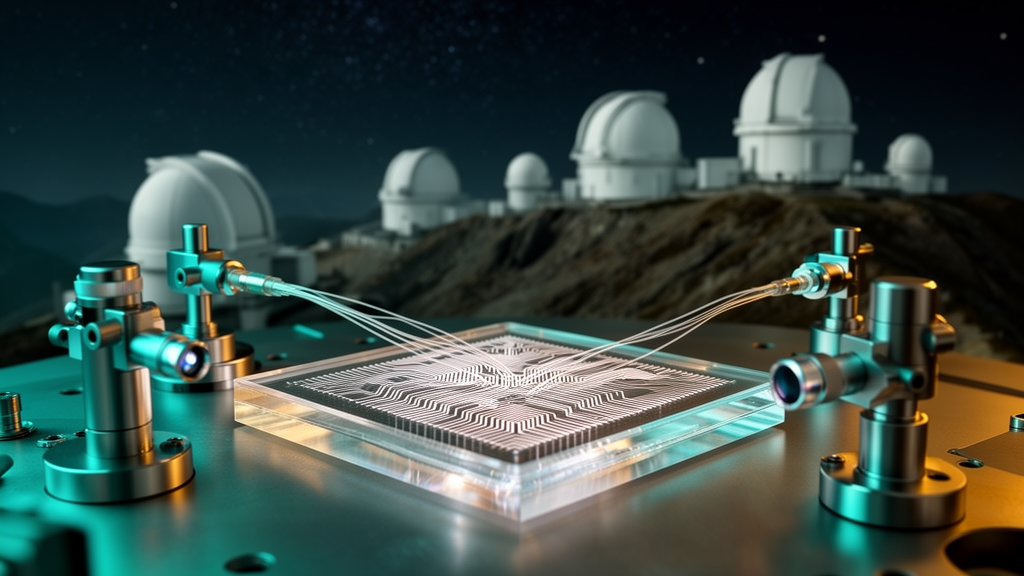
The Heriot-Watt chip relies on an advanced ultrafast-laser inscription technique, wherein laser pulses directly write microscopic waveguides within an innovative glass substrate. This laser manufacturing process unlocks an unexplored spectral range for integrated optics fabrication, providing the precise optical pathways needed to guide starlight efficiently. Inside the device, these laser-machined channels route and superimpose the incoming optical beams from separate telescopes, allowing the individual light collectors to function effectively as a single, much larger virtual aperture capable of producing substantially sharper astronomical views.
The photonic chip serves as the central optical engine inside CHARIOT, an instrument specifically designed as a flexible testbed for evaluating novel photonic devices in stellar interferometry. As detailed in the study, titled “Stellar interferometry with a K-band integrated optics beam combiner instrument at the CHARA Array – I. First on-sky fringes for CHARIOT,” the platform underwent dedicated observing campaigns across 2024 and 2025. During these operational runs, CHARIOT successfully linked telescopes at the California array, forming interference fringes and recording signals from a range of target stars to validate the stability and precision required for advanced astronomical investigations.
The on-sky results demonstrated not only that the miniature integrated optics chip could handle the demanding tolerances of stellar interferometry, but also that CHARIOT could surpass the sensitivity reach of earlier equipment. During the 2024 and 2025 campaigns, the new system detected signals from stars considerably fainter than those reached by the previous optical beam combiner it replaced. Dr Benoît emphasized that successfully observing light from real astronomical targets validated the laboratory development, proving that complex optical manipulations can be integrated into an exceptionally small and stable piece of engineered glass.
Beyond its compact footprint, the CHARIOT instrument provides crucial operational versatility for astronomical testbeds.
Lead author Dr Aline Dinkelaker, from the Leibniz Institute for Astrophysics Potsdam, highlighted that executing successful observations under actual operating conditions represents a pivotal validation for the broader discipline. Dr Dinkelaker explained that these initial on-sky results confirm that integrated photonic technologies can deliver the performance metrics and optical stability required for frontline astronomical research.
Researchers expect that as these integrated photonic devices continue to mature, they will directly advance some of astronomy’s most challenging observational objectives. In particular, scientists anticipate utilizing the technology to explore how distant planetary systems form and evolve over time, while aiding future instrumentation designed to directly detect and characterize exoplanets orbiting other stars.
The development forms part of astrophotonics, an expanding scientific field that applies integrated optics and advanced light-manipulation technologies to overcome fundamental bottlenecks in astronomical instruments. By shrinking these light-combining systems down to miniature chips small enough to rest on the palm of a hand, international teams aim to construct future astronomical instruments that are more robust, significantly more compact, and far easier to upgrade as observational demands grow.
In evaluating the initial on-sky deployment, the experimental run specifically linked two telescopes within the facility, enabling the pair to operate collectively as a single unified astronomical instrument. The Heriot-Watt research group, based within the Institute of Photonics and Quantum Sciences, took an active, central role throughout the observing campaigns that verified the device on the telescope array. Professor Robert Thomson reflected on the trajectory of the project, observing that tracing the technology from fundamental physical principles and early laboratory trials through to functional operation at an international astronomical facility stands as a major achievement. Professor Thomson pointed out that combining observations simultaneously from multiple telescopes enables astronomers to obtain significantly sharper views of the universe, effectively allowing separated collectors to operate as if they formed one vastly larger telescope. Reaching this milestone underscores the effectiveness of sustained international teamwork, transforming a concept explored over fifteen years into a verified mechanism for stellar observation.
Dr Aurélien Benoît similarly remarked upon the transition from experimental design to live data acquisition, pointing out the distinct milestone of seeing a device that the team conceived, designed, fabricated, and characterised in the laboratory successfully collecting and analysing light from actual stars at a premier astronomical interferometer. By confirming that thin glass channels can guide light in a manner analogous to electrons travelling through integrated circuits, the investigation validated the physical premise of chip-scale beam combination. Scientists anticipate that these capabilities will ultimately aid some of astronomy’s most demanding observational pursuits, particularly providing the precision required to study how planetary systems take shape and evolve, while assisting future efforts to directly detect and characterise planets orbiting other stars.
The research was formally reported in the Monthly Notices of the Royal Astronomical Society on 21 September 2026 under the publication title covering first on-sky fringes for CHARIOT with a K-band integrated optics beam combiner instrument at the CHARA Array. The institutional announcement followed in October 2026, marking an essential validation stage for astrophotonics. This discipline applies advanced light-based technologies to address enduring challenges in astronomical observation. Beyond its immediate optical success, the modular architecture of the CHARIOT instrument ensures that alternative photonic chips can be removed and replaced within hours.
The development of the integrated optics chip took place within Heriot-Watt University, a UK-based research institution with an extensive international presence. Originating in Edinburgh in 1821 as the world’s first mechanics institute, the organisation received university status by Royal Charter in 1966 and derives its name from eighteenth-century engineer James Watt and sixteenth-century philanthropist George Heriot. Today, the university maintains five distinct campuses spanning Edinburgh, the Scottish Borders, Orkney, Dubai, and Malaysia. Its academic framework encompasses 113 undergraduate programmes and 170 postgraduate programmes, educating a student body of more than 25,000 individuals representing 154 countries, alongside an alumni network of over 173,000 graduates across 190 countries worldwide.
The institution conducts research across six specialized academic schools, including Engineering and Physical Sciences, Mathematical and Computer Sciences, and Energy, Geoscience, Infrastructure and Society, along with Social Sciences, Textiles and Design, Global College, and the Edinburgh Business School. In national assessments of research quality under the Research Excellence Framework 2021, 86.8 percent of the university’s research activity was classified as world-leading or internationally excellent. By anchoring novel photonic engineering within this academic and laboratory setting, researchers seek to advance compact optical components that replace cumbersome mirror assemblies, facilitating smaller, more robust astronomical instruments that are substantially simpler to upgrade as future observational requirements expand.
Subject of Research: Integrated photonic beam combiners for stellar interferometry
Article Title: Tiny photonic chip links telescopes together to view the universe in ‘astonishing’ details
Article References: Tiny photonic chip links telescopes together to view the universe in ‘astonishing’ details. Original publication (Bibliographic details unavailable.)
Image Credits: AI Generated
DOI: Not provided
Keywords: astrophotonics, stellar interferometry, CHARA Array, CHARIOT instrument, photonic chips, beam combiners, Heriot-Watt University, integrated optics, K-band observation, ultrafast-laser inscription, Leibniz Institute for Astrophysics Potsdam, observational astronomy, telescope arrays, high-resolution astronomy, planetary systems, astronomical instrumentation
News Source: Grant Pearson. (November 12, 2026). Photonic Chip Links Telescopes at CHARA Array for High-Resolution Astronomy. Scienmag.