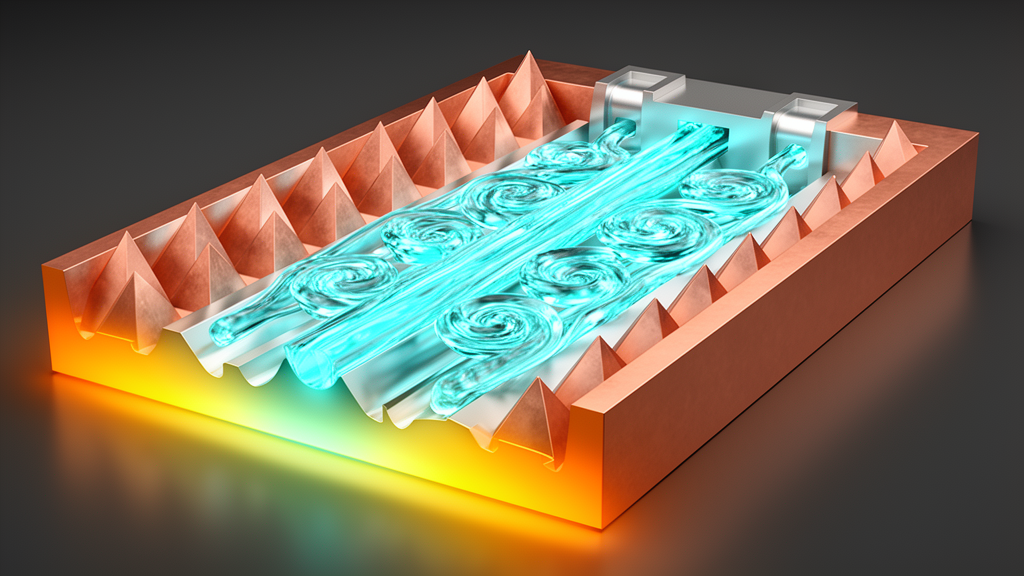
In two-dimensional conjugate heat-transfer simulations of water-cooled copper microchannels, triangular transverse ridges achieved heat-transfer enhancements of up to 61.8 percent over smooth channels, while rectangular ridges proved more effective under strict pumping-power limits. Researchers Joseph Marcello and Sumith Yesudasan at the University of New Haven analyzed how varying ridge geometry, height, and pitch alters both heat dissipation and fluid resistance in compact cooling systems.
Liquid-cooled microchannels offer an effective method for removing high heat loads from compact electronic systems, but surface modifications that augment cooling must be balanced against the hydraulic penalties they induce. To evaluate this tradeoff, the investigators performed computational fluid dynamics simulations in COMSOL Multiphysics, directly comparing semicircular, rectangular, and triangular transverse ridge profiles against smooth-channel reference cases.
The study evaluated a comprehensive matrix of operating and geometric parameters across water-cooled copper microchannels. The simulations systematically varied ridge height from 0.05 to 0.15 millimeters, ridge pitch from 0.25 to 0.50 millimeters, and Reynolds numbers from 100 to 1000. In total, the researchers conducted 135 ridged-channel simulations alongside five smooth-channel reference cases to observe detailed flow and thermal behavior.
Thermal and hydraulic performance were evaluated using the Nusselt number, pressure drop, and a conventional thermal performance factor, which compares heat-transfer enhancement against the accompanying increase in flow resistance. The research team also performed a Pareto analysis to examine the relationship between Nusselt number enhancement and reference-width pumping power across the configurations.
At a Reynolds number of 1000, with a ridge height of 0.15 millimeters and a pitch of 0.40 millimeters, the baseline smooth channel produced a Nusselt number of 14.51. Under identical conditions, semicircular, rectangular, and triangular ridges produced Nusselt numbers of 16.83, 17.98, and 23.47, representing heat-transfer increases of 16.0 percent, 23.9 percent, and 61.8 percent, respectively. Although triangular ridges generated the largest thermal gains, they also produced the highest pressure-drop penalty.
Across the complete design matrix at a Reynolds number of 1000, the maximum thermal performance factor reached 1.37. This peak value was achieved using triangular ridges with a height of 0.15 millimeters and a pitch of 0.50 millimeters, a configuration that also produced the highest overall Nusselt number of 24.01.
The Pareto analysis revealed that rectangular ridges occupied much of the lower-pumping-power frontier, whereas triangular ridges provided superior heat-transfer enhancement when higher pumping power was available. The authors concluded that triangular ridges are best suited for applications where maximizing heat transfer is the primary objective, while rectangular geometries offer competitive cooling performance when microchannel heat sinks must operate under tighter pumping constraints.
Subject of Research: Thermal and hydraulic performance of transverse ridge geometries in water-cooled microchannel heat sinks
Article Title: Thermal–hydraulic performance of transverse ridge geometries in water-cooled microchannel heat sinks
Article References: Marcello, J., & Yesudasan, S. (2026). Thermal–hydraulic performance of transverse ridge geometries in water-cooled microchannel heat sinks. Frontiers in Mechanical Engineering, 12, Article 1965238. https://doi.org/10.3389/fmech.2026.1965238
Image Credits: AI Generated
DOI: 10.3389/fmech.2026.1965238
Keywords: microchannel heat sinks, transverse ridges, conjugate heat transfer, Nusselt number, thermal performance factor, computational fluid dynamics, COMSOL Multiphysics, pressure drop, pumping power, Pareto analysis, Reynolds number, ridge geometry, copper microchannel, liquid cooling, triangular ridges, rectangular ridges, semicircular ridges
News Source: Audrey Campbell. (November 12, 2026). Triangular Ridges Boost Microchannel Heat Transfer but Increase Hydraulic Pumping Demands. Scienmag.