Adding electromyostimulation to dynamic or isometric squat-based post-activation performance enhancement protocols did not confer additional acute performance benefits beyond exercise-only conditioning in competitive amateur soccer players, while significantly altering perceptual load.
Acute performance-enhancement strategies aimed at optimizing athletic performance have received increasing attention in sports science, with post-activation performance enhancement and electromyostimulation emerging as promising methods for enhancing short-term neuromuscular performance. The randomized crossover study investigated whether combining dynamic and isometric squat conditioning with electromyostimulation would alter physical performance outcomes and perceptual responses compared to performing the conditioning exercises alone.
Twenty-two competitive male amateur soccer players with a mean age of 19.7 ± 1.1 years participated in the investigation.
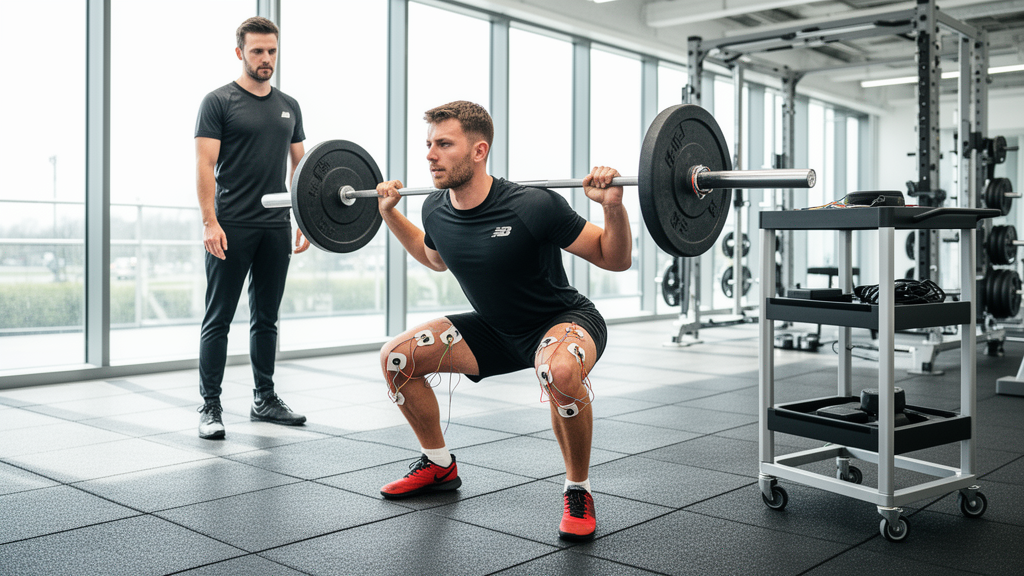
The five experimental conditions evaluated were a dynamic back squat, a maximal voluntary isometric contraction, a dynamic back squat combined with electromyostimulation, a maximal voluntary isometric contraction combined with electromyostimulation, and an electromyostimulation-only protocol. The researchers assessed performance outcomes pre-conditioning and post-conditioning across each condition, measuring countermovement jump, zig-zag agility, and shooting speed.
Linear mixed-model analyses demonstrated statistically significant time effects for countermovement jump (p = 0.047), zig-zag agility (p = 0.015), and shooting speed (p = 0.033), whereas a significant main effect of condition occurred solely for shooting speed (p < 0.001). No statistically significant condition-by-time interactions were detected across the performance measures (p > 0.05). Bonferroni-adjusted pairwise comparisons of estimated marginal means for shooting speed showed higher overall speeds in the dynamic back squat and dynamic back squat plus electromyostimulation conditions compared to the maximal voluntary isometric contraction protocols with and without stimulation (p < 0.05), with the combined dynamic squat and stimulation condition displaying the highest estimated marginal mean.
Perceptual measurements included ratings of perceived exertion, ratings of perceived discomfort, and Numeric Rating Scale scores. Linear mixed-model analyses revealed a statistically significant main effect of the intervention on ratings of perceived exertion (p = 0.006) and a highly significant main effect on Numeric Rating Scale scores (p < 0.001), while ratings of perceived discomfort exhibited no statistically significant main effect despite a trend toward significance (p = 0.073).
Subject of Research: Acute physical and perceptual effects of squat conditioning and electromyostimulation in soccer players
Article Title: Acute post-activation performance responses to isometric and dynamic squat pre-loading with and without electromyostimulation in soccer players: a randomized crossover trial
Article References: Akçay, N., Sofuoğlu, C., Arslan, E., Filipovic, A., Yana, M., & Kemmler, W. (2026). Acute post-activation performance responses to isometric and dynamic squat pre-loading with and without electromyostimulation in soccer players: a randomized crossover trial. Frontiers in Physiology, 17, Article 1948872. https://doi.org/10.3389/fphys.2026.1948872
Image Credits: AI Generated
DOI: 10.3389/fphys.2026.1948872
Keywords: electromyostimulation, post-activation performance enhancement, dynamic back squat, maximal voluntary isometric contraction, amateur soccer players, countermovement jump, zig-zag agility, shooting speed, ratings of perceived exertion, ratings of perceived discomfort, numeric rating scale, neuromuscular performance, acute performance responses, crossover study, perceptual load, squat pre-loading
News Source: Drew Townsend. (November 12, 2026). Adding Electromyostimulation to Squat Conditioning Fails to Boost Soccer Players’ Performance. Scienmag.