Researchers at the National Institute of Technology, Hachinohe College, Shibaura Institute of Technology, and The University of Tokyo have experimentally reconstructed three-dimensional regions of changing air density within a natural convection boundary layer along a heated vertical wall. Using an experimental setup based on mirror-assisted three-dimensional background-oriented schlieren imaging, the engineering team recorded transient density variations across short intervals to observe how laminar buoyancy-driven rising air reorganizes into complex transitional patterns. Their experimental findings, reported in Volume 180 of International Communications in Heat and Mass Transfer, provide rare three-dimensional volumetric measurements directly adjacent to a solid heated boundary.
Natural convection heat transfer relies on the thin layer of air that warms and ascends along a heated structure, transitioning from orderly laminar motion toward turbulent flow as it moves downstream. Resolving the three-dimensional architecture of this near-wall boundary layer has historically posed severe experimental hurdles because the solid wall physically blocks the multiple optical viewing angles required for volumetric reconstruction. Consequently, previous laboratory investigations have largely been constrained to single-point sensors or two-dimensional planar slices, leaving researchers to explore three-dimensional near-wall flow structures primarily through numerical simulations.
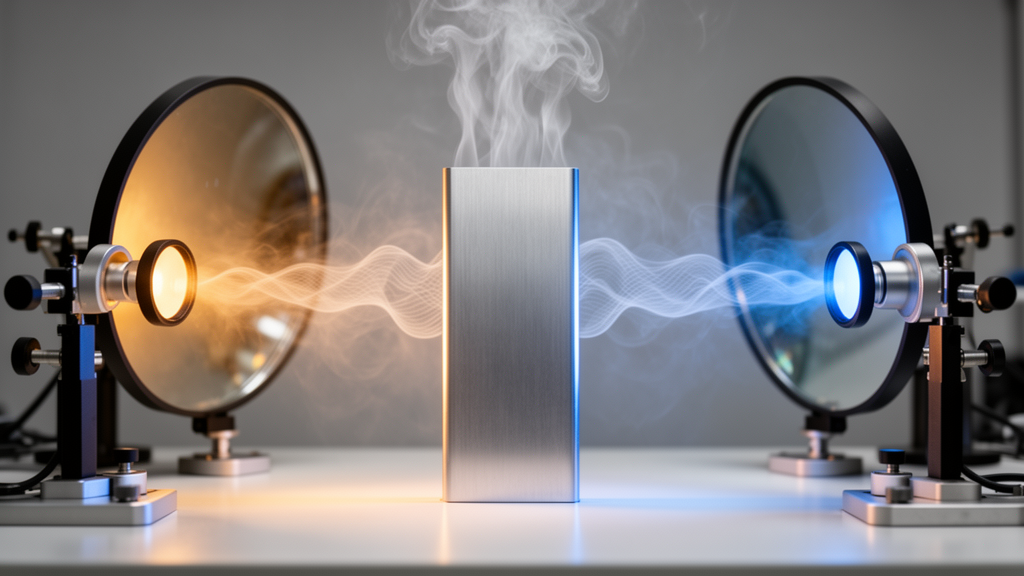
To overcome this directional obstruction, first author Shogo Ogasawara conducted the research in the laboratory of Takuma Kogawa at the National Institute of Technology, Hachinohe College, collaborating with Dr. Masahito Akamine from the Department of Aeronautics and Astronautics at The University of Tokyo. The team adapted a mirror-assisted background-oriented schlieren framework originally proposed by Akamine and colleagues in 2023. By implementing a vertical aluminum plate polished to a mirror finish, the researchers effectively turned the heated surface itself into a reflective optical component that recovered the sightlines otherwise occluded by the boundary.
The optical measurement apparatus comprised the mirror-finished heated plate, an array of twelve synchronized cameras, and two 4K display monitors projecting random-dot reference patterns. Rather than comparing heated measurement images against an unheated baseline image, the researchers compared consecutive image frames recorded synchronously after the wall temperature had fully stabilized. These sequential exposures were separated by 33.3 milliseconds, an approach that effectively suppressed the quasi-steady optical distortions created by heat-induced mechanical warping of the aluminum plate.
The reconstructed data fields captured finite-time changes in air density across each 33.3-millisecond window rather than resolving the absolute, instantaneous density distribution. By tracking these differential density structures across varying local Rayleigh numbers, the researchers mapped how buoyancy forces govern near-wall flow organization. In the upstream portion of the heated wall, the reconstructed structures appeared as smooth, elongated, gently undulating sheets exhibiting distinct spanwise coherence, aligning across the wall surface in patterns resembling horizontal roll structures.
Farther downstream along the vertical plate, the spatial organization changed substantially as the rising boundary layer progressed toward turbulence. The initially uniform, spanwise-coherent sheets began to tilt, fragment, and pair into increasingly intricate configurations. As these structures broke apart, they elongated in the streamwise direction, shifting the structural orientation of the rising warm air from a wall-parallel distribution into three-dimensionally complex, vertically extended features.
To quantify these qualitative structural changes, the research team analyzed integrated density-fluctuation values across the measurement region. The measured fluctuations increased steadily downstream with rising local Rayleigh numbers, reaching a peak near a Rayleigh number of 1.6 × 10⁹ before establishing a plateau characterized by a slight decline. In conjunction with spatial visual observations, the researchers identified a boundary-layer transition zone corresponding to local Grashof numbers spanning from 1.44 × 10⁹ to 2.16 × 10⁹, an envelope broadly consistent with established classical transition criteria.
Statistical evaluation through two-point correlation lengths corroborated the observed spatial restructuring. The correlation analysis documented a distinct quantitative shift from spanwise-dominant spatial correlation upstream to streamwise-dominant correlation downstream, capturing the physical breakdown of horizontal density sheets into vertically oriented flow structures.
The ability to resolve three-dimensional near-wall fluid dynamics carries practical relevance for engineering systems that rely entirely on passive natural convection to dissipate heat without fans or mechanical blowers. Precise experimental characterizations of these buoyancy-driven boundary layers provide benchmark datasets needed to validate computational fluid dynamics models, directly informing the thermal management of high-power electronics, battery enclosures, photovoltaic panels, and architectural surfaces such as radiant cooling panels and building envelopes.
The authors emphasized that their diagnostic technique measures finite-time changes in air density rather than continuous instantaneous density values, noting that quantitative interpretation of fine-scale turbulent features and localized fluctuation amplitudes warrants further independent experimental confirmation. Supported by JSPS KAKENHI funding and institutional facilities at Hachinohe College, the investigators established that mirror-assisted schlieren diagnostics offer an accessible, laser-free, tracer-free methodology for probing wall-bounded variable-density flows.
In reflecting on the experimental breakthrough, Dr. Kogawa pointed out the core physical advantage of their optical arrangement, stating, “Using the heated wall as a mirror helps recover viewing paths normally blocked by the wall, allowing us to examine near-wall structures in three dimensions.” He further emphasized that this configuration enables researchers to observe how regions of changing air density reorganize as the boundary layer develops. Because the heated aluminum surface served as a mirror, the synchronized camera array recovered sightlines that an opaque wall typically blocks.
The operational setup demonstrates how background-oriented schlieren diagnostics evaluate fluid dynamics without relying on specialized flow-seeding materials. Unlike conventional methods that require laser sheets and injected tracer particles, background-oriented schlieren relies strictly on synchronized cameras and background patterns. Because the methodology avoids lasers and tracer particles, the researchers noted its potential utility for investigating other wall-bounded, variable-density flows.
The research team evaluated their measured transition ranges against established hydrodynamic criteria. The investigators tracked finite-time density variations across rising local Rayleigh numbers, which serve as a measure of buoyancy-driven flow. Their integrated fluctuation metric increased downstream alongside the growing boundary layer, reaching a threshold near a local Rayleigh number of about 1.6 × 10⁹ before approaching a plateau with a slight decline. Considering this trend with the spatial patterns, the authors identified a transition range corresponding to local Grashof numbers of 1.44 × 10⁹ to 2.16 × 10⁹. This was broadly consistent with classical transition criteria, although transition estimates depend on the measured quantity and method.
The practical relevance of resolving near-wall natural convection extends directly to energy systems and industrial thermal engineering. Dr. Kogawa underscored this fundamental role, explaining, “Natural convection matters wherever heat must be transferred without fans or other forced airflow.” He pointed out that experimental access to near-wall flow structures can help researchers assess computational fluid dynamics simulations and investigate heat transfer in passively cooled equipment and buildings. In real-world thermal design, such unforced buoyancy flows dictate the cooling efficiency of power electronics, power devices, battery packs, and solar panels. Similarly, natural convection governs heat exchange at building walls, windows, and radiant panels, making experimental structural insights valuable for passive temperature-control strategies.
The investigation combines expertise from several specialized research environments across Japan. First author Shogo Ogasawara conducted the research in Takuma Kogawa’s laboratory at the National Institute of Technology, Hachinohe College. Kogawa, who earned his Ph.D. in Engineering from Tohoku University, is now an Associate Professor at Shibaura Institute of Technology, directing the Social Thermal Applications and Engineering Laboratory at the Toyosu Campus. His work integrates theoretical physics, advanced numerical simulations, and precision optical measurements, encompassing Large Eddy Simulation, radiative transfer, natural convection, and turbulence modeling. The optical framework adapted the mirror-assisted background-oriented schlieren system originally proposed in 2023 by Dr. Masahito Akamine from The University of Tokyo.
Shibaura Institute of Technology, where Kogawa now conducts his work, has maintained an educational philosophy of “learning through practice” since its predecessor, Tokyo Higher School of Industry and Commerce, was established in 1927. The private university operates campuses in Tokyo and Saitama, educating over 9,500 students under its motto of nurturing engineers who learn from society and contribute to society. SIT was also the only private science and engineering university selected for the Top Global University Project sponsored by the Ministry of Education, Culture, Sports, Science and Technology, receiving ministerial support for ten years beginning in the 2014 academic year.
Despite these observational achievements, the authors noted specific interpretive limitations inherent to their experimental methodology. The reconstructed measurements represent finite-time density changes across short intervals rather than continuous instantaneous density fields. As a result, quantitative interpretation of local fluctuation amplitudes and fine-scale turbulent features requires further independent validation. The research was supported by JSPS KAKENHI under Grant Number 24K17221, alongside experimental facilities provided by the National Institute of Technology, Hachinohe College. In their accompanying disclosure statement, the authors confirmed that they have no known competing financial interests or personal relationships that could have appeared to influence the findings reported in the journal publication.
Subject of Research: Three-dimensional optical measurement of natural convection boundary-layer flow
Article Title: Heated mirror reveals hidden 3D patterns in rising air near a wall
Article References: Heated mirror reveals hidden 3D patterns in rising air near a wall. Original publication (Bibliographic details unavailable.)
Image Credits: AI Generated
DOI: Not provided
Keywords: natural convection, background-oriented schlieren, boundary layer transition, air density fluctuation, heated vertical wall, optical flow diagnostics, Rayleigh number, Grashof number, fluid mechanics, thermal engineering, passive cooling, near-wall flow structures, synchronized camera imaging, heat-induced wall warping, correlation-length analysis, heat transfer
News Source: Bethany Barker. (November 12, 2026). Mirror-Assisted Schlieren Imaging Reconstructs 3D Air Density Changes Near Heated Wall. Scienmag.