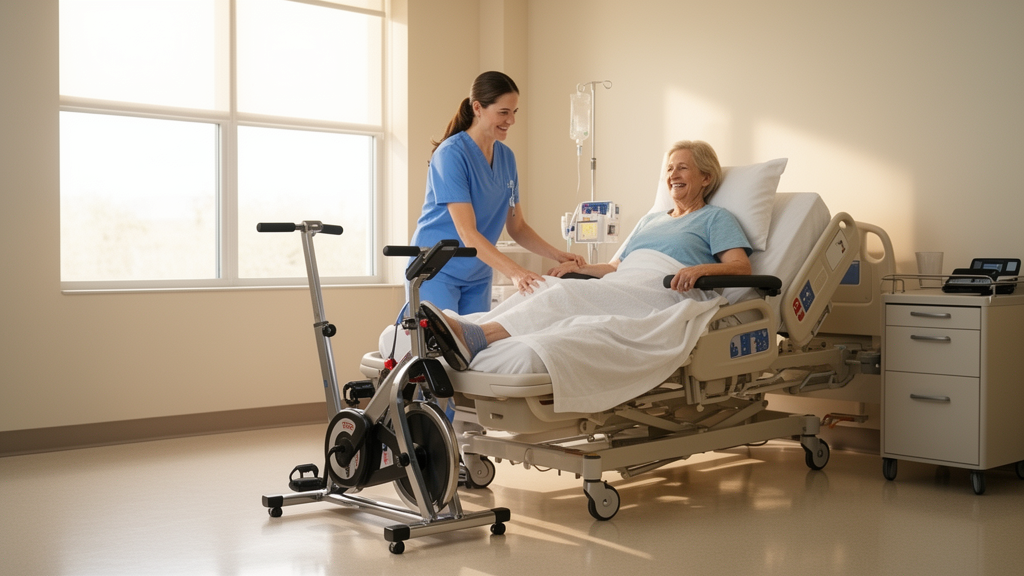
A randomized controlled clinical trial has demonstrated that adding bed pedaling exercises to an accelerated rehabilitation protocol significantly improves pain relief, knee mobility, muscle strength, and overall functional recovery following total knee replacement surgery. The parallel-group investigation, conducted by researchers evaluating postoperative care regimens, compared patients receiving both forward and backward bed pedaling alongside accelerated rehabilitation against those who underwent accelerated rehabilitation alone.
Total knee replacement represents the gold standard surgical intervention for end-stage osteoarthritis, yet conventional postoperative rehabilitation protocols have demonstrated limited clinical benefits. While accelerated rehabilitation protocols prioritize early mobilization to enhance postoperative recovery, pedaling-based therapies introduced during the acute recovery setup have shown potential to improve functional outcomes. The trial was designed to directly assess whether combining bed pedaling with accelerated rehabilitation provides superior improvements in knee pain, joint range of motion, muscle strength, swelling, and overall functional status.
The study enrolled 72 patients aged 45 to 70 years who were scheduled for primary unilateral total knee replacement between March 2025 and March 2026. Using block randomization with allocation concealment, investigators assigned participants equally into an experimental group of 36 patients and a control group of 36 patients. Both treatment cohorts initiated their designated postoperative rehabilitation protocols on day zero following surgery, while outcome assessors remained strictly blinded to group allocation throughout the trial.
Patients assigned to the experimental cohort performed bed pedaling consisting of both forward and backward rotations integrated into their accelerated rehabilitation regimen. In contrast, participants in the control cohort received accelerated rehabilitation exclusively.
The trial evaluated primary outcomes comprising knee pain, knee range of motion, knee flexor and extensor muscle strength, and localized knee swelling. Functional recovery served as the secondary outcome and was measured using the Western Ontario and McMaster Universities Osteoarthritis Index, known as the WOMAC score. Investigators evaluated all metrics at three predetermined time points: postoperative day 3, the day of hospital discharge on postoperative day 5, and at a 1-month follow-up evaluation, analyzing longitudinal data via two-factor repeated measures analysis of variance.
Over the complete evaluation timeframe, 33 participants in the experimental group and 34 participants in the control group completed the protocol follow-up. Repeated measures analysis revealed statistically significant advantages favoring the bed pedaling group across multiple recovery indicators, including reductions in pain (p < 0.001) and improvements in knee flexion range of motion (p < 0.001). Patients practicing bed pedaling also achieved significantly better outcomes in extension lag (p = 0.032), extensor muscle strength (p = 0.046), and composite WOMAC functional scores (p < 0.001).
Significant group differences were also recorded for knee swelling (p = 0.004), although investigators observed that while swelling decreased across both cohorts over time, the long-term resolution of swelling may not be entirely attributable to the pedaling intervention itself. In addition, knee flexor muscle strength improved at a comparable rate between the two groups, showing no statistically significant difference between treatments (p = 0.286).
The trial authors concluded that combining bed pedaling with accelerated rehabilitation offers distinct clinical benefits over accelerated rehabilitation alone by enhancing joint mobility, reducing pain, strengthening knee extensors, and accelerating functional recovery. Formally registered with the Clinical Trials Registry of India under identifier CTRI/2025/03/082973, the research supports the practical integration of bed pedaling exercises into standard accelerated rehabilitation pathways during the early postoperative phase.
Across the investigation, only two participants in the control group and three in the experimental cohort failed to complete the scheduled assessments, leaving 34 and 33 patients, respectively, for the final two-factor repeated measures analysis.
The addition of bed pedaling generated demonstrable gains in extensor strength and extension lag without altering flexor muscle development, which improved at an equivalent rate under accelerated rehabilitation alone. Furthermore, the investigators noted that while localized swelling differed significantly between trial arms, swelling progressively decreased across both patient cohorts over time, indicating that long-term swelling resolution cannot be solely credited to bed pedaling. Based on these distinctions, the authors concluded that integrating bed pedaling is primarily supported for the early postoperative period.
Subject of Research: Early postoperative bed pedaling combined with accelerated rehabilitation after total knee replacement
Article Title: Effectiveness of combined bed pedaling and accelerated rehabilitation versus accelerated rehabilitation alone after total knee replacement: a randomised controlled trial
Article References: Nagpal, S. K., Prabhakar, A. J., Eapen, C., D’souza, M. C., & D. Kamat, Y. (2026). Effectiveness of combined bed pedaling and accelerated rehabilitation versus accelerated rehabilitation alone after total knee replacement: a randomised controlled trial. BMC Musculoskeletal Disorders. https://doi.org/10.1186/s12891-026-10597-3
Image Credits: AI Generated
DOI: 10.1186/s12891-026-10597-3
Keywords: total knee replacement, accelerated rehabilitation, bed pedaling, knee osteoarthritis, randomized controlled trial, knee range of motion, Western Ontario and McMaster Universities Osteoarthritis Index, WOMAC, knee extensor strength, postoperative recovery, knee pain, extension lag, knee swelling, early mobilization, orthopedic rehabilitation, Clinical Trials Registry of India
News Source: Ophelia Keating. (November 12, 2026). Adding Bed Pedaling to Accelerated Rehabilitation Improves Total Knee Replacement Recovery. Scienmag.