Field trials conducted in South Korea demonstrate that the agronomic and carbon-sequestration benefits of agricultural residue biochar are governed primarily by baseline soil chemical properties, particularly initial soil pH, rather than application volume alone. Researchers evaluating pepper residue biochar in Chinese cabbage cultivation found that while the amendment enhanced both soil organic carbon stocks and crop yields under moderately acidic conditions, identical treatment levels in near-neutral soils produced diminishing carbon returns and early productivity declines. The findings, published in Applied Biological Chemistry, reveal that determining effective application rates requires calibrating biochar amendments against existing soil pH and electrical conductivity thresholds to avoid unintended nutrient precipitation or osmotic stress.
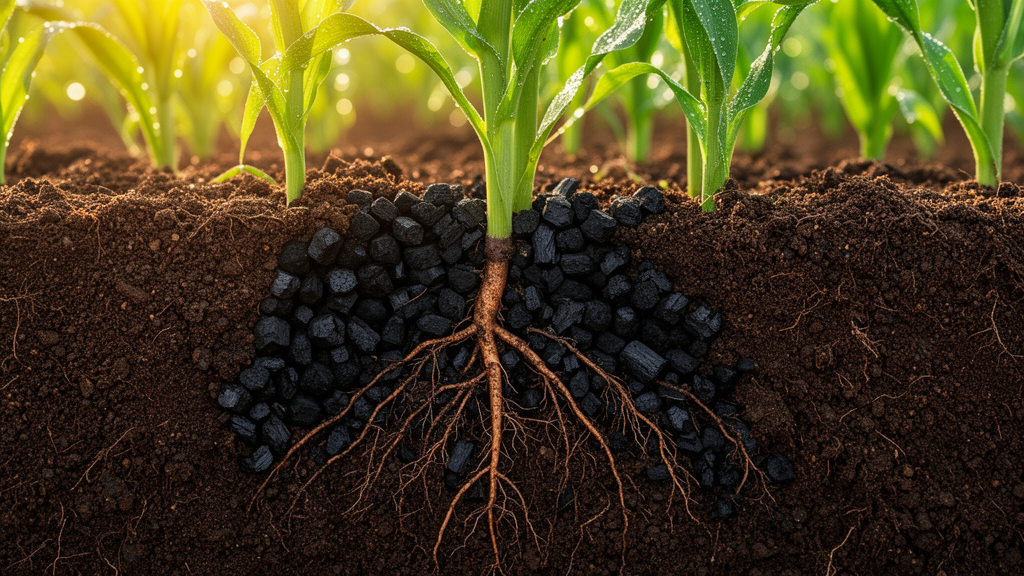
Biochar is a carbon-dense material generated via biomass pyrolysis at temperatures exceeding 350 degrees Celsius under oxygen-limited conditions, characterized by stable fused aromatic carbon rings that resist microbial degradation. While biochar has gained international attention as a climate change mitigation tool and soil conditioner capable of improving water retention, aeration, and nutrient retention, practical guidelines for agricultural deployment have often overlooked initial soil acidity. In South Korea, where biochar was formally recognized as a fertilizer category in national specifications in 2020 with standards governing total carbon, moisture, heavy metals, and pyrolytic stability ratios, systematic evaluations of crop-specific and soil-specific application thresholds remain sparse. Because pyrolysis generates alkaline compounds that give biochar an inherently high pH, incorporating the amendment alters existing chemical equilibria in divergent ways depending on starting soil properties.
To investigate these soil-dependent interactions, a research team led by Sin-Sil Kim, Yu-Na Lee, Kyeong-yeong Kim, Jae-Hong Shim, Seon-Ah Hwang, Sang-Ho Jeon, Ahn-Sung Roh, and Seong-Heon Kim evaluated red pepper residue, an abundant domestic agricultural by-product. The collected residues were dried at 70 degrees Celsius for more than 48 hours, mechanically crushed to particles measuring 2 to 3 centimeters, and pyrolyzed in an anaerobic kiln reactor purged with nitrogen gas at 10 pounds per square inch. Pyrolysis was maintained at 400 degrees Celsius for 2 hours to produce pepper residue biochar, designated as PRB. Laboratory characterization confirmed that PRB possessed an alkaline pH of 10.0, an electrical conductivity of 5.9 deciSiemens per meter, a total carbon content of 59.8 percent, and low molar ratios of hydrogen to carbon (0.7) and oxygen to carbon (0.4), alongside a porous surface matrix enriched with potassium, calcium, and magnesium.
The cultivation experiment was established in Wanju, South Korea, located at 35.824942 degrees North and 127.044875 degrees East, using Chinese cabbage (Brassica rapa L.) grown over a 90-day period from August 30 to November 30, 2024. The experimental field was partitioned into two distinct adjacent sections with identical climatic conditions but divergent historical management: Soil A, featuring an initial pH of 5.8, and Soil B, featuring a near-neutral initial pH of 6.8. Within each soil section, researchers implemented six treatments arranged in a randomized block design with three replications: an unfertilized control, an inorganic fertilizer treatment receiving total nitrogen, phosphate, and potassium at 32.0, 7.8, and 19.8 kilograms per 10 ares, and four combined treatments supplementing standard inorganic fertilization with PRB at rates of 100, 200, 300, and 500 kilograms per 10 ares.
Following harvest, comprehensive soil and plant analyses were performed in triplicate according to Rural Development Administration standard methods. Soil and biochar samples were air-dried and sieved to 2 millimeters prior to evaluating pH, electrical conductivity, and exchangeable cations extracted with 1 molar ammonium acetate. Soil organic matter was quantified using elemental analysis calibrated by a 1.724 conversion factor, available phosphate was measured through Lancaster extraction spectrophotometry at 720 nanometers, and soil organic carbon stock on an area basis was calculated from organic carbon concentration, soil bulk density, sampling depth, and coarse fragment fractions. Statistical comparisons across treatment groups were validated through analysis of variance and Duncan’s Multiple Range Test at a 5 percent significance threshold using SPSS 27.
Post-harvest soil chemistry revealed stark contrasts between the two soil regimes in response to PRB amendment. In acidic Soil A, soil pH rose steadily from an initial 5.8 up to 6.2 at the maximum biochar application rate of 500 kilograms per 10 ares, accompanied by significant increases in exchangeable calcium that assisted in neutralizing active soil acidity. Conversely, in Soil B, which began at pH 6.8, soil pH escalated rapidly to between 6.9 and 7.4 at lower biochar rates but exhibited limited further increases beyond 300 kilograms per 10 ares due to chemical equilibrium constraints and reduced net alkalinity generation in an already neutral environment. Concurrently, electrical conductivity in Soil A increased markedly by 1.4 to 2.9 deciSiemens per meter, whereas Soil B displayed a more buffered response, rising by only 0.8 to 1.1 deciSiemens per meter.
Phosphate dynamics and overall nutrient availability also responded divergently across the two baseline environments. Available phosphate in Soil A increased across all biochar additions relative to control values, climbing 29.7 percent from 323 milligrams per kilogram to 419 milligrams per kilogram under the highest application rate, though net accumulation was constrained by phosphate adsorption onto iron and aluminum oxides typical of acidic conditions. In Soil B, available phosphate peaked at 347 milligrams per kilogram under the 300 kilograms per 10 ares treatment, reflecting a 51.5 percent increase over its unamended baseline of 229 milligrams per kilogram, facilitated by high phosphate solubility between pH 6.0 and 7.0 where insoluble iron and aluminum complexes do not dominate. However, when biochar application in Soil B exceeded 300 kilograms per 10 ares, phosphate availability diminished as elevated soil alkalinity promoted calcium-phosphate precipitation.
Soil carbon sequestration assessments confirmed that PRB effectively transferred recalcitrant carbon into the soil profile, though storage efficiency depended on baseline chemistry. In Soil A, soil organic carbon stock expanded progressively with increasing biochar application, rising from a control baseline of 29.8 tonnes of carbon per hectare to 36.8 tonnes per hectare at 500 kilograms per 10 ares, representing a 23.5 percent overall increase. This stable accumulation was supported by the biochar’s condensed aromatic structure, evidenced by its hydrogen-to-carbon ratio of 0.7 and scanning electron microscopy showing 77.7 weight percent carbon content. In Soil B, soil organic carbon stocks increased up to 33.8 tonnes of carbon per hectare at 300 kilograms per 10 ares, but higher amendment rates yielded diminishing returns as carbon stabilization mechanisms reached saturation under alkaline conditions.
Crop productivity patterns showed clear upper limits to biochar amendment that diverged according to starting soil acidity. In Soil A, Chinese cabbage yield increased significantly under moderate biochar applications, peaking at 6,403 kilograms per 10 ares at the 300 kilograms per 10 ares rate, before dropping steeply to 4,414 kilograms per 10 ares when biochar was applied at 500 kilograms per 10 ares. In Soil B, cabbage yields showed only modest increases, peaking at 4,200 kilograms per 10 ares under 200 kilograms per 10 ares of biochar, before declining steadily at rates of 300 kilograms per 10 ares and above. Across both soils, application rates exceeding 300 kilograms per 10 ares induced productivity penalties driven by distinct chemical mechanisms, including root-zone osmotic stress where electrical conductivity exceeded cabbage tolerance thresholds and nutrient lockup under excessive alkalinity.
Synthesizing both agronomic performance and carbon sequestration outcomes, the authors concluded that an intermediate application rate of 200 to 300 kilograms per 10 ares provided the most balanced management window under the conditions tested. Because pepper residue biochar demonstrated greater agronomic enhancement and sustained carbon storage in the moderately acidic soil compared to the near-neutral soil, the study underscores that biochar efficacy cannot be treated as universally dose-dependent. Instead, agricultural carbon management programs must incorporate site-specific baseline soil testing, accounting for initial pH, buffering capacity, and background salinity, before determining amendment rates to optimize crop yields alongside long-term soil carbon sequestration.
Subject of Research: Soil pH dependence of biochar amendment for crop yield and carbon sequestration
Article Title: Optimizing biochar use under different soil pH conditions for sustainable crop production and soil carbon sequestration
Article References: Kim, S.-S., Lee, Y.-N., Kim, K.-Y., Shim, J.-H., Hwang, S.-A., Jeon, S.-H., Roh, A.-S., & Kim, S.-H. (2026). Optimizing biochar use under different soil pH conditions for sustainable crop production and soil carbon sequestration. Applied Biological Chemistry, 69(1), Article 46. https://doi.org/10.1186/s13765-026-01092-3
Image Credits: AI Generated
DOI: 10.1186/s13765-026-01092-3
Keywords: Biochar, Soil pH, Carbon Sequestration, Chinese Cabbage, Soil Chemistry, Agricultural Residues, Crop Yield, Soil Management, Optimizing, under, different, soil
News Source: Bethany Barker. (November 12, 2026). Baseline Soil pH Determines Optimal Biochar Application for Crops and Carbon. Scienmag.