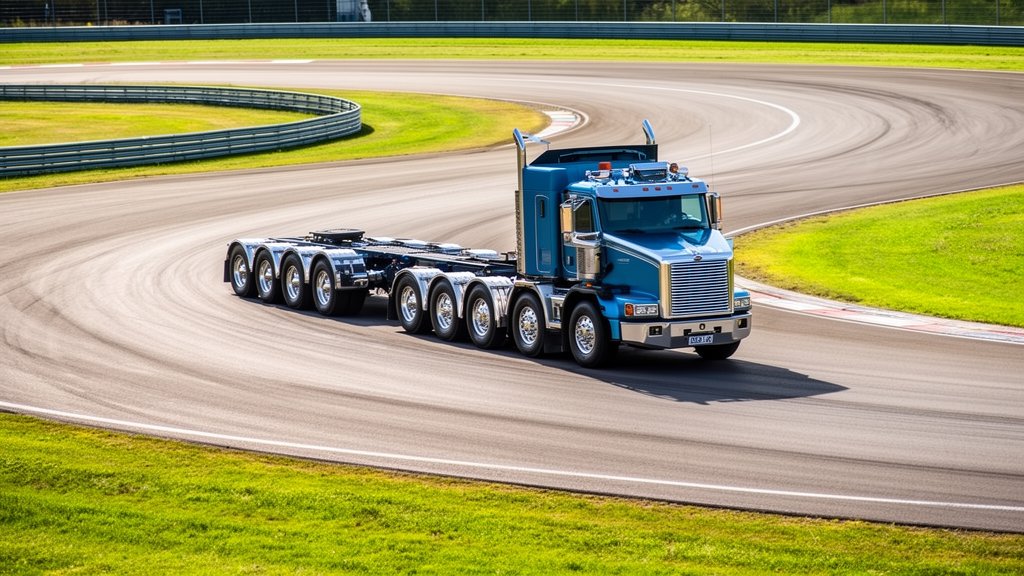
These expansive coupled vehicles, frequently deployed to convey exceptionally bulky or heavy industrial equipment, combat hardware, and agricultural machinery, are inherently prone to hazardous dynamic instabilities, including trailer sway, severe jackknifing, off-tracking discrepancies, and rearward oscillation amplification. By combining differential flatness theory, local Taylor-series Jacobian linearization, and sequential algebraic Riccati equation solutions, the proposed framework establishes guaranteed closed-loop stability while significantly curbing actuator energy expenditure during autonomous path tracking.
The core mechanical structure analyzed in the study comprises two separate truck-and-trailer units coupled back-to-back through passive revolute joints, forming an articulated multi-vehicle train engineered for cooperative heavy hauling. In this specialized arrangement, propulsion and steering are distributed across the assembly: a leading tractor unit provides primary forward traction while steering wheels situated at the front of the lead truck and at the tail end of the rear trailer provide coordinated directional guidance. Intermediate tractor units can also be integrated along the articulation chain to bolster steering precision and circumvent road obstacles. However, the resulting physical system exhibits intense structural nonlinearities and underactuation, wherein four directional and propulsive control inputs must orchestrate ten distinct coupled state variables. Without robust automated coordination, the high center of gravity, elevated wheelbase-to-track ratios, and uneven axle load distributions characteristic of these platforms severely jeopardize road safety.
To mathematically characterize the coupled platform without oversimplifying its structural kinematics, the investigators developed a continuous-time, driftless state-space model that is affine in the control inputs. The complete system state vector encompasses ten continuous variables: planar Cartesian coordinates defining position, three steering angles distributed across the articulation structure, and five distinct heading and articulation angles that dictate trailer alignment. The control input vector consists of four operational signals, specifically the primary longitudinal velocity drive alongside three independent steering rate commands. Rather than attempting ad-hoc coordinate transformations, the researchers demonstrated that this intricate multi-body kinematics is strictly differentially flat. Under differential flatness, all ten system state variables and all four actuator control inputs can be expressed analytically as differential functions of four fundamental flat outputs, precisely identified as the lead planar coordinates and two key articulation angles.
Proving differential flatness represents a crucial theoretical milestone in the authors’ control methodology because it resolves the intricate task of defining coherent trajectory setpoints for an underactuated multi-trailer chain. Because the flat outputs fully dictate the evolution of the remaining kinematic states without violating physical constraints, operational engineers can prescribe unconstrained, smooth reference paths for the designated flat outputs while deriving the corresponding setpoints for all other articulation angles and steering rates through exact differential mappings. This mathematical property inherently proves the functional controllability of the coupled-vehicle system. In addition, under the realistic operational assumption that back-to-back trailers remain approximately aligned during highway cruising and controlled maneuvers, the governing differential equations simplify into tractable trigonometric relations, allowing the direct calculation of trailer orientations and steering inputs without resorting to complex dynamic extensions or iterative numerical inversions.
To circumvent the persistent mathematical intractability of calculating global optimal feedback laws for high-dimensional nonlinear equations, the research team implemented an adaptive, instantaneous linearization routine executed at each control sampling step. Unlike conventional linearization techniques that expand system matrices around a precomputed, idealized nominal trajectory, this methodology executes a first-order Taylor series expansion directly around a temporary operating point defined by the current measured state vector and the most recently applied control vector. By calculating the analytical Jacobian matrices with respect to the ten-dimensional state space at every discrete time step, the system dynamically generates an equivalent linear state-space model. Because the operating point continuously tracks the vehicle’s real-time kinematic state, the expansion horizon remains exceptionally tight, rendering higher-order truncation errors negligible perturbations that are subsequently compensated by the intrinsic robustness of the feedback controller.
Building upon the continuously updated linear state-space approximation, the researchers formulated an optimal H-infinity feedback controller structured around a min-max differential game. In this mathematical formulation, the four control inputs act as an optimizing player striving to minimize a quadratic performance cost functional that penalizes state trajectory tracking errors and excessive actuator actuation effort. Concurrently, an opposing virtual player represents unmodeled dynamics, Taylor-series truncation errors, and external road perturbations, striving to maximize the tracking penalty in the worst conceivable manner. The analytical resolution of this competitive differential game yields an optimal linear state-feedback gain matrix derived directly from the unique positive-definite symmetric solution of a modified algebraic Riccati equation, which the onboard processor re-solves at every discrete sampling interval of the navigation control loop.
The mathematical rigor of the control design is substantiated through a comprehensive Lyapunov stability analysis, demonstrating that the five-axle vehicle system achieves rigorous H-infinity tracking performance criteria alongside asymptotic convergence. By constructing a quadratic Lyapunov candidate function weighted by the positive-definite Riccati matrix, the authors established that the time derivative of the Lyapunov function remains strictly upper-bounded under external disturbance inputs. Utilizing algebraic bounding lemmas and Barbalat’s lemma, the analysis proves that provided the cumulative external disturbances possess finite energy over an infinite time horizon, the state tracking errors are strictly bounded and asymptotically converge to zero. Furthermore, tuning the disturbance attenuation coefficient below a mathematically specified threshold guarantees that the Lyapunov derivative remains negative, providing provable global closed-loop stability without relying on localized linearization assumptions or heuristic parameter tuning.
Recognizing that real-world operational heavy vehicles cannot accommodate complete sensor instrumentation across all articulation joints and wheels, the researchers integrated an H-infinity Kalman filter to achieve robust state estimation from sparse sensor data.
The authors subjected the integrated control architecture to an extensive battery of eight distinct simulation experiments, evaluating complex trajectory-following scenarios under rigorous numerical conditions. The simulated five-axle coupled configuration was parameterized with realistic mechanical dimensions, including axle spacing lengths of one meter and two meters across the multi-trailer chassis. Visualized simulation traces corroborated that the estimated kinematic states generated by the H-infinity Kalman filter tracked the true system states with negligible delay, while state trajectories converged swiftly toward their flat-output-derived setpoints.
Detailed tabular evaluations within the research paper further quantified tracking accuracy, convergence duration, and disturbance resilience across ideal and corrupted operational regimes. Comparative convergence metrics demonstrated that adjusting the penalization weight on control effort eliminated steady-state offset, whereas increasing the diagonal elements of the state error weighting matrix accelerated tracking convergence.
In evaluating their design against established nonlinear control paradigms, the investigators highlighted decisive structural advantages over Nonlinear Model Predictive Control, sliding-mode control, and Lie-algebraic global linearization. Unlike global feedback linearization, which requires dynamic state extension and complex diffeomorphic coordinate transformations that frequently suffer from mathematical singularities during inverse mapping, the present technique operates directly on natural physical coordinates without changing state variables. Unlike standard Nonlinear Model Predictive Control, which demands intensive online non-convex optimization subject to local minima and empirical parameter initialization, the sequential algebraic Riccati approach guarantees global stability and executes well within standard discrete sampling intervals. By eliminating the necessity for canonical strict-feedback forms demanded by backstepping or ad-hoc sliding surface selection, this formulation provides an efficient, provably stable control foundation for the next generation of autonomous multi-articulated freight haulers.
Subject of Research: Nonlinear optimal control and trajectory tracking for multi-axle multi-steered coupled vehicle systems
Article Title: Nonlinear optimal control for the five-axle and three-steering coupled-vehicle system
Article References: Rigatos, G., Abbaszadeh, M., Busawon, K., Siano, P., Al Numay, M., Cuccurullo, G., & Zouari, F. (2025). Nonlinear optimal control for the five-axle and three-steering coupled-vehicle system. Autonomous Intelligent Systems, 5(1), Article 10. https://doi.org/10.1007/s43684-025-00097-x
Image Credits: AI Generated
DOI: 10.1007/s43684-025-00097-x
Keywords: nonlinear optimal control, coupled vehicle systems, five-axle vehicles, multi-steering systems, differential flatness, H-infinity control, algebraic Riccati equation, Lyapunov stability, autonomous navigation, heavy-duty transport, kinematic modeling, H-infinity Kalman filter, state estimation, trajectory tracking, Jacobian linearization, min-max differential game
News Source: Denise Maddox. (November 12, 2026). Nonlinear Optimal Control Stabilizes Heavy Five-Axle Articulated Multi-Steering Vehicles. Scienmag.