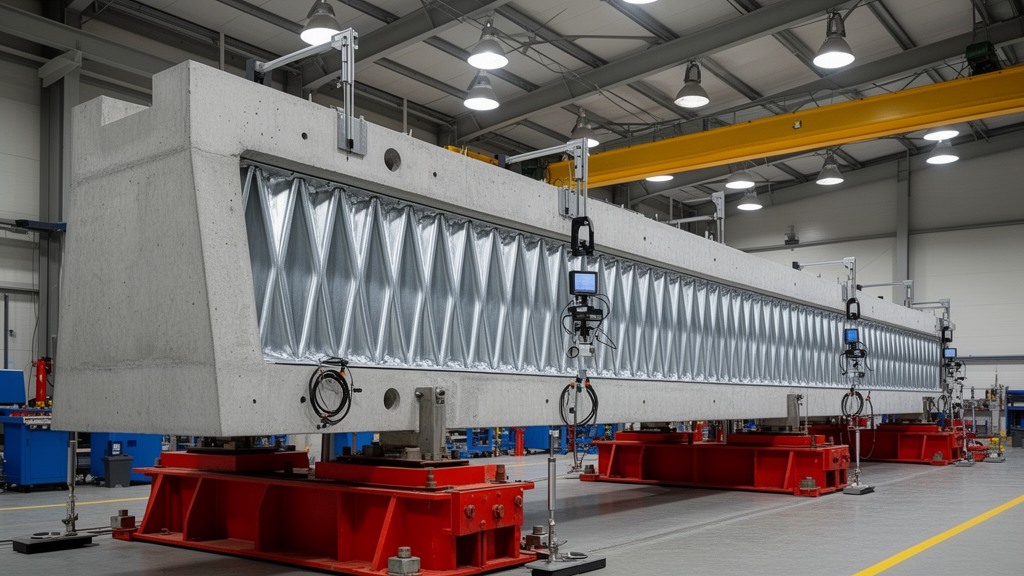
A comparative structural investigation has revealed that continuous precast segmental composite box girders with corrugated steel webs perform almost identically to conventional cast-in-place beams during initial elastic loading, but diverge sharply once cracking initiates under heavy transverse stress. Conducted through static testing of two large-scale variable cross-section beam specimens, the study demonstrated that while fabrication methods produce negligible differences in initial stiffness, deformation, and strain distribution, post-cracking mechanics follow fundamentally distinct evolutionary paths. The precast segmental assembly exhibited a twenty-five percent faster crack width growth rate and a thirty-five percent greater deflection progression rate after cracking compared to the cast-in-place baseline specimen. Crucially, the ultimate failure mechanisms differed: the monolithically poured cast-in-place beam failed through shear cracking within the concrete slabs at mid-span accompanied by side web buckling, whereas the precast segmental beam reached failure through joint opening at its critical segment connections, highlighting how segmented joints alter internal load redistribution paths.
Composite box-beam bridge structures incorporating thin corrugated steel webs have increasingly evolved toward larger main spans, multi-chamber configurations, and extended cantilever decks to accommodate growing modern transportation demands. In traditional prestressed concrete box girders, self-weight remains substantial, prestress efficiency is often limited, and concrete webs are prone to shear cracking and seismic vulnerability. Substituting thick concrete webs with corrugated steel sheets substantially decreases the total volume of concrete, lowering deadweight and project costs while utilizing the high compressive capacity of concrete slabs and the superior shear resistance of steel webs. This hybrid configuration improves industrial prefabrication potential, energy efficiency, and seismic performance compared to standard concrete bridges. However, as bridge cross-sections widen and span lengths increase, cross-sectional distortion and the specific jointing methods used in precast construction exert complex transverse stresses across bridge decks that cannot be neglected during structural design and safety assessments.
Precast segmental cantilever assembly traces back to landmark structures such as the Choisy-Le-Roi Bridge erected in Paris in 1962, followed by widespread adoption across international railway, highway, and municipal viaduct networks since the late twentieth century. Recent engineering initiatives have increasingly coupled precast segmental techniques with corrugated steel web composite bridge configurations to capture both rapid over-water construction timelines and material efficiency. The experimental baseline for this research was drawn from the engineering background of the Jiangxinzhou Yangtze River Bridge in Nanjing, China, a three-span continuous prestressed concrete girder bridge with corrugated steel webs featuring a main span of seventy-eight meters. Located along a vital navigable river channel, such structures require strict lightweighting to reduce heavy hoisting demands while accelerating on-site erection to minimize navigation disruptions, making precise knowledge of segmental joint integrity under transverse and eccentric wheel loads paramount for structural reliability.
To evaluate these transverse mechanical behaviors, researchers designed two bridge girder specimens with corrugated steel webs and identical geometric profiles, one constructed via monolithic casting and the other using precast segment assembly. Each continuous beam spanned a total length of 9.6 meters, configured in a three-span arrangement measuring 2.3 meters for the first side span, 5.0 meters for the mid-span, and 2.3 meters for the second side span, with a 200-millimeter overhang past the end supports. The cross-section varied along a parabolic curve on the bottom plate, creating a structural height of 700 millimeters over the middle interior supports that transitioned to 500 millimeters at mid-span. The top concrete slab measured 1500 millimeters wide, while the bottom concrete slab measured 1080 millimeters wide. The precast specimen was divided longitudinally into thirteen distinct segments, comprising standard 750-millimeter units, an 800-millimeter mid-span closure block, 1100-millimeter segments over internal supports, and 500-millimeter segments at end supports.
Internal structural stabilization and tendon routing were achieved through eight transverse diaphragms placed across internal supports, mid-span quarter sections, side-span centers, and beam ends. A hybrid prestressing system combined two internal prestressed tendons threaded through the top and bottom concrete slabs with two external prestressed tendons routed inside the steel-web cell, steered through the middle diaphragms and anchored at end diaphragms. The tendons utilized 15.24-millimeter nominal diameter steel strands possessing a standard tensile strength of 1860 megapascals and an elastic modulus of 195 gigapascals. The beam slabs were cast from C40 concrete, exhibiting an average cubic compressive strength of 45.69 megapascals and a modulus of 3.314 gigapascals, reinforced with HRB335 steel bars having a yield strength of 335 megapascals. The corrugated steel webs were pressed from 4-millimeter-thick Q345 steel plates with a wavelength of 300 millimeters, wave height of 50 millimeters, wave angle of 37 degrees, straight section of 80 millimeters, and horizontal projection of 70 millimeters, anchored into concrete slabs via embedded plug-in connections.
Fabrication of the precast segmental model mirrored industrial match-casting practices to ensure precision matching between adjoining concrete slabs, webs, and internal diaphragms before transport. On-site segment assembly utilized alignment guiding devices maintaining positioning deviations within two millimeters. Joint faces between segments were uniformly coated with a 3-millimeter-thick layer of CMRB-A/B epoxy resin structural adhesive, an adhesive exhibiting high thixotropy, a tensile strength of 48.7 megapascals, and an elastic modulus of 8570 megapascals. Temporary prestressing applied via center-hole jacks compressed the fresh adhesive joints under 0.2 to 0.3 megapascals of sustained pressure for twenty-four hours during curing. After curing, internal permanent tendons were tensioned along a bottom-slab-first, top-slab-later sequence to a controlled stress of 0.75 times nominal tensile strength, followed by external tendon tensioning. Full-penetration welding joined the corrugated steel web segments with ultrasonic testing confirming weld strength exceeding the parent metal, after which temporary supports were unloaded within a deflection limit of one two-thousandth of the span.
The experimental loading sequence tested the beams across five distinct static scenarios: single-point symmetrical loading at mid-span, single-point eccentric loading at mid-span, single-point symmetrical loading at side-span, single-point eccentric loading at side-span, and single-point eccentric loading driven to ultimate failure at mid-span. Hydraulic oil jacks and manual units applied concentrated loads to distribution beams and top slabs, while reaction frames accommodated side-span setups. Structural responses were captured by extensive instrumentation arrays. Displacement monitoring utilized electronic meters positioned at the mid-span, mid-span quarter, and side-span control sections across top slabs, bottom slabs, and side webs. Transverse and longitudinal concrete strains were recorded by matrix arrays of resistance strain gauges across thirteen rows at mid-span and seven rows along the side-span, spaced at 200-millimeter and 250-millimeter intervals, with seven transverse measuring stations labeled A through G spaced across the flange tip, web junctions, and box center.
During elastic loading below 200 kilonewtons, both the segmental and cast-in-place beams exhibited closely aligned structural stiffness, deflection trajectories, and strain distributions. Vertical deflections grew linearly with increasing load, recovering completely to original datums upon unloading, with the fastest deflection rate occurring at mid-span and the slowest along the side spans. Across transverse strain stations, both girders demonstrated identical distribution profiles: symmetrical loading produced peak compressive strains at the central measuring station that transitioned toward tensile strain near the outer web edges, while eccentric loading concentrated maximum compressive strain directly beneath the loading point and peak tensile strain across the opposite web. Under 200 kilonewtons of symmetrical load, transverse compressive strain at the box centerline was negative 81.2 microstrain in the segmental beam and negative 73.5 microstrain in the integral beam, representing a minor 10.5 percent variation. These measurements confirmed that uncracked epoxy joint interfaces and welded web seams effectively transfer shear forces without compromising elastic integrity.
Significant divergence manifested once loading pushed the girders past their elastic thresholds into plastic cracking. The segmental girder experienced its first transverse crack along the bottom plate at 420 kilonewtons with a crack width of 0.235 millimeters, whereas the monolithic integral beam resisted cracking until reaching 520 kilonewtons with an initial crack width of 0.221 millimeters. As loading intensified beyond 650 kilonewtons, bottom plate cracking accelerated substantially in the precast beam. At 800 kilonewtons, segmental crack widths reached 1.41 millimeters as concrete tensile capacity exhausted, widening to 2.43 millimeters at 1000 kilonewtons. By contrast, the cast-in-place beam developed a dense network of finer cracks distributed widely across the mid-span region, not forming a penetrating bottom slab crack until 1100 kilonewtons at 2.942 millimeters. At ultimate capacity, the integral beam suffered side web shear buckling and concrete spalling at 7.132 millimeters maximum crack width, whereas the segmental girder emitted loud joint debonding sounds at 1340 kilonewtons, displaying a maximum residual crack width of 6.93 millimeters upon unloading.
This damage progression culminated in notable stiffness degradation and strain divergence between the two construction techniques. Final mid-span deflection reached 40.9 millimeters in the integral girder, whereas the segmental girder deflected to 63.4 millimeters, a 1.5-fold increase directly attributable to joint opening that reduced bending stiffness. While transverse strain distributions remained geometrically similar across both beams, the precast specimen exhibited a twelve to fifteen percent faster rate of transverse strain accumulation throughout the plastic stage. Beyond 1180 kilonewtons, strain differences between the two systems consistently exceeded ten percent, with the segmental girder sustaining 14.3 percent higher tensile strains and 11.8 percent higher compressive strains than the monolithic girder at identical loads. The researchers noted that while joint slip remained negligible throughout testing, future bridge designs must account for localized stress concentrations at precast segment interfaces by incorporating enhanced transverse joint detailing, increased web stiffness, and targeted monitoring to maintain long-term serviceability and fatigue resistance.
Subject of Research: Comparative transverse mechanical performance and failure modes of precast segmental and cast-in-place composite box beams with corrugated steel webs
Article Title: Transverse mechanical performance of precast segmental box beam with corrugated steel webs
Article References: Zhao, P., Rong, X., Shao, X., WEI, Y., & Huang, Y. (2026). Transverse mechanical performance of precast segmental box beam with corrugated steel webs. Advances in Bridge Engineering, 7(1), Article 13. https://doi.org/10.1186/s43251-025-00202-3
Image Credits: AI Generated
DOI: 10.1186/s43251-025-00202-3
Keywords: bridge engineering, corrugated steel webs, precast segmental girders, box beam, transverse mechanical performance, joint opening, crack propagation, structural testing, Transverse, mechanical, performance, precast
News Source: Denise Maddox. (November 12, 2026). Precast Segmental Corrugated Steel Web Bridges Face Divergent Post-Cracking Deformation. Scienmag.