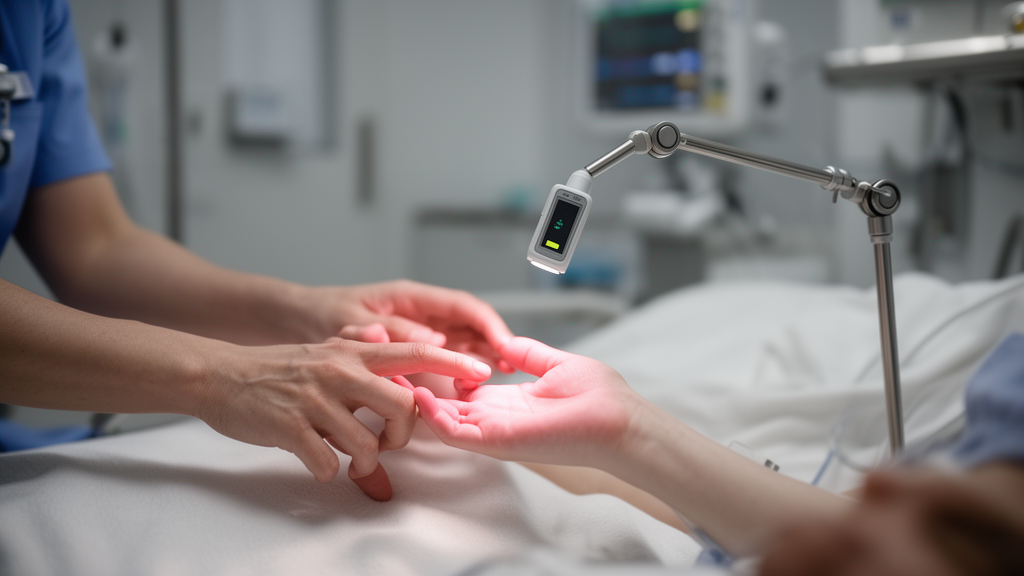
A video-based software platform significantly improves the reproducibility and precision of capillary refill time measurements in critically ill patients compared with standard visual assessments by clinicians, according to findings from a single-center observational study published in Critical Care. Capillary refill time serves as a simple marker of peripheral perfusion, but traditional visual evaluation by bedside healthcare providers has frequently suffered from limited reproducibility.
To address these assessment challenges, researchers evaluated the diagnostic performance and consistency of the YesReCan software platform for semi-automated, video-based capillary refill time analysis.
The standardized recordings were evaluated both by trained clinicians using standard visual review and through the semi-automated software approach. Researchers assessed measurement reproducibility by calculating intra-observer and inter-observer intraclass correlation coefficients, while also quantifying measurement agreement, analytical precision, and the ability to detect prolonged capillary refill time, defined as a duration exceeding 3 seconds.
The semi-automated video analysis demonstrated markedly higher reproducibility than human clinician evaluation. For intra-observer reproducibility, the software approach attained an intraclass correlation coefficient of 0.945 with a 95 percent confidence interval of 0.837 to 0.995, compared with 0.640 and a 95 percent confidence interval of 0.474 to 0.765 for visual clinician assessment. Inter-observer reproducibility showed a similar disparity, with the software achieving an intraclass correlation coefficient of 0.992 (95 percent confidence interval, 0.985 to 0.997) compared with 0.603 (95 percent confidence interval, 0.428 to 0.736) for clinician reviewers.
Measurement precision also favored the digital system, exhibiting a relative least significant change of 40.7 percent (95 percent confidence interval, 11.7 to 66.9 percent) for single measurements, compared with 74.7 percent (95 percent confidence interval, 56.1 to 89.1 percent) observed among clinicians. In evaluating overall concordance, the agreement between the software platform and clinician assessment was moderate, yielding a concordance correlation coefficient of 0.689 with a 95 percent confidence interval of 0.533 to 0.772.
The software maintained strong diagnostic discrimination for detecting prolonged refill times exceeding 3 seconds, achieving an area under the receiver operating characteristic curve of 0.885 with a 95 percent confidence interval of 0.785 to 0.962. The research team concluded that video-based capillary refill time measurement substantially improves analytical consistency and precision while preserving diagnostic utility, though they noted that prospective external validation in larger multicenter cohorts remains necessary prior to broad clinical adoption.
Subject of Research: Video-based capillary refill time measurement in critically ill patients
Article Title: YesReCan software-based capillary refill time measurement improves reproducibility compared with clinician assessment in critically ill patients
Article References: Brosse, T., Lorteau, C., Vieira, A., Fellahi, J.-L., Bidar, F., Ruste, M., & Jacquet-Lagrèze, M. (2026). YesReCan software-based capillary refill time measurement improves reproducibility compared with clinician assessment in critically ill patients. Critical Care. https://doi.org/10.1186/s13054-026-06295-0
Image Credits: AI Generated
DOI: 10.1186/s13054-026-06295-0
Keywords: capillary refill time, YesReCan software, critically ill patients, peripheral perfusion, video-based assessment, reproducibility, intraclass correlation coefficient, measurement precision, least significant change, critical care monitoring, prolonged capillary refill, concordance correlation coefficient, diagnostic performance, area under the curve, intensive care unit, observational study, semi-automated measurement, clinical assessment reproducibility
News Source: Ophelia Keating. (November 12, 2026). Software Improves Capillary Refill Time Measurement Reproducibility in Critically Ill Patients. Scienmag.