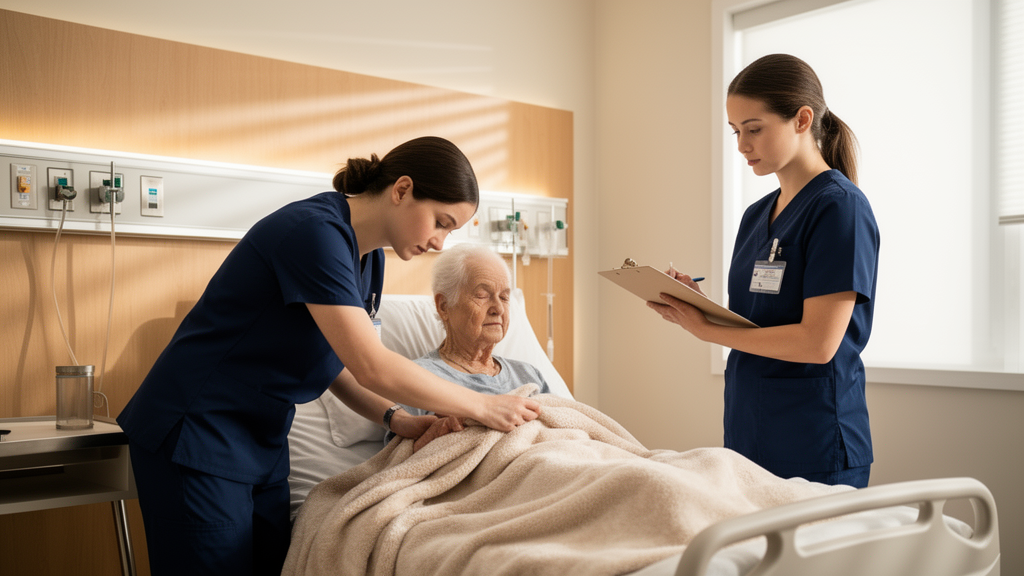
A single-session educational model combining structured reflection and scenario simulation was associated with higher immediate caring ability and theoretical knowledge scores among first-year undergraduate nursing students, according to a mixed methods study published in BMC Medical Education. The investigation evaluated an instructional framework that incorporated 3C-guided reflection—addressing Context, Content, and Course—alongside simulated clinical scenarios to cultivate humanistic care competencies. Researchers observed that students participating in the multicomponent intervention achieved higher post-intervention scores across evaluated caring domains compared to peers receiving standard theoretical instruction, while qualitative interviews offered complementary perspectives on the learners’ experiences during the classroom activities.
The researchers grounded the inquiry in reflective practice theory, emphasizing that humanistic care represents an essential component of nursing practice that directly influences patient health outcomes. Because undergraduate nursing students constitute the future clinical healthcare workforce, the authors noted that cultivating humanistic care competencies serves as an educational responsibility rather than an exclusively clinical concern. However, existing educational training models frequently encounter structural challenges, most notably a persistent disconnection between classroom theoretical concepts and applied clinical practice. To address this educational gap, the investigative team developed and evaluated an integrated pedagogical approach intended to bridge classroom instruction and practical humanistic engagement.
Conducted as a sequential explanatory mixed methods investigation, the quantitative phase employed a cluster randomized trial involving all seven intact classes of first-year nursing students at a medical university located in Guizhou Province. The study sample encompassed a total of 350 undergraduate students who were assigned at the class level using a random number table. Four intact classes comprising 200 participants were allocated to the multicomponent intervention group, while the remaining three intact classes comprising 150 participants were assigned to the control group, ensuring that entire classroom cohorts remained intact during instructional delivery.
The educational intervention consisted of a single, integrated 160-minute classroom-based session structured into four consecutive 40-minute components: theoretical instruction, scenario simulation, 3C-guided reflection, and concluding summary and assessment activities. In contrast, the control group participated in a conventional 160-minute instructional session centered on traditional theoretical teaching methods alongside corresponding assessment activities. Across both cohorts, evaluators administered measurement instruments immediately following the completion of the instructional sessions to assess knowledge acquisition and self-reported caring capacities.
To measure educational outcomes, the researchers utilized the self-report Caring Ability Inventory, standardized theoretical knowledge tests, and student satisfaction questionnaires. Quantitative analyses were conducted using linear mixed-effects models that accounted for class-level clustering, with Caring Ability Inventory models incorporating additional adjustments for baseline scores. Students in the multicomponent intervention group achieved an adjusted mean Caring Ability Inventory score that was 19.68 points higher than that of the control group, with a 95% confidence interval ranging from 17.04 to 22.33 points, a standardized effect size of 1.65, and a statistically significant difference of P < 0.001. Higher self-reported scores were also documented across all three instrument subscales, designated as Understanding, Courage, and Patience.
In addition to the self-reported caring inventory outcomes, the intervention cohort demonstrated higher immediate post-intervention theoretical knowledge performance, yielding a mean difference of 4.80 points relative to the control group, with a 95% confidence interval of 0.72 to 8.88 points and a significance value of P = 0.021. Overall learner evaluations regarding the multicomponent format were documented as generally favorable. Following the quantitative phase, the team purposively selected 40 nursing students from the intervention arm to complete semi-structured, in-depth qualitative interviews, which were analyzed thematically to explore their reflective learning experiences.
The thematic qualitative analysis identified four core themes describing the participants’ internal progression: empathy awakening, cognitive reconstruction through structured reflection, courage cultivation, and a conceptual shift toward professional caring. These qualitative insights provided supplementary depth regarding how students processed simulated clinical interactions and articulated emotional development. Nonetheless, the authors underscored that the study’s sequential explanatory mixed methods design cannot establish long-term causality or demonstrate sustained competency retention over extended periods of clinical training.
The study team also emphasized critical analytical limitations inherent to the research structure. Because the 160-minute intervention combined scenario simulation, theoretical teaching, and guided reflection within a single multicomponent package, the independent educational contribution of the 3C-guided reflection component cannot be determined. Furthermore, the quantitative findings reflect immediate post-session measurements based primarily on self-reported survey inventories rather than objective behavioral observations. The authors concluded that the proposed experience–reflection–abstraction learning cycle warrants further exploration through multi-center, longitudinal studies incorporating objective clinical assessments to evaluate sustained humanistic care performance.
Subject of Research: Humanistic care education using 3C-guided reflection and scenario simulation in nursing
Article Title: 3C-guided reflection combined with scenario simulation for humanistic care education among nursing students: a mixed methods study
Article References: Ma, L., Luo, J., Li, C., Wang, Y., Su, Q., Luo, L., Liu, R., Ran, H., Chen, Y., Hu, Q., Huang, L., & Zeng, H. (2026). 3C-guided reflection combined with scenario simulation for humanistic care education among nursing students: a mixed methods study. BMC Medical Education. https://doi.org/10.1186/s12909-026-10758-x
Image Credits: AI Generated
DOI: 10.1186/s12909-026-10758-x
Keywords: humanistic care, nursing education, scenario simulation, 3C-guided reflection, reflective practice theory, Caring Ability Inventory, undergraduate nursing students, cluster randomized trial, sequential explanatory design, linear mixed-effects models, empathy awakening, cognitive reconstruction, courage cultivation, theoretical knowledge assessment, medical education, professional caring, Guizhou Province
News Source: Courtney Benton. (November 12, 2026). Reflective Scenario Simulation Linked to Higher Immediate Caring Scores in Nursing Students. Scienmag.