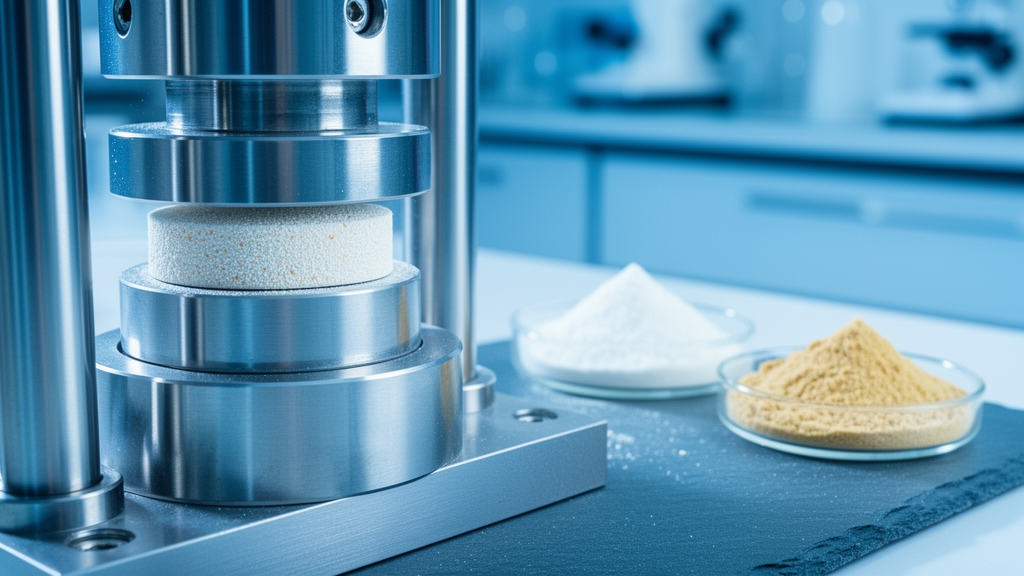
However, systematic investigations into compaction physics have revealed a counterintuitive behavior termed the tabletability flip phenomenon, wherein a solid form with inferior neat tabletability unexpectedly surpasses its more plastic counterpart once combined with the same excipient.
Bonding area depends heavily on the mechanical deformation properties of the material, its characteristic particle dimensions, environmental moisture content, and the dynamic operational parameters applied during compression, while bonding strength reflects the fundamental nature and magnitude of interparticulate molecular interactions. Because plastically deforming materials undergo extensive permanent deformation under applied load, conventional wisdom dictated that softer, highly plastic active pharmaceutical ingredients would naturally form larger bonding areas and consequently superior compacts. When drug candidates exhibit poor intrinsic tabletability in pure powder screening, formulation teams frequently discard otherwise viable polymorphs or solid forms due to anticipated manufacturing failures. The systematic research conducted by doctoral researcher Zijian Wang under the supervision of Professor Changquan Calvin Sun at the University of Minnesota addressed this screening risk by formulating a comprehensive framework encompassing experimental identification, mechanistic physics, mathematical prediction, and engineering remediation.
To determine the generality of the tabletability flip phenomenon, initial investigations systematically evaluated compaction behavior across multiple distinct pharmaceutical powder systems. Compaction testing across all six model systems consistently demonstrated the appearance of the tabletability flip phenomenon, confirming that neat tabletability rankings failed to predict mixture behavior. In each experimental model, the formulation containing the less plastic active pharmaceutical ingredient surpassed the mechanical strength of the formulation prepared with the more plastic active substance under identical tableting conditions.
Following confirmation of its broad occurrence, the research program explored the fundamental micromechanical origins of the phenomenon by examining compaction physics across particulate systems exhibiting contrasting mechanical properties. Relying on the foundational interplay model balancing bonding area against bonding strength, the researchers formulated and systematically evaluated two distinct mechanistic hypotheses to explain how excipient blending alters relative compact strength.
The first confirmed mechanism operates through a bonding area dominating pathway that arises when a ductile excipient possesses mechanical plasticity comparable to that of the softer active pharmaceutical ingredient. Under compaction pressure within this regime, the excipient particles establish relatively flat planar contact surfaces against the equally compliant, softer drug particles. Conversely, when the same ductile excipient compresses against significantly harder, less plastic drug particles, the excipient undergoes extensive localized plastic flow, effectively enveloping the rigid crystalline surfaces. Direct visual evidence of particle deformation in binary particulate mixtures substantiated this physical mechanism, demonstrating that compacts containing the harder active substance achieved a significantly larger total interparticulate bonding area than those formulated with the softer drug substance.
The second operational pathway identified by the researchers centers on a bonding strength dominating mechanism, which governs compaction behavior when an excipient exhibits mechanical plasticity substantially higher than both investigated active pharmaceutical ingredient forms. In this mechanical regime, the ultra-soft excipient readily yields under applied tableting stress and completely envelops both soft and hard drug particles, producing comparable total interparticulate bonding areas across both formulated systems. However, despite achieving nearly equivalent contact areas, the compacts containing the harder active pharmaceutical ingredient form exhibit significantly higher intrinsic interparticulate bonding strength across the consolidated interface, resulting in superior tablet tensile strength and triggering the tabletability flip phenomenon.
To translate these fundamental compaction physics into practical formulation design rules, subsequent studies systematically mapped the operational factors governing both the likelihood and the magnitude of the tabletability flip phenomenon. The resulting data revealed that the tabletability flip phenomenon manifests most readily when drugs are co-formulated with highly plastic excipients, occurring with greatest frequency at intermediate drug loading fractions and under elevated compaction pressures. Detailed parametric evaluations further established a clear hierarchy among physical powder variables, demonstrating that excipient particle size exerts a pronounced influence over both the initial occurrence and the overall magnitude of the tabletability flip. In sharp contrast, variations in active pharmaceutical ingredient particle size and changes in mechanical tableting speed produced only marginal effects on the manifestation of the phenomenon.
Building beyond descriptive observations, the research program developed predictive engineering methodologies to anticipate compaction inversions computationally prior to physical manufacturing trials. Formulators established a predictive mixture tabletability model capable of quantitatively evaluating component properties to forecast whether a specific drug-excipient combination would trigger an inversion of mechanical strength. The mathematical model accurately predicted the presence or absence of the tabletability flip phenomenon in both cases, demonstrating its potential as a diagnostic tool during tablet formulation development.
To address situations where formulation composition cannot be modified to avoid the phenomenon, the investigation introduced process-based engineering solutions centered on dry granulation processing. Dry granulation fundamentally transforms heterogeneous, ungranulated binary powder blends into consolidated, structurally homogeneous granules, shifting the tableting response from raw particulate interactions to inter-granule bonding physics. Under the governing framework, the mechanical strength of compacted granules arises directly from the collective interplay of bonding area and bonding strength between contacting granule surfaces. Researchers hypothesized that granules fabricated from softer active pharmaceutical ingredients would retain higher intrinsic plasticity, generating larger inter-granule bonding areas and preventing the tabletability flip from occurring. However, experimental testing demonstrated that granules containing a softer active pharmaceutical ingredient could still exhibit lower tabletability, despite higher plasticity, if extensive granule fragmentation occurs during compaction.
The tabletability flip phenomenon was eliminated when granule fragmentation was minimized and when granules were blended with at least 1% magnesium stearate to reduce differences in bonding strength between formulations. These insights provide guidance for optimizing dry granulation processes to enhance tabletability. Following this doctoral research, which generated five first-author publications alongside investigations into micronized crystals and lyophilized products, Zijian Wang brought this materials science expertise to Bristol Myers Squibb. Operating within the Material Science and Engineering group, Wang applies structure-property analysis to evaluate physical risks across drug substances, finished dosage forms, and processing intermediates throughout commercial product lifecycles.
Subject of Research: Mechanisms, prediction, and dry granulation mitigation of the tabletability flip phenomenon in pharmaceutical formulation
Article Title: Spotlighting rising researcher Zijian Wang: tabletability flip of drugs upon formulation
Article References: Wang, Z. (2026). Spotlighting rising researcher Zijian Wang: tabletability flip of drugs upon formulation. AAPS Open, 12(1), Article 37. https://doi.org/10.1186/s41120-026-00180-4
Image Credits: AI Generated
DOI: 10.1186/s41120-026-00180-4
Keywords: tabletability flip phenomenon, active pharmaceutical ingredients, bonding area, bonding strength, microcrystalline cellulose, dry granulation, magnesium stearate, compaction physics, plastic deformation, particle fragmentation, mixture tabletability model, pharmaceutical excipients, powder compaction, mechanical strength, particle mechanics, compressibility and compactibility
News Source: Ophelia Keating. (November 12, 2026). Formulation Can Reverse Drug Tabletability Hierarchies in Binary and Generic Mixtures. Scienmag.