Chemists at the Dalian Institute of Chemical Physics, Chinese Academy of Sciences, have demonstrated that modifying copper nanoparticles with electron-withdrawing ligands significantly promotes the direct electrochemical conversion of dilute carbon dioxide into valuable multicarbon chemicals. Led by Prof. Dunfeng Gao and Prof. Tianfu Liu, the research team reported in the Chinese Journal of Catalysis that tailoring the surface coordination environment of copper electrocatalysts overcomes critical kinetic barriers that traditionally inhibit carbon dioxide reduction at low concentrations.
Direct electrolysis of dilute carbon dioxide sourced from industrial flue gas emissions represents a promising strategy for closing the anthropogenic carbon cycle, yet practical application remains impeded by sluggish reaction kinetics under low reactant concentrations. While catalyst designs have achieved Faradaic efficiencies exceeding 90 percent for single-carbon products such as carbon monoxide and formate, the selective synthesis of multicarbon hydrocarbons and oxygenates remains a persistent bottleneck. Unlike single-carbon pathways that generally follow first-order kinetics, multicarbon formation depends on carbon-carbon coupling and exhibits a higher reaction order, requiring the enrichment of key surface intermediates such as adsorbed carbon monoxide to overcome the coupling barrier.
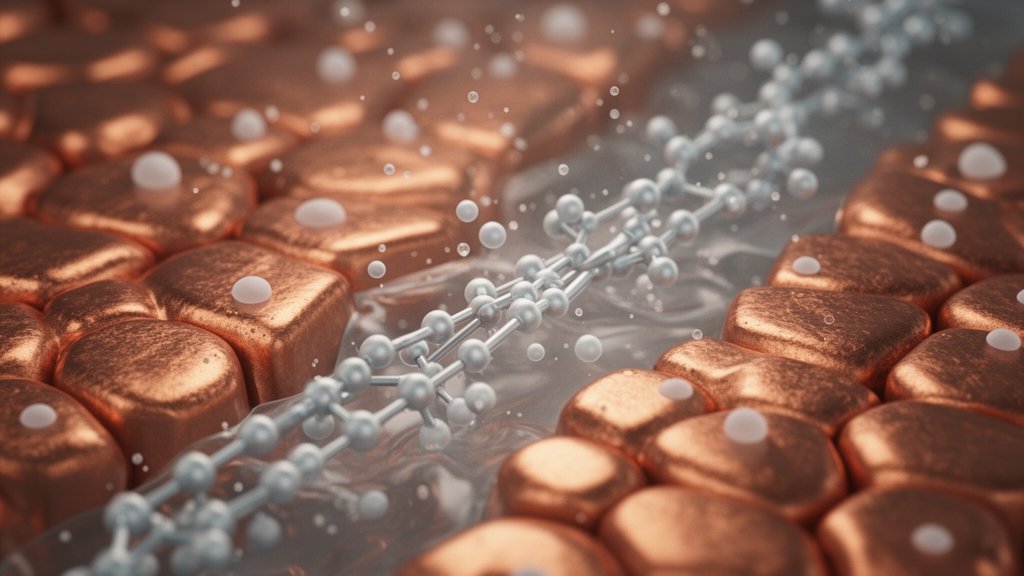
To address this kinetic limitation, the researchers developed a family of metal-organic framework pre-catalysts designated as Cu-BDC-X, in which copper centers are coordinated with 1,4-benzenedicarboxylic acid linkers bearing different functional substituents, specifically hydrogen, fluorine, and amino groups. During the electrolysis process, these metal-organic framework precursors underwent pronounced in situ electrochemical reconstruction. The divalent copper ions in the frameworks were reduced into metallic copper nanoparticles, while the functionalized organic linkers remained stably anchored to the newly formed nanoparticle surfaces, thereby creating ligand-modified copper active sites.
The electrocatalytic performance of the reconstructed catalysts was evaluated for dilute carbon dioxide conversion using a zero-gap alkaline membrane electrode assembly electrolyzer. When evaluated under realistic low-concentration operating parameters comprising a 15 percent carbon dioxide gas feed at 0.4 megapascals, the catalyst derived from the fluorine-substituted precursor, Cu-BDC-F, demonstrated exceptional catalytic performance. The modified copper catalyst achieved a Faradaic efficiency of 67.9 percent toward multicarbon products alongside a maximum multicarbon partial current density of 130 milliamperes per square centimeter.
To establish the underlying structure-performance correlations, the investigators conducted a combination of spectroscopic characterizations and theoretical calculations across the series of Cu-BDC-X pre-catalysts. Their analyses revealed that the strong electron-withdrawing capability of the fluorine substituent effectively modulates and reduces the electron density of adjacent copper active sites. This alteration in local electronic structure strengthens the adsorption of intermediate carbon monoxide species on the catalyst surface and concurrently lowers the activation energy barrier for carbon-carbon coupling, steering the reaction pathway toward multicarbon product formation.
The study highlights the critical role of electronic structure modulation through rational ligand engineering in electrocatalyst design. By demonstrating that electron-withdrawing organic functionalization can stabilize essential reaction intermediates and overcome the kinetic constraints of dilute gas streams, the findings offer a clear design methodology for developing robust catalytic systems capable of direct carbon dioxide electrolysis from industrial flue gas sources.
Subject of Research: Direct dilute carbon dioxide electrolysis using ligand-modified copper catalysts
Article Title: Promoting dilute CO2 electrolysis with electron-withdrawing ligand modification
Article References: Promoting dilute CO2 electrolysis with electron-withdrawing ligand modification. Original publication (Bibliographic details unavailable.)
Image Credits: AI Generated
DOI: Not provided
Keywords: dilute CO2 electrolysis, carbon dioxide reduction, copper nanoparticles, metal-organic frameworks, ligand modification, multicarbon products, C-C coupling, Faradaic efficiency, alkaline MEA electrolyzer, 1,4-benzenedicarboxylic acid, flue gas electrolysis, reaction kinetics, electronic structure modulation, Dalian Institute of Chemical Physics, electrochemical reconstruction, electrocatalysis
News Source: Denise Maddox. (November 12, 2026). Fluorinated Copper Catalysts Boost Dilute Carbon Dioxide Conversion to Multicarbon Products. Scienmag.