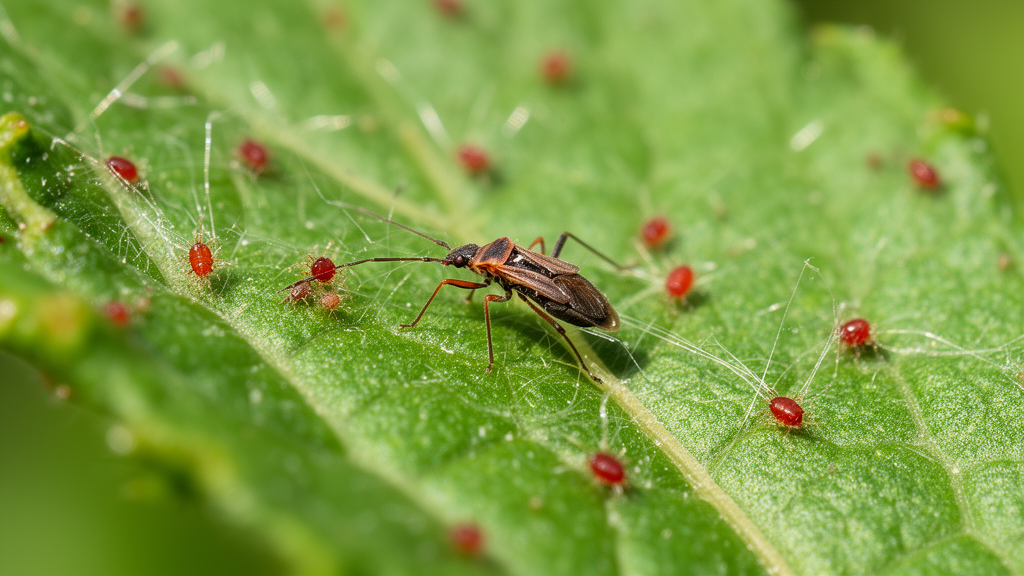
A new study published in the Egyptian Journal of Biological Pest Control provides detailed biological parameters for the predatory bug Orius vicinus when it feeds exclusively on the two-spotted spider mite, Tetranychus urticae. The research, conducted by Kübra Bilecen and Utku Yükselbaba, utilizes two-sex age–stage life table analysis to evaluate the predator’s potential as a biological control agent. The findings indicate that O. vicinus can successfully complete its life cycle and sustain its population on this specific pest, demonstrating its viability for integrated pest management programs in agricultural ecosystems.
The two-spotted spider mite is a polyphagous pest that has spread across agricultural areas worldwide, with over 1,400 host species documented, including vegetables, fruits, ornamental plants, and weeds. Due to its rapid development and high reproductive potential, T. urticae populations can increase by 40% in a short period. The mite uses piercing and sucking mouthparts to feed on plant sap, causing severe leaf damage that can lead to leaf abscission. Control of this pest has primarily relied on chemical management, but a loss of sensitivity to pesticides has been observed, with resistance reported to at least 96 active ingredients. This resistance leads to increased pesticide use, which negatively affects natural enemies and other species, causing ecological problems. Consequently, integrated pest management, which minimizes pesticide use and protects natural enemies, has become increasingly favored in recent years.
Species in the family Anthocoridae, particularly due to their high predation capacity and effective prey-seeking behavior, are important in biological control. The Orius genus, comprising about 70 species, feeds on insects and mites, including thrips, whiteflies, aphids, and spider mites. Orius vicinus is widely distributed across Europe, with records in eastern Turkey, Tajikistan, New Zealand, and potentially northern Africa. It is considered a valuable biological control agent against thrips, phytophagous mites, and whiteflies in agricultural ecosystems. The effectiveness of a natural enemy in controlling pest populations mainly depends on its biological and behavioral characteristics, specifically its ability to complete its life cycle on target prey and its functional response to different prey stages.
The study was conducted under controlled laboratory conditions at 26 ± 1°C, 60 ± 10% relative humidity, and a 16:8 light-to-dark cycle. O. vicinus individuals were obtained from flowering plants in Antalya, Turkey, and verified by a specialist at the Tokushima Prefectural Museum in Japan. The predator was propagated as a stock culture using Ephestia kuehniella eggs as a food source, while the T. urticae population was reared on cowpea plants in Plexiglas cages. For the life table analysis, 231 O. vicinus eggs were laid on pepper leaf disks containing T. urticae adults ad libitum. The eggs were inspected every 8 hours over a 24-hour period to record laying and hatching times, with hatching rates determined by dividing the number of eggs hatched by the total number of eggs.
The results revealed that the egg hatching ratio of O. vicinus was 94.8%, with a mean egg hatching time of 4.07 days. The total nymph development time was 17.6 days, with a 75.7% survival rate. The highest nymph survival rate was found to be 90.59% in the 5th nymphal stage, while the lowest was 90.59% in the 3rd nymphal stage. A total of 230 eggs were hatched, and 170 of them completed their development to become adults. The sex ratio was determined to be 1:1.1, with 81 males and 89 females. The preoviposition time was 4.39 days, the total preoviposition time was 21.85 days, and the oviposition period for female individuals was 7.2 days.
Female and male lifespans averaged 15.3 and 12.5 days, respectively. The longest lifespan of female individuals was observed to be 32.6 days, while the shortest was 7.6 days. The average number of eggs laid per female was 31.28, with a maximum of 7 eggs laid in a single day. The intrinsic rate of increase (r) was 0.095 days⁻¹, the finite rate of increase (λ) was 1.1 days⁻¹, and the net reproductive rate (R₀) was 12.04 eggs per generation. The mean generation time was 26 days. These parameters suggest that while the predator can maintain its population on spider mites, its fecundity is lower compared to when it feeds on alternative prey such as E. kuehniella eggs, which are commonly used in mass rearing due to their high-protein content.
Functional response analysis revealed that O. vicinus exhibited a type III functional response to T. urticae eggs and a type II functional response to larvae, protonymphs, deutonymphs, and adults. A type II functional response is characterized by a decrease in prey consumption rate as prey density increases, while type III responses are typically more characteristic of vertebrate predators that can learn to concentrate on prey as it becomes abundant. The attack rate for T. urticae eggs, larvae, protonymphs, deutonymphs, and adult stages was estimated to be 0.014, 0.028, 0.039, 0.041, and 0.05, respectively. Handling time was determined to be 2.8744, 0.246, 0.253, 0.167, and 0.155 hours for these stages. The estimated maximum predation rate in 24 hours was calculated as 8.35, 97.6, 94.9, 143.7, and 154.8% for the respective stages.
Choice tests indicated that the adult stage of T. urticae was the most preferred prey, while eggs were the least preferred. An individual O. vicinus consumed an average of 9.22, 21.96, 34.04, 55.56, and 114.48 T. urticae egg, larva, protonymph, deutonymph, and adult stages during its nymphal period, respectively. Over a 10-day adult period, an average of 182.08 adult mites and 7.81 eggs were consumed by one predator. In total, approximately 516 mixed T. urticae individuals were consumed during both the nymph and adult stages.
The study compares these findings with previous research on other Orius species. For instance, Keçeci (2005) reported that the nymphs of O. laevigatus and O. niger consumed 139 and 125 T. urticae nymphs, while their adults consumed 311 and 291 nymphs, over a similar period. Overall, O. vicinus exhibited a high total consumption of T. urticae compared to these other species. Additionally, Wearing and Colhoun (1999) reported a 79.5% survival rate for O. vicinus fed T. urticae when kept at 20°C, with a developmental period of 22.3 days. The lower fecundity observed in the present study on T. urticae is likely attributable to its lower nutritional value compared to E. kuehniella, which is commonly used in mass rearing due to its high-protein content.
The functional response of O. vicinus to T. urticae eggs was found to be type III, which is inconsistent with findings by Pehlivan et al. (2020) who reported a type II functional response. This functional flexibility is essential for its success in natural environments, where prey availability can fluctuate. The study suggests that O. vicinus can adapt its predatory behavior based on prey density, enhancing its effectiveness as a biological control agent.
The findings of the present study highlight that O. vicinus shows strong potential as a biological control agent against T. urticae due to its high nymphal survival, shorter development time, and substantial consumption capacity compared to other Orius species. Although its fecundity is lower when feeding on T. urticae than on E. kuehniella eggs or other pests, it effectively consumes large numbers of T. urticae across different prey stages. The predator’s functional response varies with prey stage, and it is particularly effective at controlling T. urticae as prey density increases. These traits, combined with its high survival, suggest that O. vicinus could play a valuable role in integrated pest management programs.
Further research is recommended to assess the long-term effectiveness of O. vicinus under controlled and greenhouse conditions. For practical application, mass rearing using factitious prey and periodic releases timed with pest outbreaks could enhance its utility in sustainable IPM strategies. The ability of O. vicinus to complete its life cycle on T. urticae and its high predation capacity make it a promising candidate for biological control.
Subject of Research: Biological control potential of Orius vicinus against Tetranychus urticae
Article Title: Functional response and life table analysis of Orius vicinus (ribaut) (Hemiptera: Anthocoridae) feeding on Tetranychus urticae Koch (Acari: Tetranychidae)
Article References: Bilecen, K., & Yükselbaba, U. (2025). Functional response and life table analysis of Orius vicinus (ribaut) (Hemiptera: Anthocoridae) feeding on Tetranychus urticae Koch (Acari: Tetranychidae). Egyptian Journal of Biological Pest Control, 35(1), Article 35. https://doi.org/10.1186/s41938-025-00873-0
Image Credits: AI Generated
DOI: 10.1186/s41938-025-00873-0
Keywords: Orius vicinus, Tetranychus urticae, biological control, life table analysis, functional response, integrated pest management, predator-prey dynamics, two-sex age-stage, spider mite, Anthocoridae, Tetranychidae, egg hatching ratio, nymphal survival, intrinsic rate of increase, prey preference, laboratory conditions, mass rearing, pesticide resistance, agricultural ecosystems, predation capacity
News Source: Drew Townsend. (November 12, 2026). Orius vicinus Predator Shows High Survival on Spider Mites. Scienmag.