A retrospective cohort study published in the Egyptian Liver Journal reports that a bipolar radiofrequency device known as the Habib 4X sealer needle can facilitate bloodless liver resection for hepatocellular carcinoma in patients with liver cirrhosis. The study, conducted at the National Hepatology Research Institute and the University Hospital in Egypt, analyzed data from 96 consecutive patients who underwent non-anatomical liver resections between January 2014 and December 2024. The primary objective was to evaluate the safety and efficacy of using radiofrequency-assisted transection to minimize intraoperative blood loss, a critical factor in determining surgical outcomes for patients with compromised liver function.
Hepatocellular carcinoma remains the most common primary liver cancer and a leading cause of cancer-related mortality worldwide. While liver transplantation is theoretically ideal for cirrhotic patients, organ scarcity and strict eligibility criteria limit its availability. Consequently, hepatic resection is the most widely used curative option. However, these patients often have reduced functional liver parenchyma and altered hemodynamics, making intraoperative bleeding a significant risk. The Child-Pugh classification is the standard method for assessing liver function in this population, with only Class A and early Class B patients typically considered fit for resection.
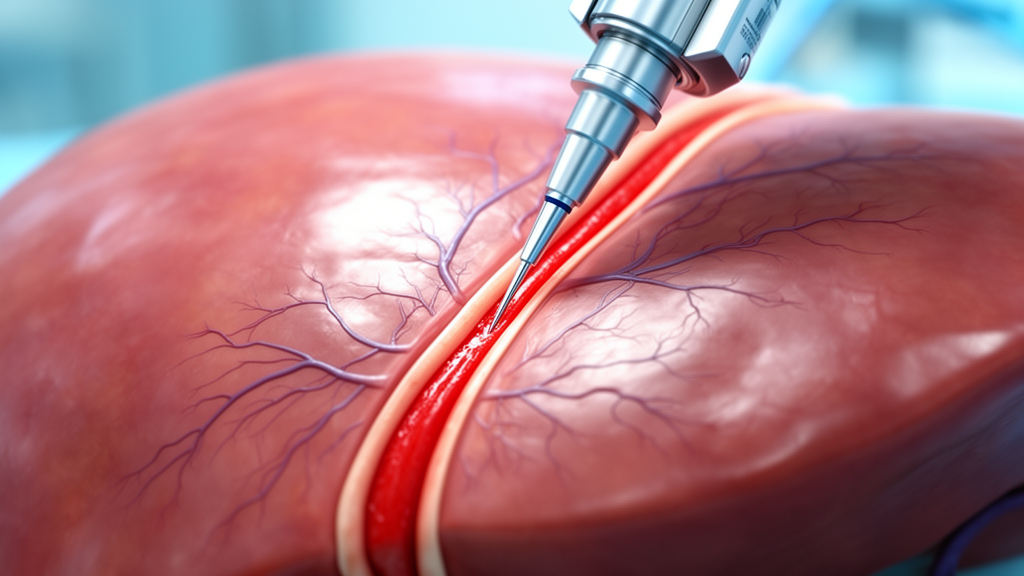
The Habib 4X is a disposable bipolar radiofrequency device manufactured by RITA Medical Systems. It features a 2×2 array of four needle electrodes arranged in a rectangle. The device connects to a generator that produces up to 250 watts of radiofrequency thermal power. By applying this energy, the device coagulates liver tissue prior to cutting, creating a plane of thermal necrosis that seals blood vessels and bile ducts. This process allows surgeons to transect the liver parenchyma in a bloodless field without the need for vascular inflow occlusion or clamping, which can be hazardous in cirrhotic livers.
The study included 96 participants, comprising 60 males and 36 females, with a mean age of 57.5 years. All patients had confirmed hepatocellular carcinoma and liver cirrhosis. The cohort was highly selected, with 95.8% classified as Child-Pugh Class A and 4.2% as early Class B. The mean Model for End-Stage Liver Disease (MELD) score was 5. Most patients, 88.5%, had a single tumor, while 10.4% had two tumors and one patient had three. Regarding anatomical distribution, 85.4% of tumors were peripherally located, making them accessible for the standard device configuration, while 14.6% were deep-seated in segments VII or VIII.
Surgical procedures were performed under general anesthesia. Intraoperative ultrasound was used to map the tumors and determine the resection line with a safety margin. The Habib 4X device was applied along the excision line to create a coagulative rim. The surgeons reported that the radiofrequency energy hardened the tissue, making palpation difficult, but the ultrasound visualization of the tumor edge remained problematic due to increased echogenicity. The resection margin was maintained at 1 cm wide to ensure adequate occlusion of vascular and biliary ducts while preventing excessive residual necrotic tissue.
The mean total operation time was 113.4 minutes, with a range of 60 to 170 minutes. The mean time for parenchymal transection was 40 minutes, ranging from 25 to 70 minutes. Intraoperative blood loss was a key metric, with a mean total blood loss of 300 cc, ranging from 50 to 1200 cc. Specifically, the mean blood loss during the parenchymal resection phase was 150 cc, with a range of 5 to 1100 cc. The mean blood transfusion requirement was 0.31 units, ranging from 0 to 2 units. Hemoglobin levels decreased from a mean of 13.1 mg/dl preoperatively to 12.23 mg/dl postoperatively.
Postoperative recovery was monitored closely for liver function and complications. The average hospital stay was four days, with a range of three to six days. Transient mild hyperbilirubinemia and transaminase elevations were observed within the first 48 hours but resolved spontaneously without leading to irreversible liver decompensation. Complications were classified using the Clavien-Dindo system. Grade I complications occurred in 19.5% of cases, primarily transient ascites managed with diuretics. Two cases, or 2.1%, experienced minimal postoperative bleeding from the abdominal wall, which was managed conservatively. No Grade III, IV, or V complications were recorded, and there were no instances of wound infection, burst abdomen, biliary leak, or ascitic fistula.
Oncological outcomes were assessed over a 12-month follow-up period. The overall survival rate was 100%. Disease-free survival was 95.8%, with four cases, or 4.2%, developing new recurrent lesions in non-adjacent hepatic segments. These recurrences were detected through triphasic CT scans and alpha-fetoprotein screening. The authors attributed the low recurrence rate to strict patient selection and the achievement of a precise 1 cm macroscopic safety margin. The thermal zone created by the device was less than 10 mm, which the authors suggest undergoes gradual physiological resorption and fibrosis without impairing broader liver function.
The study highlights the technical advantage of the bipolar radiofrequency approach in reducing operative time and blood loss. The authors note that the multiprobe device creates a coagulative necrosis plane faster than traditional methods, potentially reducing transection time. The ability to seal vessels and bile ducts up to 7 mm in diameter without vascular clamping is a significant benefit for cirrhotic patients. The device’s application was successfully extended to deeper tumors in segments VII and VIII through meticulous intraoperative mapping, demonstrating its versatility beyond superficial nodules.
However, the study has several limitations. The retrospective design lacks a prospective randomized control group for direct comparison with standard clamp-crush or anatomical resections. The stringent inclusion criteria for Child-Pugh A and early B patients with appropriate coagulation profiles introduce selection bias. The 12-month follow-up period is relatively short, and longer-term data are needed to validate overall survival and recurrence dynamics. Additionally, radiofrequency energy cannot be used near the hepatic hilum or inferior vena cava due to the risk of damaging these vital structures. The authors conclude that while the technique offers clear benefits in reducing physiological stress and resource utilization, further multicenter trials with longer follow-up are required to confirm its long-term efficacy.
The Habib 4X device operates as a bipolar disposable instrument featuring a 2×2 array of four needle electrodes positioned at the corners of a 6-by-7-millimeter rectangle. The system is linked to a 500 kHz generator capable of producing up to 250 watts of radiofrequency thermal power, with a default setting of 125 watts that surgeons can adjust based on tissue temperature requirements. The device includes a pneumatic foot pedal to control the application of energy and allows for both manual and automatic operation modes. During the procedure, the radiofrequency field generates ionic agitation and friction, leading to thermal heating of the parenchymal tissue. This process results in the occlusion of blood vessels and bile ducts with diameters up to 7 millimeters, creating a localized zone of coagulative necrosis that facilitates hemostasis and biliary management without the need for extensive vascular clamping.
In this specific cohort, the surgical team noted that the radiofrequency energy caused hardening of the liver tissue, which made determining the tumor margin by palpation difficult. Additionally, the energy increased tissue echogenicity on intraoperative ultrasound images, presenting challenges in visualizing the tumor edge. To address these technical hurdles, the surgeons relied on meticulous anatomical mapping and localization using intraoperative ultrasound to categorize tumors as either peripheral or deep parenchymal lesions. Peripheral tumors were defined as subcapsular or located superficially within segments II, III, and the lateral parts of IVb, V, and VI, whereas deep lesions extended further into segments VII or VIII. The resection line was marked with diathermy before the application of the Habib 4X to ensure the mass was removed with an appropriate safety margin.
The study’s retrospective design involved a review of de-identified medical records for consecutive eligible patients who underwent radiofrequency-assisted non-anatomical liver resections over an 11-year historical window. Data collection targeted patients who had visited the department of hepato-pancreato-biliary surgery at the National Hepatology Research Institute and the University Hospital. All participants underwent a full history and clinical examination, routine blood investigations including alpha-fetoprotein levels, and imaging procedures such as abdominal ultrasound and multislice triphasic spiral CT scans to confirm the diagnosis of hepatocellular carcinoma and assess hepatic function. The inclusion criteria required patients to have chronic hepatic disease with Child-Pugh class A or early B status, an American Society of Anesthesiologists classification of I, II, or III, an international normalized ratio below 1.7, and platelet counts exceeding 80,000 per cubic centimeter.
Postoperative care involved admission to the hepatic surgery intensive care unit, with discharge occurring once patients were vitally stable and demonstrated normal urine output and intestinal motility. Early ambulation was recommended to aid recovery, and abdominal drains were removed once the discharge changed to a serous character. The follow-up protocol was structured to monitor for recurrence and liver function, with patients seen every three days during the first two weeks, then weekly for a month. Computed tomography scans and alpha-fetoprotein measurements were performed after three months and subsequently every six months to track oncological outcomes and detect any new lesions or disease progression in the hepatic segments.
The authors emphasized that the low recurrence rate observed in this series is primarily attributed to the strict adherence to early-stage patient selection and the achievement of a precise 1-centimeter macroscopic safety margin. The localized thermal zone created by the bipolar system induces fast coagulative necrosis that seals vessels, and this thermal barrier undergoes gradual physiological resorption and fibrosis over time. This process occurs without encroaching on the broader surrounding parenchyma, thereby maximizing oncologic safety while preventing major hepatic function impairment or persistent decompensation. The ability to extend the device’s application to deeper tumors in segments VII and VIII, while maintaining a strict coagulative safety zone, illustrates the potential for reproducible surgical options in resource-constrained environments where conventional vascular clamping poses unpredictable hazards for cirrhotic livers.
Subject of Research: Bloodless liver resection for hepatocellular carcinoma using Habib sealer needle
Article Title: Bloodless liver resection for hepatocellular carcinoma in cirrhotic patients using Habib sealer needle
Article References: Baz, Y., Elshafey, H. E., El-Kassas, M., Kamal, A., Ezzat, M. M., Abdelkader, H., & Orban, Y. A. (2026). Bloodless liver resection for hepatocellular carcinoma in cirrhotic patients using Habib sealer needle. Egyptian Liver Journal, 16(1), Article 52. https://doi.org/10.1186/s43066-026-00537-0
Image Credits: AI Generated
DOI: 10.1186/s43066-026-00537-0
Keywords: hepatocellular carcinoma, liver resection, cirrhosis, radiofrequency ablation, Habib 4X, surgical technique, intraoperative blood loss, liver cancer, Bloodless, liver, resection, hepatocellular
News Source: Nathaniel Bowman. (November 12, 2026). Habib Sealer Needle Enables Bloodless Liver Resection. Scienmag.