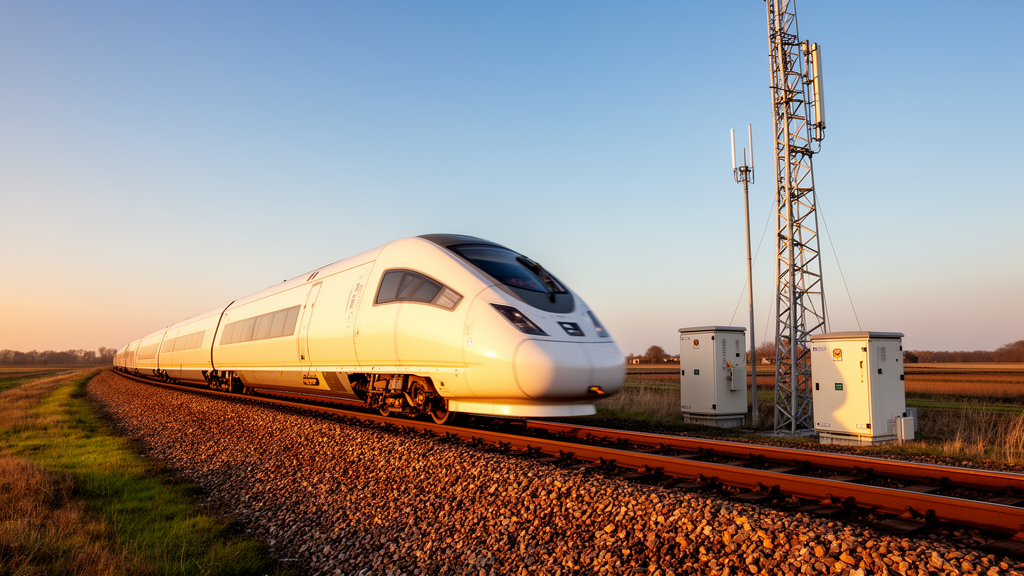
In an investigation addressing the operational vulnerabilities of edge-assisted rail transit, researchers Xiaocheng Cai and Zongchun Fu have demonstrated a co-optimization architecture that coordinates edge computing allocation with model predictive control parameters across fifth-generation cellular networks. As urban rail networks experience accelerating train speeds and denser headways, automatic train operation architectures increasingly rely on trackside edge servers to solve trajectory tracking routines within tight temporal windows. However, wireless data transfer across 5G uplinks and downlinks, combined with fluctuating computational queuing delays at edge nodes, introduces variable latency that causes controllers to base trajectory adjustments on outdated train states. Direct application of predictive algorithms without latency awareness leads to control command misalignment, state prediction drift, and degraded trajectory adherence. To resolve this friction, the researchers formulated an integrated communication, computation, and control co-optimization framework, validating it through a representative automatic train operation model. Simulation tests demonstrated that their co-optimization strategy reduces train velocity tracking root mean square error by 21.2 percent to 48.4 percent compared to conventional benchmark methods, while maintaining position deviation within 5.26 meters under extreme communication delay conditions.
The engineering challenge stems directly from the tight temporal bounds inherent in rail cyber-physical systems. Modern automatic train operation relies on continuous telemetry uploads, remote computational processing, and subsequent command downloads to onboard traction and braking actuators. Because 5G air interfaces exhibit stochastic delay jitter influenced by wireless channel conditions, dynamic scheduling policies, and hybrid automatic repeat request retransmissions, data delivery schedules cannot be guaranteed as fixed constants. Simultaneously, edge server queuing durations fluctuate according to concurrent background computational demands. The additive accumulation of uplink communication latency, server queuing waiting time, numerical algorithmic computation time, and downlink transmission delay introduces end-to-end latency that can approach or exceed sampling windows. When train controllers evaluate state information that lags behind actual physical track coordinates, control commands arrive at onboard actuators after the train has already traversed past the target state. Under standard predictive controllers that assume instantaneous feedback, this temporal discrepancy fosters cumulative estimation errors, driving excessive traction and braking fluctuations that degrade passenger comfort, reduce energy efficiency, and risk violating moving-block safety boundaries.
Prior engineering attempts to mitigate network communication latency in rail systems have historically relied on passive compensation mechanisms or rigid operational assumptions. Early automated driving strategies deployed classical proportional-integral-derivative loops or fuzzy logic algorithms configured around pre-calculated speed curves. While these legacy strategies impose minimal computational burdens, they lack the adaptive capacity to handle sudden track gradient variations, variable curve speed limits, and dynamic inter-train interactions. More recent implementations introduced model predictive control to manage line constraints and multi-objective performance targets, but these frameworks typically treat train-to-ground wireless links as idealized conduits or model delay as an unvarying constant. Alternative control designs have treated network latency as an external bounded disturbance, employing wait-and-discard strategies or robust filtering. Such reactive methods fail to actively embed latency dynamics into optimization predictions. Furthermore, conventional edge resource managers independently schedule computing power without visibility into controller horizon dimensions, leading to execution timeouts when processing resources become scarce, or squandered computational potential when processing capacity remains underutilized.
To rigorously address these operational contradictions, Cai and Fu constructed a hybrid discrete-continuous analytical model coupling train kinematics with stochastic network latency profiles. The physical motion of the train is modeled using Newton’s second law, accounting for equivalent mass, traction and braking actuation, basic running resistance derived from empirical Davis coefficients, and position-dependent track resistances caused by gradients and line curves. Continuous system equations are integrated over discrete control sampling intervals of 100 milliseconds to form the state prediction model. Parallel to vehicle dynamics, the investigators formulated a comprehensive end-to-end latency equation that unifies four distinct operational delay components. The 5G air interface delay is characterized using a truncated normal distribution, while network transmission and core forwarding are represented via a Gamma distribution, yielding a combined one-way communication delay bound. On the computational side, single-cycle algorithmic workloads are modeled as linear functions of predictive horizon parameters, while server queuing delays are derived from an M/M/1 queuing formulation tied directly to dynamic processor allocation.
At the center of the control design is a delay-aware model predictive control algorithm termed TA-MPC, which embeds network latency directly into the structural mechanics of trajectory tracking. The algorithm operates through three collaborative mechanisms: historical state reconstruction, adaptive prediction horizon adjustment, and delayed matching command issuance. Upon receiving a state telemetry packet carrying a delayed timestamp, the edge server utilizes historical records of previously executed control inputs to forward-compensate the state estimate across the missing sampling intervals, yielding an accurate reconstructed initial state for the present cycle. To preserve optimization feasibility across fluctuating latency values without altering decision vector dimensions, the controller fixes a nominal prediction horizon configured to exceed the sum of the control horizon and the maximum conceivable delay steps, dynamically absorbing compensation delays. Once the constrained quadratic program produces an optimal sequence of future control actions, the delayed matching mechanism bypasses the initial sequence element, instead selecting and transmitting the control command whose index corresponds to the projected downlink transmission delay.
Recognizing that control accuracy and computational workloads are inextricably linked, the research team constructed a two-timescale co-scheduling framework that manages control parameters and edge resources as a unified mixed-integer nonlinear programming problem. Extending the prediction and control horizons enhances constraint anticipation and trajectory accuracy, yet simultaneously increases quadratic programming matrix dimensions, expanding single-cycle computational workloads and risking computational timeouts. The authors decoupled the scheduling decisions across two distinct operational timescales to avoid continuous solver memory restructuring. While online edge resource allocations are re-evaluated at each 100-millisecond control cycle to track rapid network jitter, predictive horizon parameters are held constant across longer two-second scheduling intervals containing twenty control cycles. To solve the resulting coupled optimization problem efficiently, the team utilized the alternating direction method of multipliers, decomposing the problem into a separable convex resource allocation subproblem solved via projected gradient techniques, and a discrete parameter selection subproblem resolved across finite candidate ranges via systematic enumeration.
To confirm that this integrated framework maintains operational reliability under persistent external disturbances, the authors developed formal mathematical proofs establishing the recursive feasibility, input-to-state stability, and delay jitter bounds of the closed-loop system. The proof of recursive feasibility establishes that when the nominal prediction horizon satisfies the structural delay inequality, the backward inheritance of candidate control sequences guarantees that feasible solutions persist across all future sampling steps regardless of stochastic latency fluctuations. Furthermore, by constructing an optimal value function as an input-to-state stability Lyapunov candidate, the authors demonstrated that state tracking errors remain bounded under composite disturbances composed of dynamics modeling mismatch and state reconstruction errors. The team also derived explicit mathematical bounds governing state deviations under delay jitter, proving that trajectory deviations scale linearly with delay fluctuation amplitudes, while identifying that higher system sensitivity and elevated delay maximums decrease tolerance to jitter, underscoring the requirement for adaptive parameter coordination.
The quantitative efficacy of the proposed co-optimization framework was validated through extensive numerical simulations executed on a specialized MATLAB and Simulink testing platform. The virtual test environment modeled a 380-metric-ton train traveling across a 10-kilometer operational corridor featuring realistic straight sections, variable line curves, and changing track gradients under a 60 to 80 kilometer-per-hour speed profile. Across comparative evaluations against four baseline systems—including distributed predictive control with waiting mechanisms, edge-intelligent tree search, meta-reinforcement learning, and digital twin networks—the proposed TA-MPC system achieved the lowest velocity tracking root mean square error across all delay scaling factors. Under severe double-delay conditions, the proposed scheme limited velocity error to 1.45 kilometers per hour, outperforming the closest competing benchmark by 0.79 kilometers per hour while restricting maximum track position deviation to 5.26 meters.
The experimental evaluation further analyzed control robustness under constrained computational environments where edge server utilization reached 85 to 95 percent of capacity. Under this stress scenario, designated as S4, the proposed co-optimization framework registered an end-to-end delay violation rate of only 7.8 percent, contrasting sharply with benchmark violation rates spanning 15.3 percent to 27.6 percent. Average single-cycle execution times for the proposed approach remained at 23.8 milliseconds, representing a 30.4 percent to 53.9 percent computational speed advantage over competing methodologies. Ablation comparisons against isolated control optimization and isolated resource allocation confirmed that neither individual intervention achieves comparable error concentration. Cumulative error distribution analyses revealed that 99.2 percent of velocity errors under the proposed joint framework remained below 1.0 kilometer per hour, achieving a tight interquartile error range of 0.29 kilometers per hour. Visual trajectory comparisons across steep gradient transitions confirmed that the proposed system completely prevented the speed overshoot, hunting oscillations, and delayed phase depressions that degraded alternative control baselines.
While these simulation outcomes establish a rigorous foundation for delay-aware rail control, the authors identified several engineering constraints that define the scope of current findings and guide future development. The experimental parameters were selected from representative 5G-Railway technical standards rather than directly extracted from active operational radio signaling traces, necessitating comprehensive hardware-in-the-loop and trackside field calibration prior to commercial implementation. Additionally, the current validation models an isolated single-train trajectory correction scenario, leaving the complex dynamics of multi-train interactions, virtual train coupling, moving-block spacing regulations, and competing multi-task edge server requests for subsequent research. The operational queuing formulations also rely on steady-state Poisson assumptions that do not fully account for bursty arrivals or handover-induced packet reordering. Moving forward, the research team plans to extend the co-optimization framework to dense multi-train traffic networks, incorporate non-Poisson priority queuing models, integrate link-layer retransmission logic, and explore deep reinforcement learning architectures for real-time parameter adaptation.
Subject of Research: Joint optimization of model predictive control and edge computing resources in 5G-enabled automatic train operation
Article Title: Joint optimization of delay aware model predictive control and edge computing resources for automatic train operation in 5G networks
Article References: Cai, X., & Fu, Z. (2026). Joint optimization of delay aware model predictive control and edge computing resources for automatic train operation in 5G networks. Discover Computing, 29(1), Article 805. https://doi.org/10.1007/s10791-026-10772-z
Image Credits: AI Generated
DOI: 10.1007/s10791-026-10772-z
Keywords: Automatic Train Operation, Model Predictive Control, 5G Communication, Edge Computing, ADMM Optimization, Delay Compensation, Trajectory Tracking, State Reconstruction, Mixed-Integer Nonlinear Programming, Cyber-Physical Systems, Input-to-State Stability, Rail Transit Automation, Resource Allocation, M/M/1 Queuing Model, Quadratic Programming, Two-Timescale Scheduling, Train Dynamics
News Source: Marilyn Langley. (November 11, 2026). Co-Optimizing 5G Edge Computing and Predictive Control Cuts Train Tracking Errors. Scienmag.