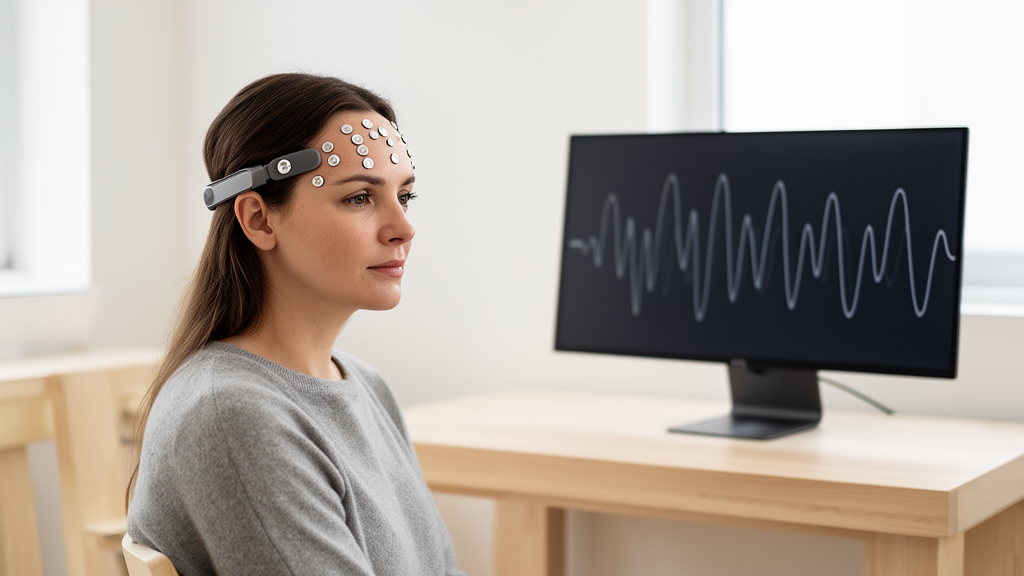
A research study published in the journal AI, Brain and Child demonstrates that integrating statistical causal inference with machine learning classifiers substantially improves the identification of student mental states from minimal electroencephalography recordings. Conducted by researchers Anupama Jawale, Ruta Prabhu, and Amiya Kumar Tripathy, the investigation addresses a longstanding obstacle in educational neuroscience and brain-computer interface design: reliably detecting cognitive conditions such as confusion and stress when using accessible, low-channel hardware. Standard electroencephalography, commonly abbreviated as EEG, measures the brain’s electrical activity non-invasively through scalp sensors, but practical applications outside clinical environments are often hindered by low signal frequencies, noise, and pervasive muscular artifacts. The authors established a methodological framework incorporating propensity score matching to balance baseline covariates and mitigate confounding influences that typically impair conventional algorithms, demonstrating that a causality-aware machine learning approach can differentiate complex mental states with classification accuracy reaching up to ninety-eight percent across distinct experimental scenarios.
The study evaluates two separate educational scenarios to measure how learners respond to digital instructional content of varying complexity. In the context of this investigation, learners are defined as undergraduate students engaged in video-based educational activities, with mental states quantified through EEG-derived attention and engagement metrics, and confusion characterized specifically as a lack of attention. The first scenario analyzes the publicly accessible Confused Student dataset originally established by Wang and colleagues, which captured brainwave patterns from ten learners watching online Massive Open Online Course lectures on basic and advanced science topics through a minimal single-channel NeuroSky MindSet device. The second scenario evaluates an original dataset collected by the authors from thirty first-year undergraduate participants aged seventeen to eighteen years at an urban college in Mumbai, India. These participants viewed seven academic videos—comprising three low-to-medium difficulty presentations on familiar science concepts and four high-difficulty presentations covering quantum physics and quantum computing—in a randomized order inside a controlled laboratory environment designed to minimize external acoustic and visual distractions.
Developing reliable classification models for minimal-electrode EEG recording requires addressing severe physiological and environmental confounds that routinely distort brainwave readings. In single-probe and minimal-channel setups, non-neural activities such as eye blinking, jaw clenching, smiling, and frowning introduce substantial electrical noise across the scalp. These facial movements can heavily skew frequency band power, signal skewness, and fractal dimensions. If such involuntary muscular activities occur disproportionately across trials—for example, if participants laugh or blink more frequently during lighter instructional modules—standard machine learning models may inadvertently map these peripheral artifacts rather than genuine cognitive processing. Furthermore, underlying neural variations, baseline cognitive fatigue, subject age, and sensor placements act as unmeasured or uncontrolled confounders in typical observational data. The researchers observed that existing analytical techniques frequently suffer from high noise sensitivity, degraded accuracy in single-channel systems, and weak generalization across subjects because conventional classifiers lack mechanisms to untangle non-EEG confounds from true mental dynamics.
To overcome these systemic analytical limitations, the investigators introduced Propensity Score Matching and Covariate Balancing Propensity Score methods into the machine learning feature engineering pipeline. In this statistical methodology, a propensity score represents the conditional probability that an observation is assigned to a specific condition given its baseline observed covariates. The authors utilized both standard logistic regression and Covariate Balancing Propensity Score weighting, with the latter directly optimizing covariate balance across high-dimensional feature spaces. By establishing balance weights for non-EEG variables, the dataset is conditioned so that the distribution of movement-related and contextual covariates becomes statistically uniform between target classes. This adjustment effectively neutralizes the confounding effect of facial movements and individual baseline shifts, constraining downstream machine learning algorithms to isolate and classify patterns that stem purely from underlying neural dynamics rather than superficial artifactual correlations.
The mathematical architecture underpinning this causal machine learning pipeline employs Average Treatment Effect estimation evaluated through Propensity Score Weighted Estimators and inverse probability weighting formulations. To establish rigorous balance between dependent and independent outcome groups, the researchers evaluated standardized mean differences across key frequency bands, comparing group means and variances against defined tolerance thresholds of zero point two and zero point five. For the first dataset, propensity scores accounted for the conditional probabilities of attention metrics and lecture video types based on observed baseline signal parameters, with derived weights appended as explicit features to represent the inverse probability of assignment. For the second dataset, the authors partitioned subjects across ten propensity strata, dividing the estimated propensity scores into deciles ranging from zero to one. Stratifying feature vectors across these deciles guarantees that class comparisons occur within subgroups sharing equivalent covariate distributions, directly reducing model overfitting induced by feature imbalances.
The recording system paired two Arduino UNO microcontroller boards with Bio EXG bio-potential processing chips and dry electrode headbands. The authors selected temporal sites because temporal lobe structures, including the amygdala, play established roles in cognitive processing, emotional generation, visual object recognition, and linguistic comprehension. Raw brainwave signals were acquired using Backyard Brains Spike Recorder software, saved as uncompressed audio waveforms to maintain temporal data integrity, and subsequently converted into structured tabular records. The signal was processed through a fourth-order zero-phase Butterworth bandpass filter spanning zero point five to forty-five Hertz, eliminating baseline drift and high-frequency noise while preserving delta, theta, alpha, beta, and low gamma oscillations.
Following digital filtering, the researchers applied Welch’s method to compute Power Spectral Density across overlapping windowed segments smoothed with Hanning tapers, mitigating spectral leakage across stochastic signal sequences. A comprehensive suite of thirteen frequency-domain and nonlinear statistical features was extracted from the resulting spectral transformations, including relative band power ratios, spectral entropy, time skewness, Hilbert-Huang transform harmonics-to-noise ratio, sample entropy, and spectral centroid metrics. Model-based feature importance evaluations showed that time-domain skewness, beta-band oscillatory power, and spectral entropy ranked as the most decisive variables for identifying cognitive shifts. Regularized techniques and tree-based importance rankings were subsequently applied to prune redundant metrics, preventing curse-of-dimensionality degradation before transferring the balanced feature arrays into supervised classification algorithms.
The research team evaluated a diverse panel of machine learning algorithms trained on the propensity-balanced feature matrices using stratified ten-fold cross-validation. The evaluated architectures included Support Vector Machines utilizing radial basis functions, Random Forest, Bagged Classification and Regression Trees, Gradient Boosting for Additive Models, Bayesian Generalized Linear Models, k-Nearest Neighbors, AdaBoost, XGBoost, and LightGBM. The LightGBM classifier attained superior performance, achieving an overall classification accuracy of ninety-eight point four percent. Comparative evaluations demonstrated that Bagged Classification and Regression Trees reached approximately ninety-seven percent accuracy, Support Vector Machines achieved approximately ninety-six percent, Gradient Boosting for Additive Models attained approximately ninety-one percent, and Bayesian Generalized Linear Models attained approximately fifty-eight percent. The authors highlighted that while baseline artificial neural networks applied to the unadjusted Confused Student dataset historically yielded around seventy-eight percent accuracy, incorporating causal balancing mechanisms produced marked performance gains across both educational cohorts.
Statistical evaluation of the classification results confirmed high precision, recall, and balanced accuracy across attention and stress states, even as the overall Cohen’s kappa statistic remained within the zero point four eight to zero point five zero range. The investigators noted that this moderate kappa magnitude reflects high expected chance agreement stemming from underlying class distributions and stable physiological baselines rather than algorithmic classification failure. The observed performance improvement is contextualized within the Dynamic Systems Theory framework of cognitive processing, which models human cognition as emergent, nonlinear interactions among interconnected physiological subsystems. By stratifying datasets across background variables such as stimulus difficulty, the causal methodology stabilizes external operational parameters. This reduction of confounding noise mimics a systemic phase transition, allowing clear neural regularities associated with confusion or heightened cognitive load to emerge distinctly from single-channel sensor measurements.
Despite the high classification rates reported, the authors underscored substantial methodological limitations inherent to minimal-hardware neural interfaces. Single-probe and few-electrode recording apparatuses capture electrical potentials from localized scalp areas, providing restricted spatial resolution compared to multi-channel clinical systems capable of simultaneous whole-cortex observation. Consequently, complex distributed brain phenomena requiring broad topological connectivity analysis, such as frontoparietal synchronization networks, cannot be observed using three-electrode temporal montages. The authors stated that while their causal machine learning methodology successfully mitigates localized movement artifacts and baseline imbalances, the findings do not universally generalize to all emotional or psychiatric categories.
Subject of Research: Causal machine learning and propensity score matching for electroencephalography mental state classification
Article Title: A causal machine learning approach for investigating learners’ mental states through electroencephalography (EEG)
Article References: Jawale, A., Prabhu, R., & Tripathy, A. K. (2025). A causal machine learning approach for investigating learners’ mental states through electroencephalography (EEG). AI, Brain and Child, 1(1), Article 13. https://doi.org/10.1007/s44436-025-00014-2
Image Credits: AI Generated
DOI: 10.1007/s44436-025-00014-2
Keywords: Electroencephalography, Causal Machine Learning, Propensity Score Matching, Educational Neuroscience, Brain-Computer Interfaces, Mental State Classification, Covariate Balancing, LightGBM, causal, machine, learning, approach
News Source: Teresa Odom. (November 11, 2026). Causal Machine Learning Enhances Mental State Detection from Low Channel EEG Signals. Scienmag.