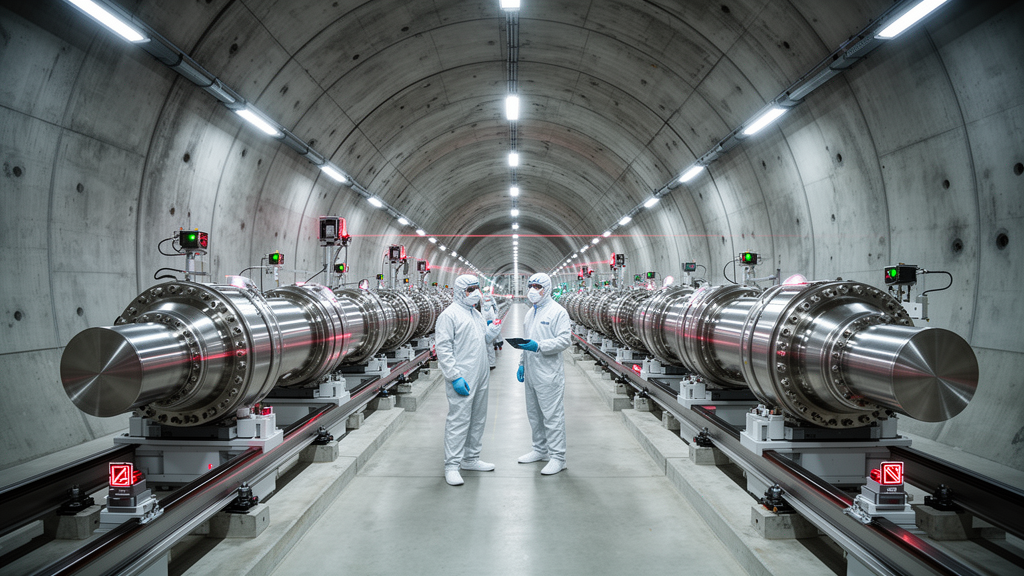
Analytical estimates and numerical simulations have demonstrated that realistic magnet alignment tolerances and dedicated correction algorithms can successfully achieve ultra-low vertical emittance targets for the proposed Future Circular Collider electron-positron stage, known as the FCC-ee. In a study published in EPJ Techniques and Instrumentation, researchers Tessa K. Charles, Bernhard Holzer, Rogelio Tomas, Katsunobu Oide, Léon van Riesen-Haupt, and Frank Zimmermann reported that correction algorithms achieved successful convergence across the majority of applied error seeds, producing a median vertical emittance of 0.90 picometers alongside a horizontal emittance of 1.50 nanometers.
The FCC-ee storage ring is designed as a circular accelerator spanning approximately 100 kilometers in circumference, engineered to attain an ultra-low vertical emittance of 1 picometer and luminosities reaching up to 230 × 10^34 cm^-2 s^-1 per collision point. Operating at the top-quark pair production energy of 182.5 GeV per beam, the collider aims for a target luminosity exceeding 10^34 cm^-2 s^-1 at each of up to four interaction points. Meeting these operational benchmarks establishes rigorous requirements across both arc optics and interaction region optics, requiring vertical beta function values at the collision points, denoted as beta_y*, on the order of 1 millimeter.
Achieving successful machine operation depends strictly on emittance tuning, which the authors characterize as a condition sine qua non for the large facility. The collider’s immense ring size, substantial natural chromaticity, exceptionally small beta* values, targeted low vertical emittance, and low coupling ratio render the optical lattice particularly vulnerable to magnet misalignments and magnetic field errors. If left uncorrected, these imperfections threaten to inflate both horizontal and vertical beam emittances while degrading luminosity performance across the collider’s four planned operating modes.
Because establishing excessively tight alignment specifications around a 100-kilometer circumference would serve as a major project cost driver, the researchers systematically evaluated magnet position tolerances. For the collider arcs, the assumed dipole root-mean-square alignment error of 1 millimeter represents an extremely relaxed criterion. Furthermore, arc girder root-mean-square alignments of 150 micrometers and quadrupole and sextupole magnet alignment tolerances of 50 micrometers root-mean-square relative to the girder remain within reach of conventional alignment practices. These tolerances are less restrictive than those envisioned for many next-generation storage-ring light sources, although the scale of the FCC-ee and its longer cell lengths could introduce distinct technical difficulties.
To establish these parameters, the research team deployed analytical estimation methods verified against simulation data to evaluate how specific magnet types influence overall beam dynamics and inform relative alignment tolerances. The investigators then simulated an extensive correction strategy that accounted for a wide array of magnet misalignments and magnetic field errors across the lattice. The field error tolerances identified through these evaluations remain comparable to tolerances already achieved in operating synchrotron light source facilities.
The evaluation also examined quadrupole magnet vibrations, which can induce vertical offsets between the colliding electron and positron beams at the interaction points. The authors analyzed three operational vibration regimes: coherent vibrations driven by external seismic activity, vibrations occurring resonant with the betatron frequency, and non-resonant incoherent vibrations. Among these vibrational dynamics, controlling the relative vertical displacement of the final electron and positron focusing quadrupoles, which reside within a shared cryostat, represents the most critical stability requirement for maintaining collision integrity.
While emittance tuning evaluations remain ongoing, the authors conclude that these preliminary results provide a promising indication that achievable alignment tolerances, field quality constraints, and advanced correction methods can deliver the requisite low coupling and beam emittance for the collider. However, further research remains necessary to evaluate non-linear terms that act to restrict the dynamic aperture of the storage ring.
Subject of Research: Magnet alignment tolerances, correction methods, and vibration stability for the proposed FCC-ee collider
Article Title: Alignment & stability challenges for FCC-ee
Article References: Charles, T. K., Holzer, B., Tomas, R., Oide, K., van Riesen-Haupt, L., & Zimmermann, F. (2023). Alignment & stability challenges for FCC-ee. EPJ Techniques and Instrumentation, 10(1), Article 8. https://doi.org/10.1140/epjti/s40485-023-00096-3
Image Credits: AI Generated
DOI: 10.1140/epjti/s40485-023-00096-3
Keywords: FCC-ee, Future Circular Collider, particle accelerator, magnet alignment, beam emittance, luminosity, vibration stability, accelerator optics, Alignment, stability, challenges, scientific research
News Source: Denise Maddox. (November 11, 2026). Alignment & stability challenges for FCC-ee. Scienmag.