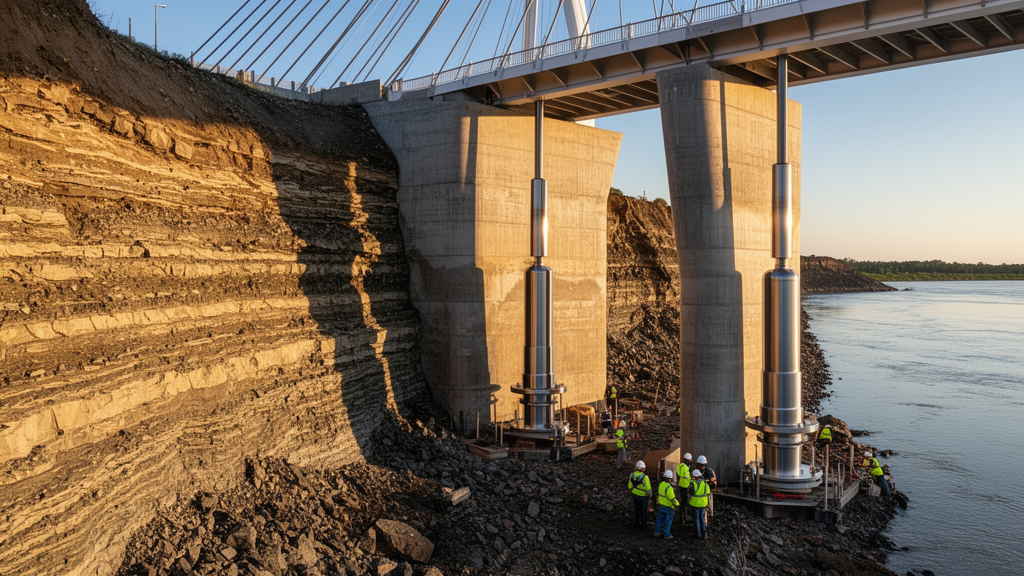
Researchers Ramesh Kumar Singh and Sunil Thakur have developed a machine learning framework that predicts strain-dependent soil damping using routine geotechnical data, significantly improving the accuracy of seismic analysis for bridge foundations. Published in Discover Civil Engineering, the study addresses a critical gap in civil engineering where conventional empirical models often fail to capture the site-specific variability inherent in heterogeneous alluvial deposits. By integrating a Random Forest model into nonlinear soil-pile-structure interaction simulations, the authors demonstrate that more precise damping estimates lead to a substantial reduction in prediction errors for structural demands during earthquakes.
The central challenge in seismic bridge design lies in the uncertainty surrounding how soil dissipates energy during ground shaking. Traditional approaches rely on generalized empirical curves, such as those established by Seed and Idriss or Vucetic and Dobry, which may not adequately represent the complex behavior of sands, silts, and gravels found in alluvial regions. The study posits that neglecting this strain-dependent, site-specific variability introduces significant uncertainty into the design of bridge foundations, potentially leading to either excessive conservativeness or, more dangerously, underestimation of seismic demands.
To address this, the researchers compiled a physics-informed dataset comprising 2,340 soil-layer records from ten distinct bridge foundation sites. This database was constructed to capture a wide range of geotechnical conditions, with corrected Standard Penetration Test N60 values varying from 4, indicating loose soil, to 140, indicating very dense soil. The grain size attributes in the dataset reflect a transition from sandy to gravely soils, with fines content ranging from 2% to 45%. The plasticity index was generally low to medium, between 0 and 12, suggesting that the majority of the soils investigated were coarse-grained.
The core of the methodology involves training a Random Forest regression model to predict damping ratios based on readily available geotechnical parameters. These inputs include the SPT-N60 value, median particle size D50, uniformity coefficient, curvature coefficient, fines content, and plasticity index. The model was trained and validated using the compiled dataset, aiming to replicate the nonlinear relationship between shear strain amplitude and damping ratio that characterizes soil dynamic behavior. This approach eliminates the need for specialized and costly dynamic laboratory tests, such as resonant column or cyclic triaxial tests, which are often infeasible in many developing regions.
The Random Forest model demonstrated superior predictive accuracy compared to alternative algorithms such as XGBoost and Artificial Neural Networks. Cross-validation results showed an R-squared value of 0.88, with a root mean square error of 0.52% and a mean absolute error of 0.35%. The XGBoost model achieved an R-squared of 0.85, while the ANN model reached 0.81. Statistical analysis indicated that the difference in test root mean square error between the Random Forest and XGBoost models was significant, with a p-value less than 0.01. The uncertainty of the predictions was further assessed using bootstrap resampling, yielding a 95% confidence interval for the test R-squared of 0.85 to 0.91.
Feature importance analysis revealed that shear strain amplitude is the dominant predictor of soil damping, contributing 42% of the model’s explanatory power. This is followed by the SPT-N60 value at 18% and fines content at 12%. Other factors, including median particle size and plasticity index, contributed smaller but still relevant portions to the prediction. These rankings align with established soil dynamics theory, which suggests that the magnitude of shear strain is the primary driver of energy dissipation in soils. The model successfully differentiated between soil types, predicting lower damping at small strains for coarse-grained soils and higher damping for fine-grained soils, consistent with known physical mechanisms.
The practical utility of the model was evaluated by integrating the predicted damping values into nonlinear soil-pile-structure interaction simulations. These simulations compared the seismic response of bridge foundations using the new machine learning-based damping against responses derived from conventional empirical assumptions. The results showed that the machine learning approach produced reduced displacement amplitudes and smoother response patterns, indicating a more realistic representation of energy dissipation under seismic loading. The bending moment distributions along the pile length also differed, with the machine learning-based damping reducing peak moments and shifting the depth of maximum moment toward lower soil layers.
Quantitative comparison of the simulation results highlighted the magnitude of the improvement. The prediction error for pile bending moment was reduced from 26% to 6%, representing a 20 percentage point decrease. Similarly, the prediction error for lateral displacement was reduced from 29% to 8%, a 21 percentage point reduction. These improvements suggest that the estimated seismic demands on the foundation become more accurate, allowing engineers to optimize reinforcement details and pile dimensions within specified safety factors without relying on overly conservative assumptions that may increase construction costs unnecessarily.
The study acknowledges several limitations that are important for interpreting the results. First, the training data was generated through physics-informed calibration rather than direct experimental measurements, meaning approximately 30% of the damping variability in the training set originates from this calibration process. Second, the model was calibrated primarily for coarse-grained alluvial soils with low to medium plasticity and has not been tested on soft soils, highly plastic clays, or organic soils. Third, the framework does not account for liquefaction, where pore pressure buildup can cause catastrophic degradation of damping and stiffness. Finally, the benchmark responses were derived from numerical simulations rather than prototype-scale experimental measurements, such as centrifuge tests or field data.
Despite these limitations, the framework offers significant practical advantages for infrastructure development, particularly in regions like Nepal where direct dynamic testing is rarely feasible due to cost and time constraints. The methodology relies solely on standard geotechnical investigations, making it accessible for routine design practices. The authors note that the Random Forest model can be readily implemented within Python or R computing frameworks, with resulting damping curves exportable for commercial finite-element codes. This integration bridges the gap between data-driven soil modeling and infrastructure performance frameworks, a need previously identified in reviews of machine learning applications in geotechnical engineering.
The findings contribute to the broader goal of improving the dynamic characterization of soil properties in engineering systems. While the study focuses on bridge foundations, the authors suggest that the methodology could be extended to other applications, such as seismic foundation design for buildings, retaining walls under dynamic earth pressures, and buried pipelines in liquefaction-prone areas. By providing a more defensible basis for seismic performance assessment, the proposed framework aims to enhance the safety and economy of infrastructure design in heterogeneous alluvial environments.
Future research directions include extending the database to include a wider variety of soil types, such as soft soils and highly plastic clays, to improve the model’s generalizability. The authors also recommend incorporating direct resonant column measurements on a subset of soil layers to reduce dependency on calibrated data. Additionally, validation through centrifuge tests and field measurements would provide a more rigorous confirmation of the model’s predictions. These steps are essential for transitioning the framework from a numerical benchmark to a widely adopted tool in practice, ensuring that the improved accuracy in seismic analysis translates into tangible benefits for infrastructure resilience.
Subject of Research: Machine learning prediction of strain-dependent soil damping for seismic analysis of bridge foundations
Article Title: Machine learning prediction of strain dependent soil damping improves seismic analysis of bridge foundations
Article References: Singh, R. K., & Thakur, S. (2026). Machine learning prediction of strain dependent soil damping improves seismic analysis of bridge foundations. Discover Civil Engineering, 3(1), Article 249. https://doi.org/10.1007/s44290-026-00641-5
Image Credits: AI Generated
DOI: 10.1007/s44290-026-00641-5
Keywords: machine learning, soil damping, seismic analysis, bridge foundations, geotechnical engineering, Random Forest, soil-pile-structure interaction, alluvial deposits, Machine, learning, prediction, strain
News Source: Teresa Odom. (November 11, 2026). Machine Learning Soil Damping Model Enhances Bridge Seismic Safety. Scienmag.