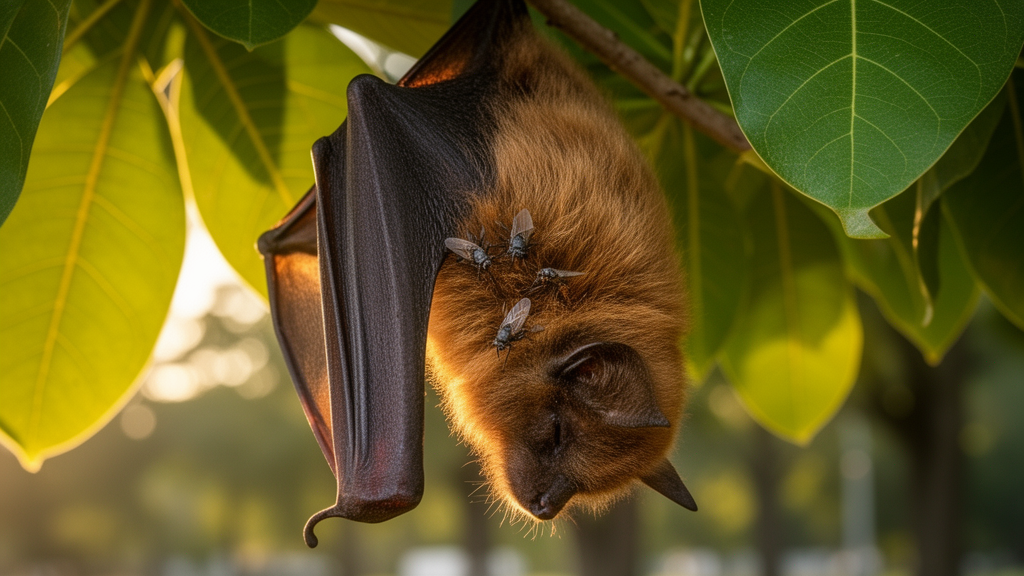
In a cross-sectional ecological field and laboratory study conducted in Watansoppeng, Soppeng Regency, South Sulawesi, researchers detected ectoparasites on every examined bat, recording an observed sample infestation proportion of 100.0 percent. Out of ten bats assessed at an urban roost, ten were found to harbor ectoparasites, yielding an exact binomial 95 percent confidence interval spanning from 69.2 percent to 100.0 percent. The research team recovered a total of 34 ectoparasite specimens from the animals, with individual parasite counts ranging between two and six specimens per host bat, reflecting both a descriptive mean abundance and a descriptive mean intensity of 3.4 parasites per bat.
The investigation was designed to evaluate bat ectoparasite infestation in Soppeng Regency while contextualizing local environmental-health vulnerability using provincial data from the Indonesian Health Survey 2023, known as SKI 2023. As noted in the study’s background, bats harbor diverse assemblages of microorganisms, and their obligate ectoparasites may serve as an underutilized surveillance layer at interfaces where humans and wildlife interact. By examining the ectoparasites living directly on urban bats, the researchers sought to generate preliminary descriptive baseline data relevant to broader environmental and public health monitoring frameworks.
Fieldwork and specimen collection took place at Taman Kalong, an established urban bat roost situated within Watansoppeng in Soppeng Regency. During the cross-sectional survey, ten individual bats were captured and systematically inspected across their external bodies. The field protocol involved thoroughly combing through the fur and the delicate wing membranes of each animal to ensure comprehensive collection of external parasites. All recovered ectoparasites were immediately preserved in 70 percent ethanol to maintain specimen integrity for subsequent laboratory inspection.
Following preservation, the 34 recovered specimens were transported to the laboratory and evaluated stereomicroscopically to characterize their morphological features. Microscopic examination revealed that representative specimens were morphologically consistent with members of the bat fly family Nycteribiidae. Furthermore, selected specimens among the collection were provisionally identified by the research team as Eucampsipoda cf. sundaica, documenting the specific parasite taxa associated with the roosting host bats in this urban environment.
In parallel with the biological sampling, the authors incorporated provincial indicators from the Indonesian Health Survey 2023 to provide environmental and public health context for the region. The researchers restricted the use of these SKI 2023 metrics strictly to contextual data rather than direct causal or statistical associations. The survey indicators demonstrated high community access to basic drinking water across the province, but simultaneously revealed critical infrastructure gaps in safely managed sanitation, municipal and domestic wastewater management, and household solid-waste management practices.
The study authors emphasized that while the detection of ectoparasites across all ten examined bats provides valuable preliminary descriptive evidence of a bat–ectoparasite association at Taman Kalong, the finding represents an initial localized observation that should not be generalized to the wider bat population inhabiting Soppeng Regency. To build upon these baseline observations and advance One Health surveillance, the researchers concluded that future research initiatives should integrate host-resolved sampling, ongoing ectoparasite monitoring, local environmental indicators, molecular identification techniques, and targeted pathogen screening at human–wildlife interfaces.
Subject of Research: Preliminary survey of bat ectoparasite infestation and environmental health context in Soppeng, Indonesia
Article Title: Preliminary bat ectoparasite findings in Soppeng, Indonesia: implications for One Health surveillance
Article References: Manyullei, S., Arifin, M. E., Mallongi, A., Ibrahim, E., Moedjiono, A. I., & Girikallo, G. G. (2026). Preliminary bat ectoparasite findings in Soppeng, Indonesia: implications for One Health surveillance. BMC Veterinary Research. https://doi.org/10.1186/s12917-026-05995-7
Image Credits: AI Generated
DOI: 10.1186/s12917-026-05995-7
Keywords: Soppeng Regency, South Sulawesi, Watansoppeng, Taman Kalong, bats, ectoparasites, Nycteribiidae, Eucampsipoda cf. sundaica, One Health surveillance, Indonesian Health Survey, SKI 2023, urban bat roost, cross-sectional study, stereomicroscopy, infestation prevalence, parasite intensity, environmental-health vulnerability
News Source: Drew Townsend. (November 11, 2026). All Ten Sampled Urban Bats in Soppeng Harbor Ectoparasites. Scienmag.