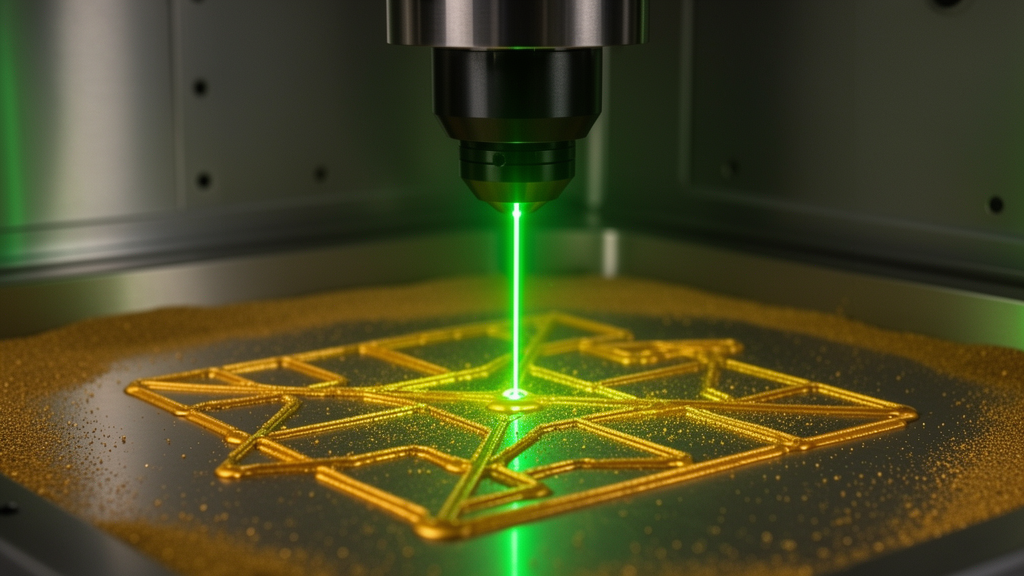
Published in the journal Gold Bulletin in September 2023, the study focuses on single-track experiments conducted on steel substrates to evaluate the feasibility of Laser Powder Bed Fusion (LPBF) for precious metals. The central finding is that the green wavelength offers superior energy absorption, allowing for faster scanning speeds and lower power requirements while maintaining continuous and regular melt tracks. This technical advancement addresses a long-standing challenge in the jewelry and watchmaking industries, where pure gold and gold alloys are notoriously difficult to process using conventional infrared lasers due to their high thermal conductivity and low light absorption.
The difficulty in manufacturing gold via LPBF stems from the physical properties of the metal. When the laser energy is not absorbed efficiently, it is reflected or scattered, leading to insufficient melting of the powder bed. Additionally, gold’s high thermal conductivity rapidly dissipates the heat that is absorbed, making it difficult to maintain a stable melt pool. Previous attempts to overcome these limitations have included powder surface treatments, such as oxidation, or the addition of alloying elements like germanium to reduce thermal conductivity.
The study by Aymeric Domine, Lucas Dembinski, Ludovic Vitu, and Noureddine Fenineche explores an alternative approach by utilizing recent advancements in laser technology. The research team compared the performance of this green laser against a conventional 1,064 nanometer infrared laser. By changing the wavelength from infrared to green, the absorptivity of the 18-karat gold alloy increased dramatically. The measured absorptivity rose from 7% at 1,064 nanometers to 37% at 515 nanometers. This five-fold increase in energy absorption is the key factor that enables more efficient melting and better process control during the additive manufacturing of gold components.
To conduct the experiments, the team used a specific 18-karat yellow gold powder with a composition of 750 parts gold, 125 parts silver, and 125 parts copper. The powder was produced via argon gas atomization, resulting in spherical particles with a narrow size distribution. Characterization using a Mastersizer 2000 revealed a median particle size (d50) of 20.0 micrometers, with d10 at 12.7 micrometers and d90 at 30.8 micrometers. The powder morphology was confirmed to be spherical using a Jeol 7800-SF scanning electron microscope.
The experimental setup involved two distinct laser systems. The first was a Truprint 1000 machine equipped with a TruDisk 1020 laser operating at 515 nanometers, with a maximum power of 1 kilowatt and a beam diameter of 200 micrometers. The second system was a Realizer 250 machine using a 1,064 nanometer laser with a maximum power of 400 watts and a smaller spot diameter of 35 micrometers. Both machines operated in argon chambers to prevent oxidation, with oxygen levels kept below 100 parts per million for the green laser system and below 0.5% for the infrared system. Single tracks were manufactured on steel substrates that had been machined with a 50-micrometer high channel to contain the powder layer.
The team systematically varied laser power and scanning speed to map out the process window for each wavelength. For each laser, 16 different parameter combinations were tested. The primary metrics for evaluation included track width, depth, and the state of melting. The researchers categorized the melting states into three distinct regimes: lack of fusion, where energy is insufficient to melt the pool correctly; unstable melt pool, where energy is too low to maintain continuity and particles are ejected; and continuous track, where the melt pool is regular and stable. The goal was to identify the parameters that produce a continuous track without porosity or particle ejection, which is essential for manufacturing high-quality jewelry items.
The results clearly favored the 515 nanometer green laser. At a scanning speed of 200 millimeters per second, the green laser produced a track width of 362 micrometers at 200 watts of power. As the power increased to 360 watts, the width expanded to 518 micrometers. In contrast, the 1,064 nanometer infrared laser required higher power to achieve similar melting conditions due to its lower absorptivity. The study found that a minimum linear energy density of 0.6 joules per millimeter was necessary to produce a continuous track with the green laser. This energy input is significantly lower than what is required for the infrared laser, indicating that the green laser is more energy-efficient for processing gold alloys.
One of the most significant practical implications of the study is the ability to increase scanning speed when using the green laser. The researchers demonstrated that even at a high scanning speed of 450 millimeters per second, the 515 nanometer laser could still produce regular and continuous tracks. This is a substantial improvement over the infrared laser, which struggled to maintain track continuity at higher speeds.
The difference in track penetration between the two lasers was also notable. When using the 515 nanometer laser at 300 watts and 200 millimeters per second, a conduction mode was formed, and some penetration into the steel substrate was observed. This penetration is indicated by a grey coloration in the tracks, caused by steel mixing into the melt pool during manufacturing. In contrast, the 1,064 nanometer laser showed no measurable penetration into the substrate at any of the tested power and speed combinations. This lack of penetration is attributed to the lower energy absorption of the infrared wavelength.
The study also highlighted the importance of wettability and energy input in determining track geometry. An increase in laser power generally leads to an increase in track width, a phenomenon explained by the higher energy input and the wettability of the melt pool on the substrate.
Limitations of the study include the use of a steel substrate for the single-track experiments. While this allowed for a clear comparison of laser performance, it does not fully replicate the conditions of manufacturing a multi-layer gold part. In a real-world scenario, the powder would be deposited on a gold substrate or on previously melted gold layers. The researchers acknowledged that using a substrate of the same chemical composition as the powder would allow for more accurate track manufacturing. The next step in their research program is to manufacture full samples using the optimized parameters and to measure porosity rates and surface roughness.
In conclusion, the use of a 515 nanometer green laser offers a compelling solution to the challenges of additive manufacturing 18-karat yellow gold. The significant increase in absorptivity allows for lower energy inputs, higher scanning speeds, and more stable melt pools compared to the conventional 1,064 nanometer infrared laser. These advantages make the green laser a more efficient and versatile tool for producing gold components in the jewelry and watchmaking industries. While further research is needed to optimize multi-layer part production, the single-track results provide strong evidence that green laser LPBF is a viable and promising technology for the future of precious metal manufacturing.
Subject of Research: Comparison of 515 nm and 1064 nm lasers for additive manufacturing of 18-karat gold
Article Title: 18 Karat yellow gold single-tracks manufactured by Laser Powder Bed Fusion (LPBF): 1 064 nm and 515 nm laser comparison
Article References: Domine, A., Dembinski, L., Vitu, L., & Fenineche, N. (2023). 18 Karat yellow gold single-tracks manufactured by Laser Powder Bed Fusion (LPBF): 1 064 nm and 515 nm laser comparison. Gold Bulletin, 56(2), 53-58. https://doi.org/10.1007/s13404-023-00337-z
Image Credits: AI Generated
DOI: 10.1007/s13404-023-00337-z
Keywords: additive manufacturing, laser powder bed fusion, gold alloy, green laser, infrared laser, jewelry manufacturing, material processing, absorptivity, Karat, yellow, gold, single-tracks
News Source: Denise Maddox. (November 11, 2026). Green Laser Improves Gold Additive Manufacturing Efficiency. Scienmag.