• HOME
  • NEWS
  • EXPLORE
    • CAREER
      • Companies
      • Jobs
    • EVENTS
    • iGEM
      • News
      • Team
    • PHOTOS
    • VIDEO
    • WIKI
  • BLOG
  • COMMUNITY
    • FACEBOOK
    • INSTAGRAM
    • TWITTER
Tuesday, November 17, 2026
BIOENGINEER.ORG
No Result
View All Result
  • Login
  • HOME
  • NEWS
  • EXPLORE
    • CAREER
      • Companies
      • Jobs
        • Lecturer
        • PhD Studentship
        • Postdoc
        • Research Assistant
    • EVENTS
    • iGEM
      • News
      • Team
    • PHOTOS
    • VIDEO
    • WIKI
  • BLOG
  • COMMUNITY
    • FACEBOOK
    • INSTAGRAM
    • TWITTER
No Result
View All Result
Bioengineer.org
No Result
View All Result
Home NEWS Science News Technology

Q-learning improves battery balance in farm electric vehicles

by
November 11, 2026
in Technology
Reading Time: 2 mins read
0
Q-learning improves battery balance in farm electric vehicles

Q-learning improves battery balance in farm electric vehicles

Share on FacebookShare on TwitterShare on LinkedinShare on RedditShare on Telegram

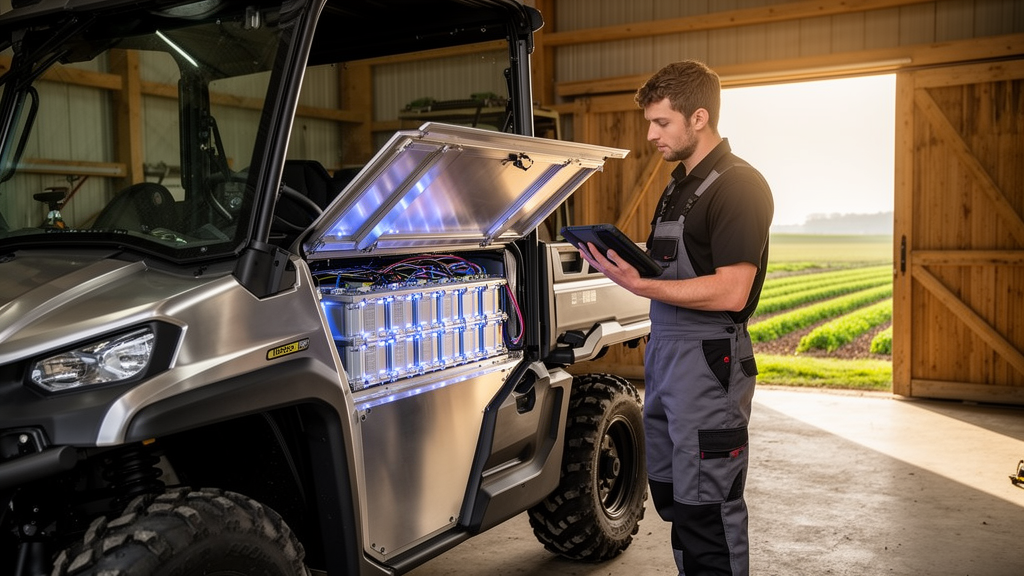
A study published in Discover Applied Sciences presents a Q-learning-based Dual-Battery Energy Management System (DBEMS) designed to optimize power allocation for agricultural electric vehicles. The research addresses the challenge of managing two lithium-ion battery packs under variable field conditions, where load demands can fluctuate significantly.

The study was conducted by Palla Siva Kumari and Mareddy Padma Lalitha, who developed a control strategy to handle the electrical behavior of the battery packs. The electrical behaviour of each battery is represented using a first-order resistor-capacitor model. The researchers subjected the system to various load profiles, including ploughing, transportation, and mixed-duty scenarios, to test the robustness of the energy management strategy under realistic agricultural conditions.

To evaluate the performance of the proposed controller, the team introduced Gaussian disturbances at levels of 0%, 5%, and 10% to simulate load uncertainty. The evaluation framework comprised 243 simulation runs, covering three different controllers, three load profiles, three noise levels, and nine random initializations.

All tested controllers successfully supplied the required load energy of 730 Wh, indicating that basic functionality was maintained across all strategies. However, the proposed Q-learning-based DBEMS achieved the highest Balance Index of 0.991. This result represents a 2.69% improvement over the rule-based controller, demonstrating a superior ability to keep the batteries balanced during operation.

The proposed controller reduced the switching frequency from 15 to 10 switches per kilowatt-hour, corresponding to a 33.33% reduction.

When compared to a conventional reinforcement learning benchmark, the proposed controller showed significant improvements in state-of-charge management. The mean State-of-Charge gap was reduced from 1.75% to 1.45%, a decrease of 17.14%. Additionally, the root-mean-square error dropped from 1.65% to 1.38%, representing a 16.36% reduction. These metrics indicate that the adaptive Q-learning method provides more precise control over the energy distribution between the two battery packs.

Under conditions of 10% load uncertainty, the controller retained stable performance, with a Balance Index standard deviation of approximately ±0.005. The variation in switching frequency remained below ±1.2 switches per kilowatt-hour, further confirming the robustness of the system.

The study highlights the effectiveness of adaptive reinforcement learning in managing dual-battery systems for electric vehicles used in agriculture.

Subject of Research: Adaptive reinforcement learning for dual-battery energy management in agricultural electric vehicles

Article Title: Adaptive reinforcement learning based dual battery energy management for agricultural electric vehicles under stochastic field load uncertainty

Article References: Kumari, P. S., & Lalitha, M. P. (2026). Adaptive reinforcement learning based dual battery energy management for agricultural electric vehicles under stochastic field load uncertainty. Discover Applied Sciences. https://doi.org/10.1007/s42452-026-09755-y

Image Credits: AI Generated

DOI: 10.1007/s42452-026-09755-y

Keywords: Q-learning, Dual-Battery Energy Management System, Agricultural Electric Vehicles, Lithium-ion Batteries, Stochastic Load Uncertainty, Reinforcement Learning, Battery Equalization, Switching Frequency, State-of-Charge, Resistor-Capacitor Model, Gaussian Disturbances, Simulation Runs, Balance Index, Root-Mean-Square Error, Energy Allocation, Agricultural Duty Cycles, Power Allocation, Control Strategy, Operational Efficiency, Battery Longevity

News Source: Faith Mcneil. (November 11, 2026). Q-learning improves battery balance in farm electric vehicles. Scienmag.


Tags: Agricultural Duty CyclesAgricultural Electric VehiclesBalance IndexBattery EqualizationBattery LongevityControl StrategyDual-Battery Energy Management Systemenergy allocationGaussian Disturbanceslithium-ion batteriesoperational efficiencypower allocationQ-learningReinforcement LearningResistor-Capacitor Modelroot mean square errorSimulation Runsstate of chargeStochastic Load Uncertaintyswitching frequency
Share12Tweet7Share2ShareShareShare1

Related Posts

Mirabilis Jalapa Extracts Modulate Optical Band Gap in Polyvinyl Alcohol Films

Mirabilis Jalapa Extracts Modulate Optical Band Gap in Polyvinyl Alcohol Films

November 17, 2026
Affect-Aware Framework May Improve Relational Grounding in LLM Conversations

Affect-Aware Framework May Improve Relational Grounding in LLM Conversations

November 17, 2026

Algal Nanoparticles Offer Versatile Tools to Remove Emerging Contaminants from Wastewater

November 17, 2026

Balanced Workplace Helping Boosts Peer Social Status by Reducing Relational Uncertainty

November 17, 2026

POPULAR NEWS

  • Orthognathic Mixed Reality Templates Show Sub-Two-Millimeter Deviations in Early Scoping Review

    Orthognathic Mixed Reality Templates Show Sub-Two-Millimeter Deviations in Early Scoping Review

    29 shares
    Share 12 Tweet 7
  • Iron Oxide Nanoparticles Alleviate Cadmium Stress and Accumulation in Atractylodes Lancea

    29 shares
    Share 12 Tweet 7
  • Elevated Lipoprotein (a) Does Not Predict Long-Term Mortality After Heart Attack

    29 shares
    Share 12 Tweet 7
  • Incremental Deep Learning Reconstruction Improves High-Resolution Coronary CT Angiography Image Quality

    29 shares
    Share 12 Tweet 7

About

We bring you the latest biotechnology news from best research centers and universities around the world. Check our website.

Follow us

Recent News

Mirabilis Jalapa Extracts Modulate Optical Band Gap in Polyvinyl Alcohol Films

BTN3A3 Downregulation Across Multiple Cancers Points to Potential Metastatic Biomarker

Affect-Aware Framework May Improve Relational Grounding in LLM Conversations

Subscribe to Blog via Email

Enter your email address to subscribe to this blog and receive notifications of new posts by email.

Join 88 other subscribers
  • Contact Us

Bioengineer.org © Copyright 2023 All Rights Reserved.

Welcome Back!

Login to your account below

Forgotten Password?

Retrieve your password

Please enter your username or email address to reset your password.

Log In
No Result
View All Result
  • Homepages
    • Home Page 1
    • Home Page 2
  • News
  • National
  • Business
  • Health
  • Lifestyle
  • Science

Bioengineer.org © Copyright 2023 All Rights Reserved.