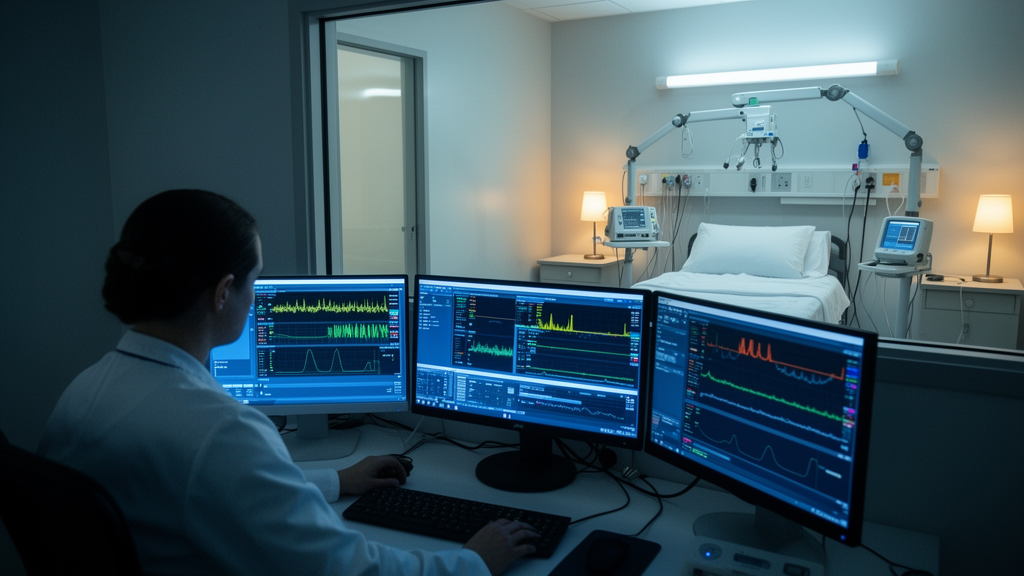
A simulation-based optimization framework implemented in MATLAB has successfully automated the calibration of a digital twin modeling patient flow in a hospital sleep unit, lowering queue estimation discrepancies to 1.11 percent. The computational system replaces time-consuming manual parameter adjustments previously required to configure discrete-event simulation models of specialized healthcare departments.
Sustained clinical demand associated with sleep-disordered breathing, particularly obstructive sleep apnea, frequently burdens specialized pulmonary units. In certain clinical environments, these operational constraints lead to prolonged waiting lists that exceed one year for essential diagnostic evaluations, such as respiratory polygraphy.
The optimization framework builds upon an existing discrete-event simulation model created as a digital twin of patient flow within the Sleep-Disordered Breathing Unit of the Pulmonology Department at Hospital Álvaro Cunqueiro in Vigo, Spain. In prior evaluations against real-world hospital records, that baseline simulation achieved a weighted Relative Percent Difference of 3.6 percent for the mean number of patients waiting in queue and 34.6 percent for mean patient waiting time.
Despite the initial model’s performance, the transition probabilities determining how patients navigate consecutive stages of clinical care required manual calibration. This iterative procedure depended heavily on expert judgment, which the investigators noted restricted both the reproducibility and the operational optimality of the calibrated parameters.
To resolve these calibration hurdles, researchers coupled the discrete-event model to a simulation-based optimization architecture designed to calibrate the underlying state-transition matrix automatically. In the primary experiment focusing on the mean patient queue count, the algorithm derived an optimal routing configuration that reduced the global weighted Relative Percent Difference from the manual baseline of 3.6 percent down to 1.11 percent.
The study also explored trade-offs through complementary experiments that integrated patient waiting time into the objective function or shifted care stage weighting toward respiratory polygraphy. These secondary calibrations demonstrated that the framework can successfully prioritize clinically critical diagnostic stages, though doing so increased the aggregate error observed in the general queue metric.
Developed by investigators across the Fundación Biomédica Galicia Sur, the School of Industrial Engineering at the Universidade de Vigo, and Hospital Álvaro Cunqueiro, the framework represents the first reported application of simulation-based optimization for automated state-transition calibration in a sleep unit digital twin.
Subject of Research: Automated calibration of a sleep-disordered breathing unit digital twin using simulation-based optimization
Article Title: A simulation-based optimization framework for calibration of a digital twin in a sleep-disordered breathing unit
Article References: Álvarez-Vázquez, J., Casal-Guisande, M., Bouza-Rodríguez, J.-B., Mosteiro-Añón, M., Fernández-Villar, A., & Torres-Durán, M. (2026). A simulation-based optimization framework for calibration of a digital twin in a sleep-disordered breathing unit. Frontiers in Digital Health, 8, Article 1900707. https://doi.org/10.3389/fdgth.2026.1900707
Image Credits: AI Generated
DOI: 10.3389/fdgth.2026.1900707
Keywords: discrete-event simulation, digital twin, simulation-based optimization, sleep-disordered breathing, obstructive sleep apnea, patient flow, waiting lists, respiratory polygraphy, state-transition matrix, relative percent difference, queue calibration, health informatics, Hospital Álvaro Cunqueiro, MATLAB, parameter tuning, pulmonology, care stage routing
News Source: Ophelia Keating. (November 11, 2026). Optimization Framework Reduces Sleep Unit Simulation Queue Error to 1.11 Percent. Scienmag.