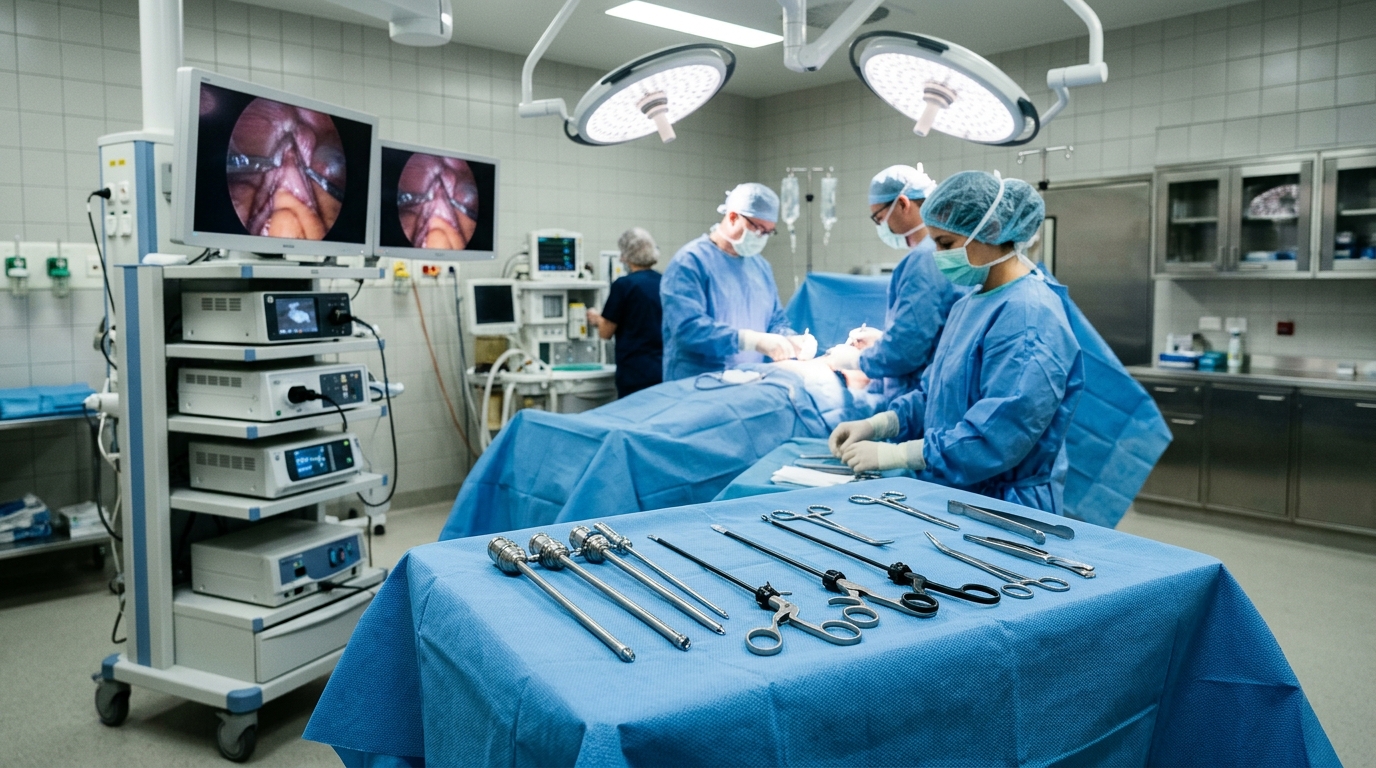
A preoperative nomogram developed by researchers at Shijiazhuang People’s Hospital demonstrated strong discriminative performance in predicting difficult laparoscopic cholecystectomy, according to a retrospective study published in BMC Surgery. Difficult laparoscopic cholecystectomy is associated with an increased risk of intraoperative complications. The study aimed to develop and validate a preoperative nomogram for predicting difficult laparoscopic cholecystectomy.
The retrospective investigation analyzed clinical records from 284 consecutive patients who underwent laparoscopic cholecystectomy at Shijiazhuang People’s Hospital between September 2025 and May 2026. The study population was chronologically divided into two groups: a training cohort consisting of 194 patients and a subsequent temporal validation cohort comprising 90 patients. Operative difficulty was graded according to the standardized Nassar scale, with procedures categorized as grade III or grade IV defined as difficult laparoscopic cholecystectomy cases.
To select variables for model construction, the research team employed least absolute shrinkage and selection operator regression followed by multivariable logistic regression analysis. This statistical screening identified three independent preoperative predictors of surgical difficulty: the body roundness index, the presence of pericholecystic fluid, and serum fibrinogen levels. These three clinical variables were incorporated into the final nomogram designed to estimate the probability of encountering a difficult procedure before entering the operating room.
The model showed good discrimination across both cohorts. The model yielded an area under the receiver operating characteristic curve of 0.827, with a 95 percent confidence interval of 0.756 to 0.898, in the training cohort of 194 patients. In the temporal validation cohort of 90 patients, the area under the curve was 0.849, with a 95 percent confidence interval of 0.759 to 0.939. Internal validation via nested bootstrap resampling with 500 iterations produced an optimism-corrected concordance index of 0.822, corresponding to a minimal estimated optimism of 0.005.
Calibration assessments, however, demonstrated measurable discrepancies between predicted risks and observed clinical outcomes in the temporal validation cohort. The Hosmer–Lemeshow goodness-of-fit test yielded a chi-square value of 6.52 with a p-value of 0.089. Further examination revealed a calibration intercept of 1.0215, with a 95 percent confidence interval of 0.0149 to 2.2827, indicating a systematic underestimation of the observed risk. Furthermore, the calibration slope was 1.3357, with a 95 percent confidence interval of 0.7483 to 2.1282, suggesting that the model’s predicted risks spanned a narrower distribution than the actual observed outcomes.
To assess potential clinical utility, the authors performed decision curve analysis across a range of threshold probabilities. Decision curve analysis provided exploratory evidence of potential net benefit across selected threshold probabilities.
The study authors concluded that while the nomogram exhibited promising predictive accuracy for difficult laparoscopic cholecystectomy and may assist in perioperative planning, important limitations remain. The authors noted that independent multicenter validation is required before routine clinical application.
Subject of Research: Preoperative predictive modeling and temporal validation for difficult laparoscopic cholecystectomy
Article Title: Development and temporal validation of a predictive model for difficult laparoscopic cholecystectomy
Article References: Liu, W., Yang, R., & Zhang, J. (2026). Development and temporal validation of a predictive model for difficult laparoscopic cholecystectomy. BMC Surgery. https://doi.org/10.1186/s12893-026-04260-w
Image Credits: AI Generated
DOI: 10.1186/s12893-026-04260-w
Keywords: laparoscopic cholecystectomy, difficult cholecystectomy, preoperative nomogram, body roundness index, pericholecystic fluid, fibrinogen, Nassar scale, temporal validation, surgical risk stratification, multivariable logistic regression, LASSO regression, Shijiazhuang People's Hospital, area under the ROC curve, decision curve analysis, Hosmer-Lemeshow test, calibration slope, intraoperative complications
News Source: Ophelia Keating. (November 11, 2026). Preoperative Nomogram Shows Strong Discrimination for Predicting Difficult Laparoscopic Cholecystectomy. Scienmag.