A lightweight one-dimensional convolutional neural network trained on frequency-embedded power spectral density sequences significantly outperformed raw time-domain signals in decoding imagined speech from electroencephalography data, according to an original research study published in Frontiers in Human Neuroscience by researchers from the University of Sydney and Dolby Australia.
A brain-computer interface is an emerging technology for decoding users' intentions, enabling speech decoding from electroencephalography signals. In this investigation, authors Simanto Saha, James Wagner, and Alistair McEwan developed a multi-class classification pipeline designed to categorize sequential neural signals into five target words or phrases.
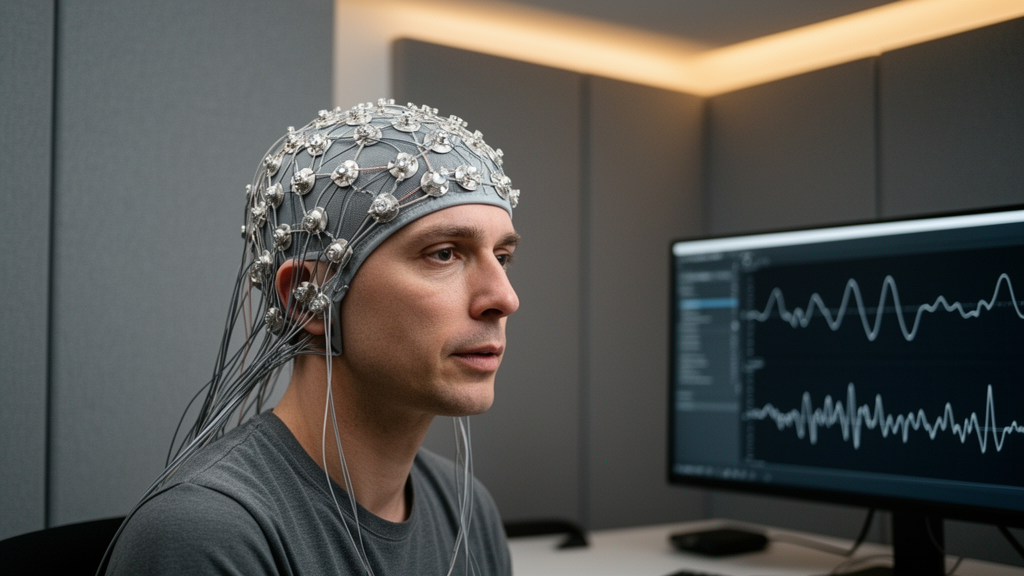
Electroencephalography signals were preprocessed using a bandpass filter between 4 and 120 Hz and a 60 Hz notch filter. The researchers then estimated power spectral density using the modified Welch method, constructing frequency-embedded representations to systematically contrast against conventional time-domain features using a lightweight one-dimensional convolutional neural network architecture tailored for sequential data.
In intra-subject evaluations across participants, the model achieved a mean classification accuracy of 64.4 ± 8.3 percent when utilizing frequency-embedded power spectral density sequences, compared to 46.1 ± 5.1 percent when trained on time-domain signals. Individual peak accuracies within single subjects reached 82 percent with power spectral density representations, whereas peak performance with raw time-domain signals reached 54 percent.
Despite strong intra-subject outcomes, transferring classification capabilities across different individuals proved far more challenging. Pairwise inter-subject testing yielded a best observed accuracy of 42 percent, while pooled inter-subject models achieved mean accuracies of only 23.3 ± 1.0 percent for time-domain signals and 24.5 ± 0.4 percent for spectral sequences, remaining near chance level for five-class classification.
The authors concluded that while frequency-embedded spectral features offer substantial improvements for subject-specific imagined speech classification, inter-subject generalization remains a primary bottleneck in electroencephalography-based brain-computer interfaces, highlighting the necessity for further research into user-independent decoding pipelines.
The research was formally accepted for publication on 26 October 2026 following initial submission on 28 August 2026, appearing in the Brain-Computer Interfaces specialty section of Frontiers in Human Neuroscience. Academic investigators Simanto Saha and Alistair McEwan conducted the study at the University of Sydney in Darlington, partnering with industrial researcher James Wagner from Dolby Australia in McMahons Point. Simanto Saha served as the corresponding author for the collaborative work, which was distributed under open-access terms and indexed under key subject headings covering electroencephalography, power spectral density, one-dimensional convolutional neural networks, and automatic speech recognition.
Subject of Research: EEG-to-text classification using frequency-embedded sequence learning and 1D convolutional neural networks
Article Title: Frequency-embedded sequence learning for multi-class EEG-to-text interface
Article References: Saha, S., Wagner, J., & McEwan, A. (2026). Frequency-embedded sequence learning for multi-class EEG-to-text interface. Frontiers in Human Neuroscience, 20, Article 1980894. https://doi.org/10.3389/fnhum.2026.1980894
Image Credits: AI Generated
DOI: 10.3389/fnhum.2026.1980894
Keywords: brain-computer interfaces, electroencephalography, 1D-CNN, convolutional neural networks, power spectral density, modified Welch method, EEG-to-text classification, imagined speech decoding, intra-subject evaluation, inter-subject generalization, time-domain EEG, frequency-embedded sequences, bandpass filtering, notch filter, speech decoding, sequential data modeling, multi-class classification
News Source: Cassandra Pierce. (November 11, 2026). Frequency-Embedded Sequences Improve Intra-Subject EEG Speech Classification Over Time-Domain Signals. Scienmag.