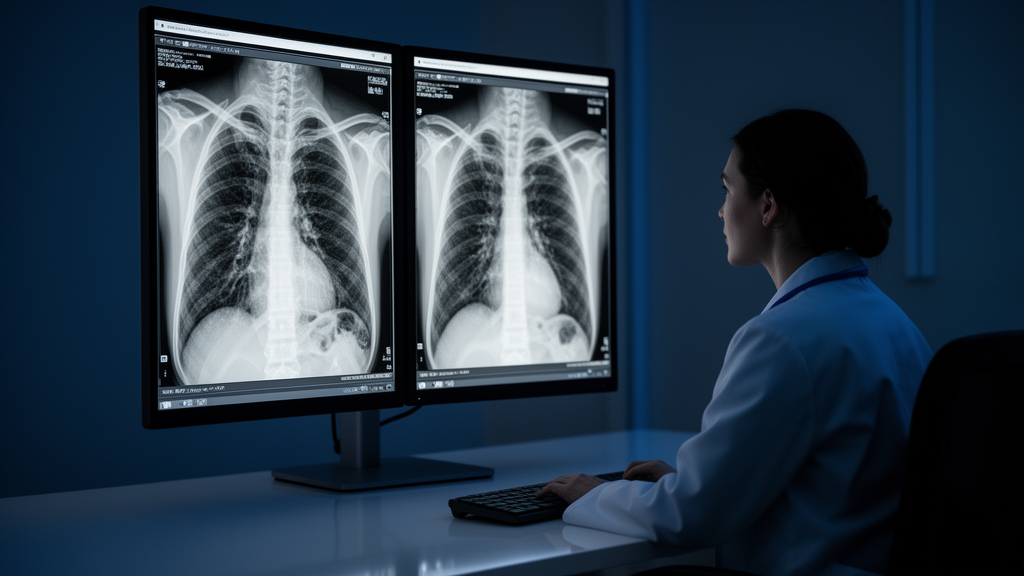
The investigation, conducted using chest radiographs from the VinDr ChestX dataset and the South African Medical Bureau for Occupational Diseases, suggested that aggregate benchmarks can conceal the loss of fine-grained evidence needed for under-represented pathologies such as silicosis.
The controlled experiments revealed a marked descriptive divergence between different pulmonary conditions. Performance in detecting silicosis showed a strong positive correlation with input resolution, improving steadily as image size increased up to 640 by 640 pixels.
To address the resolution constraint without requiring complete retraining of large models, the team evaluated AutoSwin, a trainable downsampling frontend based on a Hierarchical Shifted Window Transformer architecture. When evaluated on clinical radiographs, AutoSwin increased the macro-averaged area under the receiver operating characteristic curve from 0.5527 to 0.7437 on the Medical Bureau for Occupational Diseases dataset, while boosting the metric from 0.8505 to 0.8873 on the VinDr benchmark.
The researchers noted that these preliminary findings motivate pathology-specific resolution assessments as a vital component of future medical foundation model design. Furthermore, the results demonstrate that learned downsampling architectures provide a viable mechanism to recover task-relevant visual details when the retraining of full-scale, high-resolution foundation models remains computationally impractical.
Subject of Research: Learned downsampling for chest radiograph foundation models
Article Title: AutoSwin: learned downsampling for adapting high-resolution chest X-rays to fixed-resolution foundation models
Article References: Bruton, J., Terespolsky, S., Sive, W., Ehrlich, R., Yassi, A., Wang, H., & Klein, R. (2026). AutoSwin: Learned Downsampling for Adapting High-Resolution Chest X-rays to Fixed-Resolution Foundation Models. Frontiers in Computer Science, 8, 1947682. https://doi.org/10.3389/fcomp.2026.1947682
Image Credits: AI Generated
DOI: 10.3389/fcomp.2026.1947682
Keywords: chest radiography, medical foundation models, learned downsampling, AutoSwin, Swin Transformers, silicosis, tuberculosis, VinDr ChestX, MBOD, computer-aided diagnosis, computer vision, input resolution, macro-averaged AUC, hierarchical shifted window transformer, pathology-dependent bottleneck, spatial scale, occupational diseases
News Source: Blake Davidson. (November 11, 2026). AutoSwin Downsampling Enhances Medical Foundation Model Performance on Chest Radiographs. Scienmag.