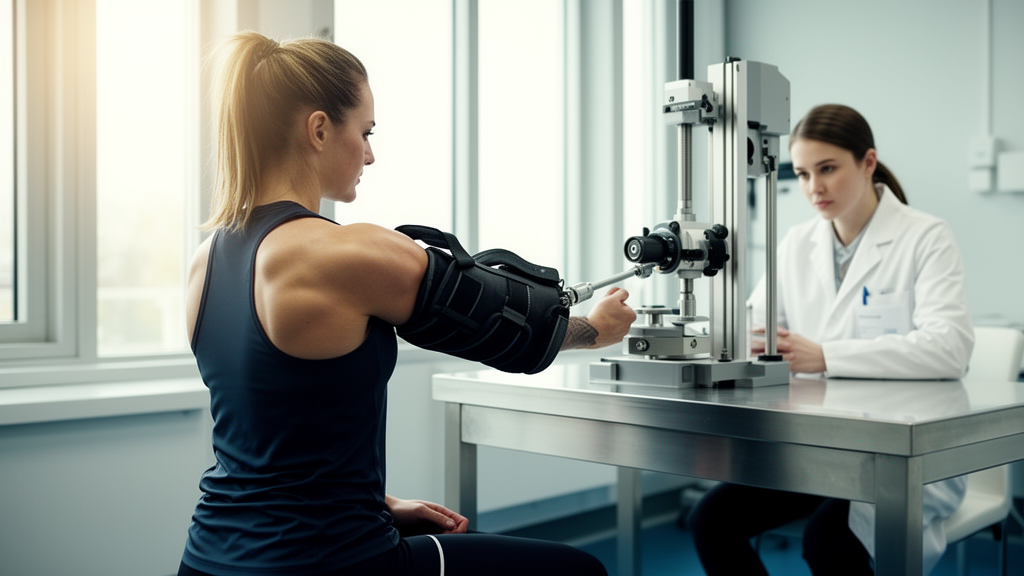
In a randomized controlled trial published in Frontiers in Physiology, researchers found that three weeks of non-dominant arm immobilization significantly reduced maximal muscle force in team-sport athletes while simultaneously altering their response to a sustained submaximal exercise task. The study, led by Wael Daab and colleagues from institutions in Tunisia, the United Arab Emirates, and France, investigated how short-term disuse affects neuromuscular function and exercise-induced fatigability. The central finding indicates that while immobilization impaired the muscle’s capacity to generate peak force, it resulted in increased endurance time during a task performed at a relative intensity, a shift the authors attribute to a lower absolute load rather than an intrinsic improvement in fatigue resistance.
The research team recruited 24 team-sport athletes, who were randomly allocated to either an immobilization group or a control group. Twelve participants underwent three weeks of immobilization of their non-dominant arm, while the other twelve served as controls. This parallel-group design allowed the researchers to isolate the effects of disuse from natural variability in neuromuscular performance. The study specifically targeted the elbow flexors, a muscle group critical for many athletic movements, to assess changes in both central and peripheral mechanisms of fatigue.
Before and after the three-week intervention, participants performed a sustained isometric contraction at 50% of their maximal voluntary contraction (MVC) until task failure. A crucial methodological detail is that the target force was recalculated as 50% of the MVC measured at each visit. Consequently, because the immobilized group experienced a reduction in their absolute MVC, the absolute force they had to maintain during the fatiguing task was lower after the intervention compared to before. This relative-intensity approach meant that the physiological demand on the muscle was adjusted to the participant’s current capacity, rather than being fixed at an absolute weight.
In the immobilization group, the intervention led to a measurable reduction in anthropometrically estimated upper-arm muscle-and-bone area, decreasing by 7.3%. More significantly, pre-exercise MVC dropped by 22.9%, whereas neither of these metrics changed in the control group. This decline in maximal force-generating capacity directly influenced the parameters of the subsequent fatigue test. The absolute target force for the sustained contraction was lower after immobilization, averaging 69.3 Newtons compared to 89.9 Newtons before the intervention. This reduction in absolute load is a key factor in interpreting the subsequent changes in endurance and fatigue markers.
Under this lower absolute demand, the immobilized athletes demonstrated an increase in endurance time, sustaining the contraction for an average of 281.65 seconds after immobilization, compared to 220.88 seconds before. This increase was statistically significant, with a p-value of less than 0.001. Furthermore, the exercise-induced decline in MVC was smaller after immobilization, dropping by 14.4% compared to a 31.5% decline before the intervention. The statistical analysis revealed a significant group by condition by exercise interaction for this decline, with an F-value of 15.74 and a p-value of less than 0.001, indicating that the change in fatigue response was specific to the immobilization condition.
The researchers also examined peripheral fatigue mechanisms by measuring potentiated twitch force (Qtw,pot), which reflects the contractile state of the muscle fibers. The exercise-induced decline in Qtw,pot was also attenuated after immobilization in the experimental group, decreasing by 15.2% compared to a 38.9% decline before the intervention. This interaction was statistically significant, with an F-value of 4.58 and a p-value of 0.044. In contrast, the control group maintained a large decline in potentiated twitch force, highlighting that the observed attenuation in the immobilized group was not a general artifact of the testing protocol but a specific consequence of the disuse period.
Central fatigue mechanisms were assessed through voluntary activation (VA) and M-wave responses, which quantify the neural drive to the muscle and the electrical response of the muscle membrane, respectively. While both VA and root mean square (RMS) of the M-wave decreased after exercise in all participants, no significant group by condition by exercise interaction was detected for either metric. The p-values for these interactions were 0.130 for VA and 0.391 for RMS/Mmax. The authors caution that given the sample size, these non-significant results indicate that a differential central or sarcolemmal response was not detected, rather than proving that such a response was absent. This distinction is important for understanding the limits of the study’s conclusions regarding central nervous system adaptations.
The study concludes that short-term immobilization impairs maximal force-generating capacity but increases endurance time during a sustained submaximal task when performed at the same relative intensity. The authors emphasize that the observed peripheral signature, characterized by smaller declines in maximal force and potentiated twitch force, most plausibly reflects a smaller peripheral fatigue response to a reduced absolute demand. They explicitly state that these findings should not be interpreted as an intrinsic enhancement of contractile fatigue resistance. Instead, the results describe altered fatigability during a relative-intensity task, highlighting the complex interplay between muscle capacity, load intensity, and fatigue mechanisms in team-sport athletes.
Subject of Research: Effects of short-term arm immobilization on neuromuscular function and fatigue in team-sport athletes
Article Title: Short-term arm immobilization reduces maximal force and alters fatigue responses to a relative-intensity task in team-sport athletes: a randomized controlled trial
Article References: Erriahi, S., Daab, W., Ammar, A., Zghal, F., Hamdi, S., Ben Hsen, I., & Bouzid, M. A. (2026). Short-term arm immobilization reduces maximal force and alters fatigue responses to a relative-intensity task in team-sport athletes: a randomized controlled trial. Frontiers in Physiology, 17, Article 1977296. https://doi.org/10.3389/fphys.2026.1977296
Image Credits: AI Generated
DOI: 10.3389/fphys.2026.1977296
Keywords: muscle immobilization, neuromuscular fatigue, randomized controlled trial, team-sport athletes, maximal voluntary contraction, peripheral fatigue, exercise physiology, muscle disuse, Short-term, immobilization, reduces, maximal
News Source: Drew Townsend. (November 11, 2026). Arm Immobilization Reduces Force, Alters Fatigue in Athletes. Scienmag.