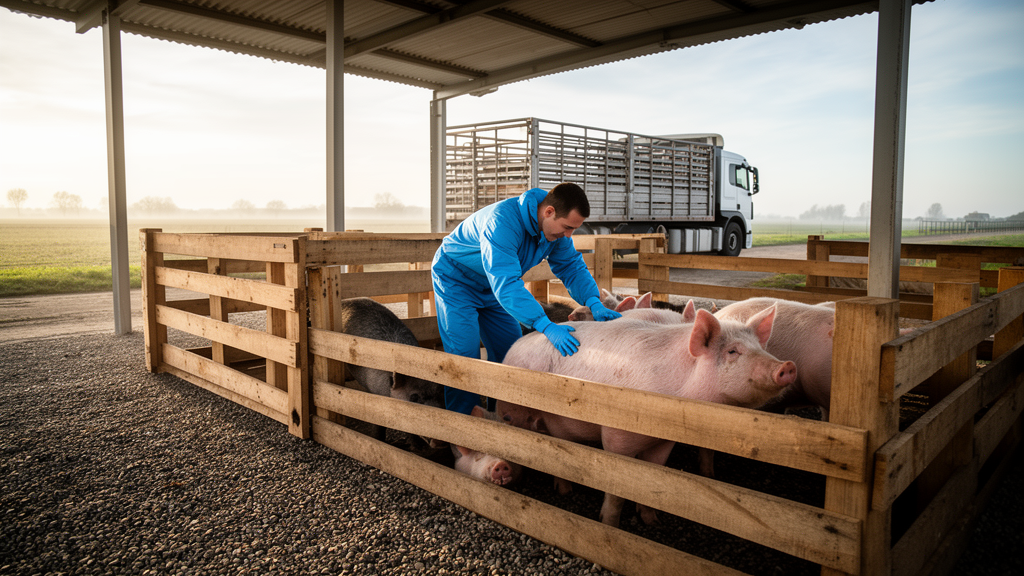
Researchers investigating cross-border livestock commerce between Zambia and the Democratic Republic of Congo have identified substantial regulatory and surveillance gaps that delineate critical transmission pathways for the parasitic tapeworm Taenia solium. By evaluating the pig production and supply chain connecting Zambia’s Copperbelt and Luapula Provinces in Southern Africa directly to Haut-Katanga Province in Central Africa, the study revealed marked discrepancies between administrative records and physical cross-border traffic. These unmonitored commercial flows allow potentially infected animals and uninspected pork to circulate through slaughter facilities and retail outlets, establishing tangible exposure pathways for a major foodborne zoonotic pathogen that remains highly prevalent throughout sub-Saharan Africa.
To address these persistent risks, the researchers emphasized that conducting a comprehensive farm-to-fork analysis of regional pig production and distribution networks is essential to identify, track, and ultimately mitigate underlying risk factors. The study set out specifically to map the operational architecture of the cross-border pig and carcass food chain, evaluate the professional roles and management practices of participating stakeholders regarding animals presumed to be infected, and pinpoint critical operational junctures to improve pork safety management.
To capture the full complexity of this international livestock network, the research team carried out a rigorous mixed-methods investigation from September 2023 to January 2025. The investigative strategy triangulated four complementary empirical sources: extensive direct field observations across trade hubs, detailed interviews conducted with 96 supply chain stakeholders, archival administrative registries maintained by border veterinary services, and dedicated enumerations of pigs moving across border transit points.
The empirical mapping identified a highly organized cross-border food chain structured around six distinct operational stages: initial supply sources, handling procedures, veterinary health inspection, statutory taxation and regulation, transportation logistics, and initial and terminal points of consumption. Operating across these successive phases, the researchers cataloged ten distinct stakeholder categories whose activities sustain the cross-border meat trade. These key participant groups include pig shelter managers, livestock buyers, commercial sellers, specialized pig slaughterers, cargo and animal handlers, border veterinarians, motorized and non-motorized transporters, combined slaughterer-retailer pork vendors, official veterinary inspectors, and end-market pork sellers operating from domestic residences, open market stalls, and popular grilled-pork establishments.
A central revelation of the study emerged from the stark divergence between administrative trade records and direct field counts conducted at the international boundary. Over the course of a single monitoring week, research observers documented 1,696 live pigs and 32 dressed carcasses actively crossing the border from Zambia into the Democratic Republic of Congo. By sharp contrast, official border veterinary services registries documented only 4,799 animals across an entire calendar year. This dramatic statistical gap highlights the massive volume of cross-border livestock commerce that completely circumvents official documentation, demonstrating that routine border controls capture only a fraction of animal movements while allowing high volumes of unmonitored livestock to flow unchecked into regional processing and consumption channels.
Alongside the unrecorded traffic, direct field observations and stakeholder interviews documented pervasive failures in veterinary health inspections throughout the food chain. Diagnostic screening protocols were rarely enforced in practice, with observers noting significant gaps in formal veterinary inspections and the non-systematic execution of tongue palpation from initial supply sources all the way to municipal slaughterhouses.
The study team concluded that the combination of limited statutory regulation and widespread health oversight gaps—stretching continuously from border crossings through slaughter facilities to retail points—creates severe exposure pathways for human populations. In the absence of rigorous veterinary screening, the widespread trade and marketing of uninspected, suspect meat serves as an active mechanism for human exposure to Taenia solium along this transboundary pig food chain. The researchers stressed that these findings illuminate notable vulnerabilities in cross-border surveillance and disease monitoring infrastructure. To effectively curb potential introduction and transmission pathways for this parasitic infection, they underscore an urgent and critical need for coordinated multi-country control programs and harmonized veterinary oversight mechanisms uniting authorities across Zambia and the Democratic Republic of Congo.
Subject of Research: Cross-border pig food chain mapping and Taenia solium transmission pathways between Zambia and DRC
Article Title: Mapping the cross-border pig/carcass food chain between Zambia and the Democratic Republic of Congo: Identifying potential transmission pathways for Taenia solium
Article References: Alain, T. K., Gégoire, K. A., Mosses, T. K., & Gabriël, S. (2026). Mapping the cross-border pig/carcass food chain between Zambia and the Democratic Republic of Congo: Identifying potential transmission pathways for Taenia solium. BMC Veterinary Research. https://doi.org/10.1186/s12917-026-06019-0
Image Credits: AI Generated
DOI: 10.1186/s12917-026-06019-0
Keywords: Taenia solium, cysticercosis, pig food chain, pork safety, zoonotic parasites, cross-border trade, Zambia, Democratic Republic of Congo, Copperbelt Province, Luapula Province, Haut-Katanga Province, border veterinary services, veterinary inspection, tongue palpation, slaughterhouse hygiene, cystic lesions, foodborne zoonosis, pork retail
News Source: Drew Townsend. (November 11, 2026). Cross-Border Pig Trade Surveillance Gaps Expose Potential Tapeworm Transmission Pathways. Scienmag.