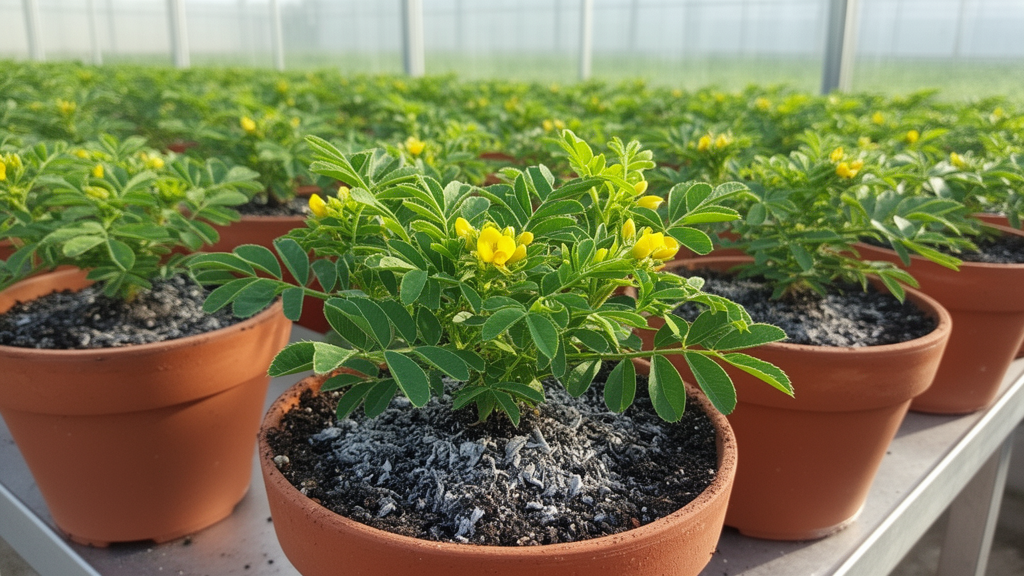
In a 90-day controlled pot trial, researchers demonstrated that amending soil with intermediate proportions of thermal power plant fly ash significantly improved soil physicochemical characteristics and supported the physiological performance of the medicinal plant Tribulus terrestris L., while excessive concentrations suppressed plant growth. Utilizing one-way analysis of variance and Tukey’s honestly significant difference post-hoc testing, the investigation revealed that fly ash additions exerted statistically significant effects across evaluated soil properties, plant biochemical parameters, and photosynthetic pigments. Rather than observing linear improvements across all application rates, the investigators found that beneficial responses clustered around moderate fly ash concentrations, establishing that the utility of this coal combustion by-product as an agricultural amendment depends strictly on dosage management.
Fly ash is an industrial by-product generated in substantial quantities by thermal power generation facilities, where it is conventionally classified and managed as solid waste. Although scientific interest in repurposing fly ash as an agricultural soil amendment has expanded in recent years, its integrated influence on soil physicochemical dynamics, nutrient availability, and physiological stress responses within medicinal crops has received limited scholarly attention. Addressing this knowledge gap, the study examined whether fly ash amendments could alter the physical and chemical matrix of soil in ways that enhance the biological performance of Tribulus terrestris L., an herb valued for its medicinal properties, under strictly regulated pot conditions.
To evaluate these interactions systematically, the researchers established a 90-day pot experiment testing six distinct volumetric ratios of fly ash blended with standard garden soil. The designated treatments ranged from T0 through T5, where treatment T0 served as the unamended control comprising zero percent fly ash and one hundred percent garden soil on a volume-to-volume basis. Successive amendment treatments integrated increasing proportions of fly ash: treatment T1 contained 20 percent fly ash, treatment T2 contained 30 percent fly ash, treatment T3 contained 40 percent fly ash, treatment T4 contained 50 percent fly ash, and treatment T5 consisted entirely of 100 percent raw fly ash.
Throughout the experimental timeline, the research team conducted elemental analyses of the base materials, encompassing the unmixed fly ash substrate alongside the various amended soil mixtures. In addition to testing baseline substrate qualities, the researchers measured physical and chemical soil properties alongside comprehensive biochemical parameters and photosynthetic pigment concentrations within the cultivated Tribulus terrestris plants. One-way analysis of variance confirmed that fly ash application produced statistically significant differences across all evaluated soil parameters, plant biochemical indicators, and photosynthetic pigment levels at a significance threshold of p < 0.05, confirming that the substrate modifications actively influenced plant physiology.
The application of fly ash induced substantial modifications in the fundamental physicochemical properties of the growing medium compared to untreated soil. Soil analyses indicated that fly ash incorporation effectively increased the water-holding capacity and elevated the electrical conductivity of the amended substrate. Concurrently, the treatment significantly reduced soil bulk density and lowered soil pH values, creating an altered rooting environment. Furthermore, the amended substrate demonstrated increased baseline concentrations of several essential micronutrients, providing an altered reservoir of mineral elements available to the developing medicinal plants during the 90-day cultivation period.
Post-hoc comparisons using Tukey’s honestly significant difference test demonstrated that plant physiological and biochemical responses varied markedly depending on the specific amendment dosage. The strongest overall physiological responses were documented at intermediate fly ash incorporation levels, with the 40 percent fly ash treatment, designated as T3, producing the most favorable outcomes in Tribulus terrestris. However, plant vitality did not continue to rise with heavier applications. Instead, physiological performance declined sharply at the highest treatment level of 100 percent fly ash (T5), with both the 50 percent (T4) and 100 percent (T5) treatments actively inhibiting the growth of the medicinal plants.
Correlation analyses conducted between elemental concentrations and plant performance metrics elucidated the complex relationships governing nutrient uptake and physiological adaptation. While the availability of micronutrients in the amended substrate generally displayed positive correlations with plant growth responses, only selected individual elemental relationships satisfied the rigorous criteria for statistical significance. Pearson’s correlation testing demonstrated that the strongest positive correlations emerged between the stress-related amino acid proline and several vital minerals, specifically zinc, copper, manganese, nickel, iron, and magnesium. In parallel, magnesium concentrations exhibited moderate positive correlations with total plant protein content, nitrogen levels, and soluble sugar accumulation.
Despite the documented capacity of fly ash to enhance soil properties and bolster the physiological performance of Tribulus terrestris L. under controlled pot conditions, the investigators underscored critical constraints regarding real-world agricultural implementation. Because the findings were obtained exclusively within a short-term, 90-day pot environment, the authors emphasized that longer-term field trials must be conducted to observe ecological behavior under open conditions. Furthermore, rigorous plant-tissue metal assessments and comprehensive environmental and toxicological safety evaluations remain mandatory before fly ash amendments can be responsibly recommended for cultivating medicinal plants destined for pharmacological utilization.
Subject of Research: Effects of fly ash soil amendment on soil properties and Tribulus terrestris performance
Article Title: Fly ash-mediated changes in soil properties regulate nutrient dynamics, plant growth, and stress responses in Tribulus terrestris L
Article References: Singh, J., Raj, S., Kaur, D. P., Tufail, Malik, S., & Preetam, S. (2026). Fly ash-mediated changes in soil properties regulate nutrient dynamics, plant growth, and stress responses in Tribulus terrestris L. Discover Materials. https://doi.org/10.1007/s43939-026-01034-2
Image Credits: AI Generated
DOI: 10.1007/s43939-026-01034-2
Keywords: Tribulus terrestris, fly ash, soil amendment, soil physicochemical properties, thermal power plant waste, pot experiment, water-holding capacity, electrical conductivity, bulk density, soil pH, proline, photosynthetic pigments, plant nutrient dynamics, micronutrient availability, medicinal plants, one-way ANOVA, Tukey's HSD post-hoc analysis, Pearson correlation analysis
News Source: Denise Maddox. (November 11, 2026). Moderate Fly Ash Levels Improve Tribulus terrestris Growth in Controlled Pot Study. Scienmag.