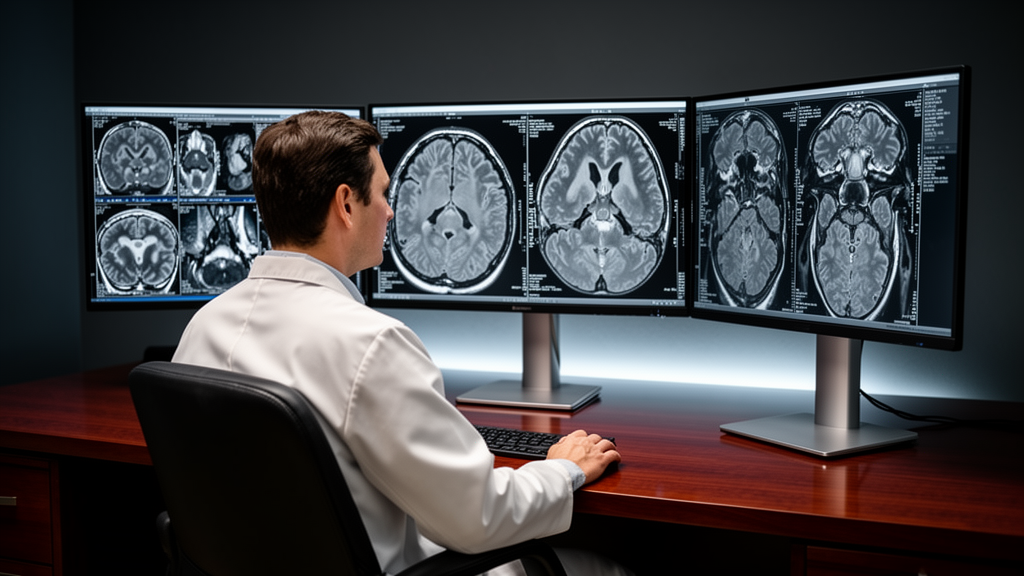
A retrospective study published in BMC Neurology presents a machine learning model that integrates multi-parametric MRI radiomics with clinical data to predict clinical outcomes in patients with acute ischemic stroke. The research team aimed to develop and validate a clinical-radiomics nomogram to help distinguish between patients with good and poor prognosis. The study was conducted using a cohort of 214 patients who underwent baseline multi-parametric MRI scans.
The researchers retrospectively included 214 patients with acute ischemic stroke, assigning them to four distinct cohorts for model development and testing. The training cohort consisted of 105 patients, while the validation cohort included 43 patients. Two test cohorts were established to evaluate the model’s performance: an internal test cohort of 33 patients and an external test cohort of 33 patients. All participants underwent baseline multi-parametric MRI scans, which provided the imaging data necessary for radiomic feature extraction.
To define clinical outcomes, the researchers stratified patients based on their modified Rankin Scale scores at 90 days after discharge. Patients with a score of 2 or lower were classified as having a good prognosis, whereas those with a score greater than 2 were categorized as having a poor prognosis.
The imaging analysis involved extracting a total of 1130 radiomic features from three specific MRI sequences. These sequences included diffusion-weighted imaging, the apparent diffusion coefficient, and cerebral blood flow images generated from arterial spin labeling data. The extracted features were then used to construct the radiomics component of the predictive model.
Three distinct models were constructed to predict AIS prognosis: a clinical model, a radiomics model, and a combined clinical-radiomics model. The performance of these models was evaluated using several metrics, including the area under the curve for discrimination, calibration curves for goodness-of-fit, and decision curve analysis for clinical utility.
The results demonstrated that the integrated clinical-radiomics nomogram outperformed the individual models in both test cohorts. In the internal test cohort, the combined model achieved an area under the curve of 0.796, compared to 0.787 for the clinical model and 0.783 for the radiomics model. In the external test cohort, the integrated model showed an AUC of 0.741, surpassing the clinical model’s 0.670 and the radiomics model’s 0.682. The nomogram also demonstrated strong goodness-of-fit in both the training and validation cohorts.
Decision curve analysis further indicated the clinical utility of the integrated model. The study concluded that the clinical-radiomics model is effective in predicting clinical outcomes in acute ischemic stroke patients. The authors suggested that this tool could be used to guide personalized treatment strategies.
Subject of Research: Development and validation of a clinical-radiomics nomogram for predicting acute ischemic stroke outcomes
Article Title: Multi-parametric MRI radiomics-based machine learning model for predicting clinical outcomes in acute ischemic stroke
Article References: Wu, X., Zhang, X., Fang, J., Chen, L., Liang, X., Liang, L., Li, L., Zhang, L., Zhang, B., & Wang, F. (2026). Multi-parametric MRI radiomics-based machine learning model for predicting clinical outcomes in acute ischemic stroke. BMC Neurology. https://doi.org/10.1186/s12883-026-05341-2
Image Credits: AI Generated
DOI: 10.1186/s12883-026-05341-2
Keywords: acute ischemic stroke, MRI radiomics, machine learning, clinical prediction, modified Rankin Scale, diffusion-weighted imaging, arterial spin labeling, prognosis modeling, neuroimaging, clinical nomogram, stroke recovery, predictive analytics, medical imaging, patient stratification, functional outcome, retrospective study, model validation, decision curve analysis, cerebral blood flow, apparent diffusion coefficient
News Source: Cassandra Pierce. (November 11, 2026). MRI Radiomics Model Predicts Stroke Outcomes. Scienmag.