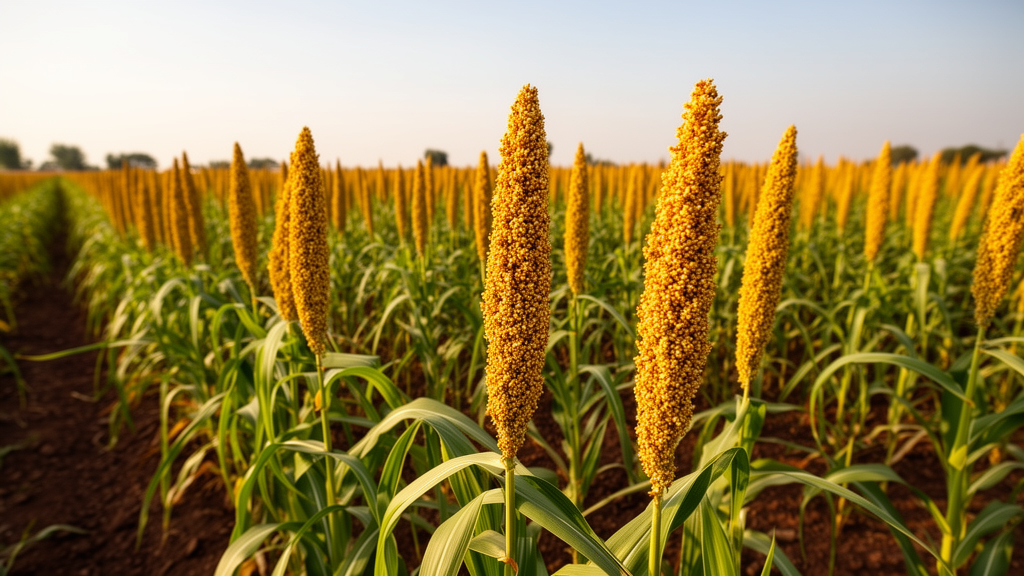
Researchers evaluating 218 pearl millet genotypes across four distinct growing environments have identified five elite donor lines that combine high mineral concentrations, reduced anti-nutritional compounds, and stable grain yield. The multi-environment evaluation, utilizing germplasm from the global Pearl Millet Inbred Germplasm Association Panel, established that genotypes G88, G20, G132, G110, and G175 consistently excelled across comprehensive multi-trait selection protocols. These top-ranked accessions—specifically identified as IP 17690, ICTP 8203, IP 3757, IP 2058, and IP 7922—garnered support from at least six out of seven analytical stability models while simultaneously meeting Best Linear Unbiased Prediction thresholds for target agronomic and nutritional traits, offering validated parental material for crop biofortification programs.
The investigation addressed fundamental challenges associated with pearl millet improvement, specifically the complex inheritance patterns governing grain nutritional parameters and the substantial influence exerted by genotype-by-environment interactions. Although pearl millet functions as a climate-resilient and nutrient-dense cereal capable of addressing micronutrient malnutrition, environmental variations traditionally confound attempts to select stable cultivars. To overcome these impediments, the researchers conducted combined analysis of variance across the four trial environments, which revealed highly significant effects attributable to genotypes, testing environments, and genotype-by-environment interactions for all evaluated characteristics. Broad-sense heritability estimates remained remarkably high across all seven measured traits, spanning from 0.83 to 0.99, indicating substantial genetic control despite pronounced environmental sensitivities.
To untangle correlated traits, the research team implemented multi-trait genotype selection via the Multi-Trait Selection Index following an exploratory factor analysis that organized the seven target traits into five latent factors. This simultaneous selection procedure generated favorable predicted genetic gains across critical micronutrients and agronomic productivity, forecasting improvements of 26.38 percent for iron, 9.81 percent for zinc, 4.94 percent for phosphorus, and 1.38 percent for seed yield per plant. Conversely, the model recorded a modest negative predicted response of 6.89 percent for manganese, demonstrating a concrete genetic trade-off during concurrent multi-trait improvement.
Based on calculated Multi-Trait Selection Index values, the investigators shortlisted 33 superior genotypes from the broader 218-member panel to undergo rigorous multi-model stability assessments. Best Linear Unbiased Prediction analysis pinpointed exceptional individual accessions possessing extreme phenotypic values across the profiled dimensions. Genotype G158 stood out as the foremost donor for suppressing anti-nutritional factors, recording the lowest predicted concentrations of total tannin content at 0.55 milligrams per gram and phytic acid content at 2.47 milligrams per gram. For individual nutrient enhancements, genotype G179 secured the highest predicted iron concentration at 111.39 milligrams per kilogram, while genotype G175 achieved the highest predicted zinc concentration at 56.41 milligrams per kilogram.
The prediction modeling further cataloged standout genotypes across the remaining nutritional and yield metrics under study. Genotype G88 recorded the peak predicted phosphorus concentration of 9233.50 milligrams per kilogram, genotype G113 demonstrated the highest predicted manganese concentration at 34.60 milligrams per kilogram, and genotype G20 delivered the superior predicted seed yield per plant at 22.65 grams. To assess phenotypic stability across environments, the authors examined genotype plus genotype-by-environment interaction biplots, finding that the first two principal components accounted for 98.48 to 99.94 percent of total variation across the evaluated traits. Across the seven distinct analytical frameworks, specific accessions appeared repeatedly as premier candidates for individual attributes, including G113 for total tannin content, G62 for phytic acid content, G129 for phosphorus, G109 for iron, G175 for zinc, G1 for manganese, and G88 for seed yield per plant.
Evaluating stability rankings across independent analytical algorithms illuminated how different statistical criteria prioritized candidate donors. Genotype G169 attained first rank across three separate models: the Additive Main Effects and Multiplicative Interaction model one, the AMMI Stability Value, and the Genotype Selection Index. In contrast, alternative methods highlighted distinct leaders, placing genotype G110 first under the Additive Main Effects and Multiplicative Interaction model two, genotype G198 first under the Weighted Average of Absolute Scores framework, genotype G108 first under Best Linear Unbiased Prediction metrics, and genotype G88 first in the which-won-where environmental evaluation.
Synthesizing the seven analytical approaches established an integrated ranking that isolated ten elite genotypes supported by at least six analytical pipelines and backed by Best Linear Unbiased Prediction selection for at least one trait. Leading this combined cohort were accessions G88, G20, G132, G110, and G175, designated respectively in repository collections as IP 17690, ICTP 8203, IP 3757, IP 2058, and IP 7922. These five accessions successfully united enhanced concentrations of essential minerals with decreased anti-nutritional factors, sustained seed yield, and reliable phenotypic stability across disparate environmental conditions. The research team concluded that these verified accessions serve as valuable genetic resources and promising parental lines for developing environmentally stable, nutrient-dense pearl millet cultivars.
Subject of Research: Multi-trait selection and stability evaluation of global pearl millet germplasm
Article Title: Harnessing genotype × environment interactions and multi-trait selection indices to identify nutritionally superior pearl millet accessions from global PMiGAP germplasm
Article References: Hemanth, S., Singh, S. P., Singhal, T., Naveen, A., Yadav, S., Kapoor, C., Sharma, S., Bhargavi, H. A., Jangala, D. J., Nag, S., Singh, N., Nepolean, T., & Satyavathi, C. T. (2026). Harnessing genotype × environment interactions and multi-trait selection indices to identify nutritionally superior pearl millet accessions from global PMiGAP germplasm. BMC Plant Biology. https://doi.org/10.1186/s12870-026-10327-w
Image Credits: AI Generated
DOI: 10.1186/s12870-026-10327-w
Keywords: pearl millet, biofortification, genotype by environment interaction, multi-trait selection index, PMiGAP, micronutrient malnutrition, grain nutritional quality, total tannin content, phytic acid content, seed yield per plant, broad-sense heritability, BLUP analysis, AMMI model, GGE biplot, WAASB, crop stability analysis
News Source: Daisy Hatcher. (November 10, 2026). Multi-Trait Analysis Identifies Five Stable Nutrient-Rich Pearl Millet Accessions. Scienmag.