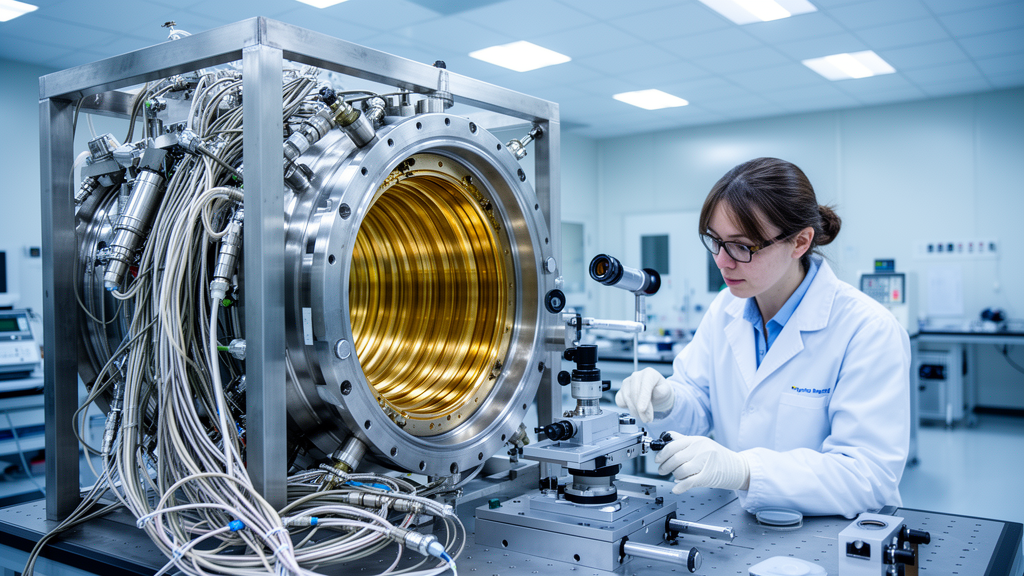
Dr. Rima Schüssler has been appointed to lead a newly established Helmholtz Investigator Group at the Helmholtz Institute Jena, an institute of the GSI Helmholtzzentrum für Schwerionenforschung based on the campus of Friedrich Schiller University in Jena. Backed by one million euros in funding from the Helmholtz Association distributed across a five-year period, the research team is preparing to conduct high-precision mass measurements on heavy, highly charged ions. The primary scientific objective of the initiative is to perform rigorous experimental tests of quantum electrodynamics and examine the validity of the Standard Model of particle physics in extremely strong electromagnetic fields with unprecedented precision.
High-precision mass determinations of highly charged ions provide critical experimental data across several core domains of contemporary physics. These measurements contribute directly to narrowing down the absolute mass of neutrinos, probing for potential physical phenomena beyond the Standard Model, and testing the foundational tenets of Einstein’s equivalence principle described by the mass-energy relation. To date, however, the practical application of high-precision mass spectrometry has been largely restricted to atomic ions possessing only intermediate masses or moderate charge states, leaving the extreme regimes of heavy, highly stripped atomic systems experimentally unexplored.
Achieving the required measurement sensitivity demands isolating individual ions within specialized electromagnetic containers known as Penning traps. In this experimental framework, researchers determine an ion’s mass by recording its characteristic motional frequency while it is confined within a strong, homogeneous magnetic field.
To overcome current limitations regarding ionic mass and charge, Schüssler’s early-career group plans to construct and install a dedicated Penning trap mass spectrometer at the HITRAP facility located at GSI and FAIR. HITRAP represents a unique deceleration facility capable of slowing heavy, highly charged ions produced by the high-energy accelerator complex down to kinetic energies low enough to permit stable physical trapping. Pairing decelerated ions from HITRAP with high-precision Penning trap mass spectrometry establishes a novel experimental avenue to examine quantum electrodynamics in strong fields by determining the inner electron binding energies directly from net mass differences.
The experimental setup is engineered to reach a relative measurement uncertainty of less than 10⁻¹¹, which will allow scientists to determine electron binding energies with an uncertainty below one electronvolt, even when analyzing the heaviest elements. This mass spectrometric methodology serves as an entirely complementary counterpart to existing quantum electrodynamics tests based on X-ray spectroscopy, including measurements previously carried out at the Experimental Storage Ring at GSI and FAIR. By evaluating identical atomic properties through distinct experimental channels, researchers can independently assess and systematically cross-check potential systematic uncertainties across both techniques.
The technical architecture of the planned instrument features a state-of-the-art Penning trap configuration comprising multiple connected traps designed to store and measure distinct highly charged ionic species simultaneously. Ions will be supplied through two independent pathways: directly from the HITRAP beamline for the heaviest ions in the highest charge states, or from an auxiliary offline ion source providing medium-mass and medium-charge ions.
The five-year operational roadmap for the Helmholtz Investigator Group is structured into distinct experimental phases. The team will initially utilize the offline ion source to calibrate, benchmark, and commission the multi-trap spectrometer. In the final year of the project, the focus will shift toward executing binding energy measurements using the highly charged heavy ions delivered directly from the accelerator facility. Although the HITRAP beamline is currently serving as an interim injector designated as project PARTIH for the international Facility for Antiproton and Ion Research until 2028, the installation will subsequently be returned to its standalone HITRAP configuration to resume beam-based precision physics at GSI.
Dr. Schüssler highlighted that the new Penning trap setup at HITRAP provides an exceptional framework to push high-precision mass spectrometry toward the heaviest ions in their highest possible charge states, expanding both fundamental quantum electrodynamics evaluations and broader precision measurements at the facility. Professor Thomas Stöhlker, director of the Helmholtz Institute Jena and head of the Atomic, Quantum and Fundamental Physics research division at GSI and FAIR, noted that these trap-based measurements address fundamental questions regarding natural laws and contribute decisively to testing the Standard Model while reinforcing institutional capabilities in basic research.
Institutional leadership also underscored the strategic role of early-career programs within the research center. Professor Thomas Nilsson, Scientific Managing Director of GSI and FAIR, observed that the competitive million-euro award honors Schüssler’s forward-looking experimental concept aimed at expanding modern measurement boundaries. The new team represents the fourth early-career research group funded at GSI and FAIR in recent years through the Helmholtz Association’s peer-reviewed selection process. It operates alongside another Helmholtz Junior Research Group led by Jun.-Prof. Dr. Peter Micke at HI Jena, as well as laser-fusion research groups led by Dr. Jonas Ohland and Dr. Yannik Zobus funded by the Federal Ministry of Research, Technology, and Space.
Schüssler brings extensive background in cryogenic engineering, high-vacuum systems, ion detection instrumentation, and precision data analysis to the initiative. During her doctoral work with Professor Klaus Blaum’s group at MPIK Heidelberg, she played a key role in developing the PENTATRAP mass spectrometer and discovered long-lived metastable electronic states in highly charged ions, a result published in Nature with implications for next-generation optical clocks. Following postdoctoral research on trapped-ion quantum computing at the University of Amsterdam, she continues international collaborations across Heidelberg, Darmstadt, Amsterdam, and Paris, participating in the ECHo neutrino mass collaboration, the SPARC/APPA precision network, and the organizing committee for the 2025 European Conference on Trapped Ions.
Under this funding scheme, the Helmholtz Association provides backing to outstanding postdoctoral researchers, granting them the opportunity to establish independent research groups. Candidate selection is administered through an evaluation conducted by an international panel of reviewers.
Subject of Research: High-precision mass measurements of highly charged ions to test quantum electrodynamics in strong fields
Article Title: Millions in funding for Dr. Rima Schüssler's Young Researchers Group
Article References: Millions in funding for Dr. Rima Schüssler's Young Researchers Group. Original publication (Bibliographic details unavailable.)
Image Credits: AI Generated
DOI: Not provided
Keywords: Dr. Rima Schüssler, Helmholtz Investigator Group, Helmholtz Institute Jena, GSI Helmholtzzentrum für Schwerionenforschung, HITRAP facility, Penning trap mass spectrometry, quantum electrodynamics, highly charged ions, Standard Model of particle physics, electron binding energy, cryogenic temperatures, FAIR accelerator center, ESR storage ring, PENTATRAP, ECHo collaboration, SPARC/APPA collaboration, Einstein's equivalence principle
News Source: Katie Riggs. (November 10, 2026). New Helmholtz Research Group Uses Penning Traps to Test Quantum Electrodynamics. Scienmag.