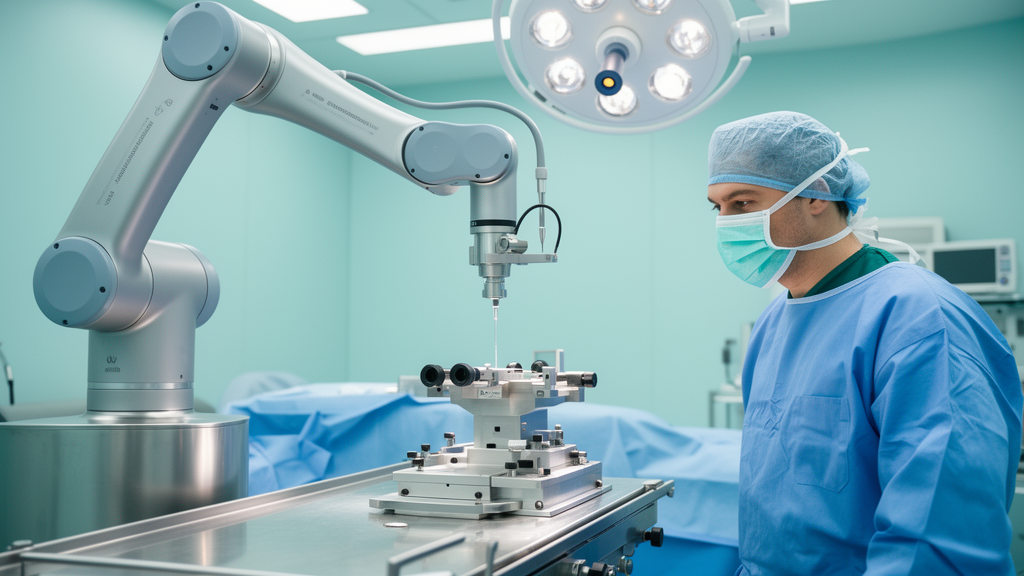
A retrospective comparative study published in Acta Neurochirurgica reports that robot-assisted stereotactic biopsy offers a significantly shorter procedural time compared to traditional frame-based manual guidance, while maintaining comparable safety and diagnostic efficacy. The research team analyzed data from 182 patients who underwent a total of 191 brain biopsies to evaluate the performance of the ROSA ONE® Brain System against standard frame-based techniques. The aim of this study was to compare the safety and efficacy of robot-assisted (RA) and frame-based manually-guided (MG) stereotactic biopsy in the diagnostics of focal brain lesions.
The investigation focused on the diagnostics of focal brain lesions, where stereotactic biopsy has long been an essential tool for establishing treatment strategies. With frame-based biopsy being the standard method, novel frameless robotic solutions are gradually entering mainstream use—potentially increasing diagnostic accuracy and precision. The researchers specifically compared robot-assisted (RA) and frame-based manually-guided (MG) procedures, paying special attention to the duration of the procedure, including both total procedural time and total operating room (OR) time. They also assessed procedural complications and the diagnostic yield of the obtained material, which included rates of nondiagnostic biopsy and trajectory errors.
The study population comprised 182 patients undergoing diagnostic evaluation of focal intracranial lesions. Of the 191 total biopsies performed, 52 were conducted using the robotic system, while 139 utilized the frame-based manual guidance approach. The robotic procedures were performed using the ROSA ONE® Brain System, manufactured by Zimmer Biomet Inc. The classification of neurosurgical complications proposed by Landriel Ibañez FA et al. was additionally applied.
The primary finding regarding efficiency was a significant reduction in total procedural time for the robot-assisted group. The median total procedural time for RA biopsies was 85 (69–151) minutes. In contrast, the median total procedural time for MG biopsies was 140 (120–165) minutes. This difference was statistically significant, with a p-value of less than 0.001. However, the difference was no longer reflected in total operating room times. The median total OR time for the RA group was 85 minutes (69–151), compared to 100 minutes (88–118) for the MG group, yielding a p-value of 0.266.
Regarding diagnostic efficacy, the study found no statistically significant differences between the two groups in terms of nondiagnostic biopsy rates. The rate of nondiagnostic biopsies was 9.62% in the RA group and 11.51% in the MG group, with a p-value of 0.709. Similarly, there was no statistically significant difference in trajectory error. The trajectory error rate was 5.77% for RA biopsies and 3.60% for MG biopsies, resulting in a p-value of 0.686.
Safety outcomes were also comparable between the two groups. The overall complication rate was 15.38% in the robot-assisted group and 24.46% in the manually-guided group. Despite the numerical difference, this variation did not reach statistical significance, with a p-value of 0.189.
The study concludes that robot-assisted stereotactic biopsy is a reasonable alternative to frame-based manual guidance. The authors emphasize that while there are no significant differences in efficacy or safety profiles, the robotic method offers remarkably shorter procedural times.
Subject of Research: Comparison of robotic and frame-based stereotactic biopsy for focal brain lesions
Article Title: Robotic versus frame-based stereotactic biopsy in the diagnostics of focal brain lesions: a retrospective comparative study
Article References: Brożek, G. A., Pilawska, S. A., Grzywna, E., Pietraszko, W., Stachura, K., Kwinta, B. M., & Krzyżewski, R. M. (2026). Robotic versus frame-based stereotactic biopsy in the diagnostics of focal brain lesions: a retrospective comparative study. Acta Neurochirurgica. https://doi.org/10.1007/s00701-026-07035-7
Image Credits: AI Generated
DOI: 10.1007/s00701-026-07035-7
Keywords: stereotactic biopsy, robotic surgery, neurosurgery, brain lesions, diagnostic accuracy, surgical safety, retrospective study, Acta Neurochirurgica, Robotic, versus, frame-based, stereotactic
News Source: Ophelia Keating. (November 10, 2026). Robotic Brain Biopsy Faster, Equally Safe in Study. Scienmag.