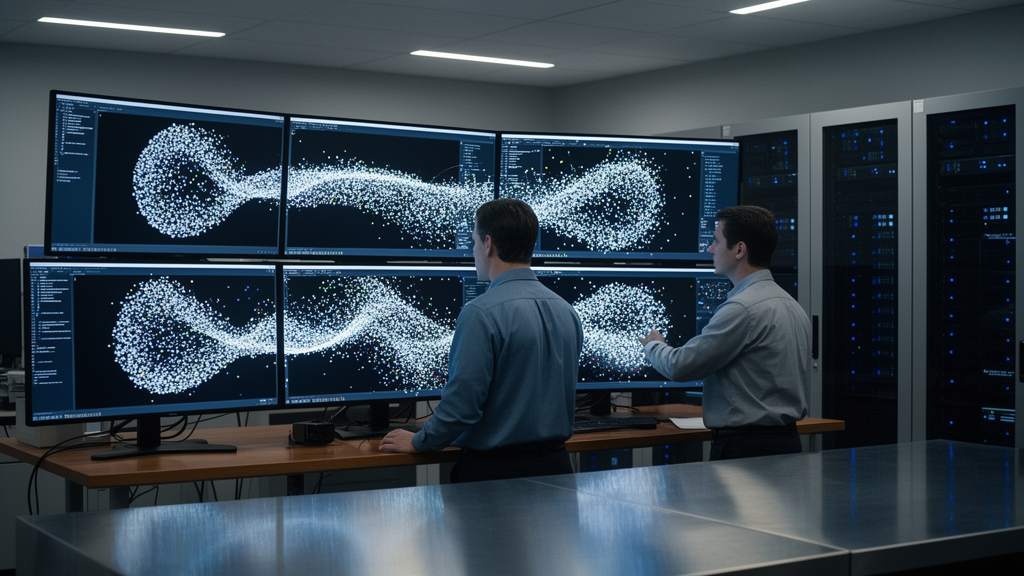
High-energy physics experiments increasingly rely on continuous data acquisition streams and commercial heterogeneous processors to reconstruct particle trajectories, creating acute software maintenance challenges when algorithms are tightly coupled to proprietary hardware architectures. To address the difficulty of developing, upgrading, and porting reconstruction routines across distinct computing fabrics without sacrificing execution speed, researchers have demonstrated that the SYCL heterogeneous programming model enables a single modern C++ codebase to achieve effective performance portability across diverse central processing units, graphics processing units, and field-programmable gate arrays. Evaluating this unified programming paradigm on the particle track reconstruction pipeline created for the Forward Tracker of the upcoming PANDA experiment at the FAIR facility, the investigation confirms that hardware abstraction layers can execute intensive scientific workflows across multi-vendor computing architectures. By decoupling high-level algorithmic logic from vendor-specific accelerator backends, the implementation allows identical source code to target heterogeneous hardware targets while maintaining computational efficiency comparable to native programming languages.
Modern particle physics apparatuses generate unprecedented volumes of raw detector telemetry that demand real-time computational filtration and offline analytical processing. Exemplified by facilities such as the ALICE experiment at the Large Hadron Collider, which directs continuous raw data streams reaching up to three terabytes per second to high-density CPU and GPU nodes running the O2 software platform, next-generation research installations are shifting away from rigid, custom-built hardware triggers toward flexible commercial infrastructure. Comparable continuous readout architectures are being developed for both the CBM and PANDA detector systems currently under construction at the FAIR accelerator complex. Autonomous detector subsystems in these modern facilities produce continuous, free-streaming data packages that must undergo online event reconstruction and selection pipelines to establish whether raw collision chunks should be preserved to storage or discarded, imposing stringent throughput constraints on heterogeneous platforms combining multi-core host processors and specialized computing accelerators.
Constructing high-throughput tracking pipelines across divergent hardware families has historically forced experimental collaborations to maintain separate, vendor-dependent codebases relying on specialized tools such as CUDA or HIP. This fragmentation requires substantial human labor, impedes code reusability, and restricts the long-term migration of scientific software to emerging processor designs. The open-standard SYCL programming model, maintained by the Khronos Group, addresses this computational bottleneck by defining a single-source, host-kernel C++17 abstraction that delegates execution units, known as kernels, to diverse compliant target devices. To investigate the practical viability and portability overhead of this abstraction layer, the research team ported the track reconstruction algorithm designed for the PANDA Forward Tracker straw-tube detector, examining its execution properties across two mature, production-grade SYCL compilation toolchains: AdaptiveCpp, which was formerly known as hipSYCL and utilizes native toolchains to target various CPU and GPU architectures, and Intel oneAPI Data Parallel C++, which implements native SYCL alongside specialized compiler plugins extending support to AMD and NVIDIA architectures.
The physical detection system under study consists of the Forward Tracker in the PANDA experiment, an apparatus engineered to investigate hadron physics, open charm mesons, charmonium states, and gluonic excitations using antiproton beams with momenta between 1.5 and 15 gigaelectronvolts per speed of light colliding against an internal hydrogen target. The Forward Tracker itself is a gaseous tracking detector comprising six stations arranged in pairs: stations FT12 situated upstream of a dipole magnet, FT34 placed directly within the magnetic volume, and FT56 located downstream. Every station contains four double layers of gaseous straw tubes, with the outermost layers oriented vertically and inner layers inclined by positive five degrees and negative five degrees to resolve horizontal and vertical projections across 12,224 individual electronic channels. As charged particles pass through the active gas volume, induced electrical signals establish hit records characterized by specific straw locations and drift radii representing the shortest physical distance between the trajectory and the central anode wire.
The track reconstruction algorithm processes these hit collections through three consecutive mechanical stages designed to reconstruct trajectories in field-free drift zones, resolve curved trajectories within the dipole field, and match overall segments into global particle tracks. In the initial field-free stage within stations FT12 and FT56, the algorithm identifies linear track projections on the horizontal ZOX plane by evaluating hit pairs from vertical straw layers, filtering candidates against the collision origin in FT12, and computing straight lines tangent to hit circles. Surviving candidates undergo duplicate filtering where tracks overlapping across three layers with neighboring hit straws are removed. Validated horizontal candidates are then projected onto the vertical ZOY plane using hit coordinates from inclined straw layers. When particles enter the dipole field in station FT34, magnetic deflection bends their path into circular arcs on the horizontal plane, prompting the algorithm to fit circles tangent to FT12 tracks before matching finished track extensions through station FT56.
To evaluate tracking accuracy before conducting extensive performance portability benchmarks, the authors tested the mathematical reconstruction routine against Monte Carlo simulations generated via the PandaRoot framework. These benchmarking sets modeled multi-particle events containing one, three, five, and eight muons across momentum energies of 0.55, 2.55, and 5.55 gigaelectronvolts emitted across polar angles spanning from zero to fifteen degrees. A simulated track was classified as correctly reconstructed if it traversed all detector stations and at least eighty percent of its reconstructed hits matched the original simulated straws. Across these challenging simulation conditions, the algorithm demonstrated robust tracking accuracy surpassing ninety percent in nearly all tested configurations, falling below that threshold only in the dense, overlapping environment characterized by eight low-energy muons at 0.55 gigaelectronvolts, thereby verifying the baseline algorithmic precision required for experimental operation.
Translating the sequential reconstruction procedure into an accelerated SYCL pipeline required decomposing the computational workflow into seven distinct kernels submitted across eleven distinct execution steps within a single unified SYCL queue. Although naive initial implementations parallelized calculations coarsely at the single-event level, optimal acceleration required tailoring parallel granularity across three operational hierarchies: hit-pair level, track-candidate level, and event level. The computationally demanding initial LineZOX kernel employs fine-grained nd_range parallelism on the hit-pair level, enabling precise control over work-group configurations and thread distribution across individual collision events. Conversely, intermediate tracking routines operate on individual track candidates using standard range constructs, while duplicate filtration, trajectory matching, and an auxiliary Rewrite kernel process whole events. This auxiliary Rewrite kernel copies valid track candidates into smaller, dense buffers following duplicate elimination, mitigating the quadratic memory complexity of earlier stages and minimizing overall host-device memory movement across flat continuous hit buffers.
The computational performance and cross-platform portability of the unified SYCL implementation were rigorously measured across a comprehensive collection of enterprise processing architectures using datasets scaled up to 640,000 simulated events. Host hardware configurations comprised 64-core AMD EPYC 7742 Rome processors, 64-core AMD EPYC 7763 Milan processors, and a 24-core Intel Xeon Gold 6248R Cascade Lake processor, while dedicated accelerator targets encompassed NVIDIA Volta V100 and Ampere A100 GPUs alongside AMD Instinct MI50 and MI100 accelerators. Benchmarking throughput across expanding event batch sizes revealed that per-event execution efficiency improved steadily as input volumes increased from 10,000 to 640,000 events. This observed scaling confirms that increasing batch dimensions progressively dilutes the proportional runtime overhead imposed by the SYCL abstraction layer and kernel dispatch mechanisms, enabling high-density enterprise processors to achieve maximum sustained event throughput under full computational load.
Comparing compiler efficiencies across host processors revealed distinct runtime dynamics between the AdaptiveCpp and Data Parallel C++ compilation pipelines. On identical AMD EPYC Rome hardware, nonlinear global optimization modeling based on Amdahl’s law demonstrated parallelization fractions of 0.98 for AdaptiveCpp and 0.99 for Data Parallel C++, yet AdaptiveCpp achieved significantly higher absolute throughput because its OpenMP runtime backend incurred lower invocation overhead than the OpenCL backend employed by Data Parallel C++ during rapid successive kernel calls. Furthermore, single-thread evaluations indicated that AdaptiveCpp delivered per-thread throughput closely approaching the native single-threaded C++ baseline. When scaling across physical processing cores, the 24-core Intel Cascade Lake platform demonstrated the highest throughput per normalized core due to reduced parallel scaling penalties, while evaluations on the 64-core Milan system revealed that enabling two logical threads per physical core caused throughput degradation under AdaptiveCpp while producing static throughput under Data Parallel C++.
Evaluating the SYCL tracking pipeline on enterprise graphics processors and comparing results directly against native CUDA and HIP implementations confirmed that the unified codebase achieved performance portability without severe execution penalties. Across both NVIDIA Ampere and Volta architectures, AdaptiveCpp yielded superior execution rates compared to Data Parallel C++, whereas Data Parallel C++ matched or outperformed AdaptiveCpp on AMD CDNA architectures. In head-to-head comparisons against native CUDA and HIP implementations structured with identical algorithmic logic, the SYCL codebase achieved virtually identical throughput across most GPU targets, exhibiting a substantial performance gap only on the AMD CDNA architecture where native HIP maintained an advantage. Exploratory compilation targeting the AMD Alveo U280 FPGA accelerator required adapting the LineZOX kernel to basic ranges and distributing memory across DDR and high-bandwidth memory banks, but non-pipelined tracking mechanics yielded execution speeds two to three orders of magnitude lower than standard processors. Ultimately, the investigation demonstrates that standardized SYCL kernels provide reliable, cross-vendor performance portability for complex experimental physics software without requiring vendor-specific codebase branches.
Subject of Research: Cross-platform performance portability of high-energy physics particle tracking algorithms using the SYCL programming model
Article Title: Performance Portability of the Particle Tracking Algorithm Using SYCL
Article References: Soból, B., Papenbrock, M., Stockmanns, T., & Korcyl, G. (2025). Performance Portability of the Particle Tracking Algorithm Using SYCL. Computing and Software for Big Science, 9(1), Article 13. https://doi.org/10.1007/s41781-025-00143-6
Image Credits: AI Generated
DOI: 10.1007/s41781-025-00143-6
Keywords: SYCL, Particle Tracking, Heterogeneous Computing, High Energy Physics, PANDA Experiment, Performance Portability, Parallel Algorithms, GPU Acceleration, Performance, Portability, Particle, Tracking
News Source: Denise Maddox. (November 10, 2026). Researchers Achieve Cross-Platform Particle Tracking Portability Across Processors Using SYCL Framework. Scienmag.