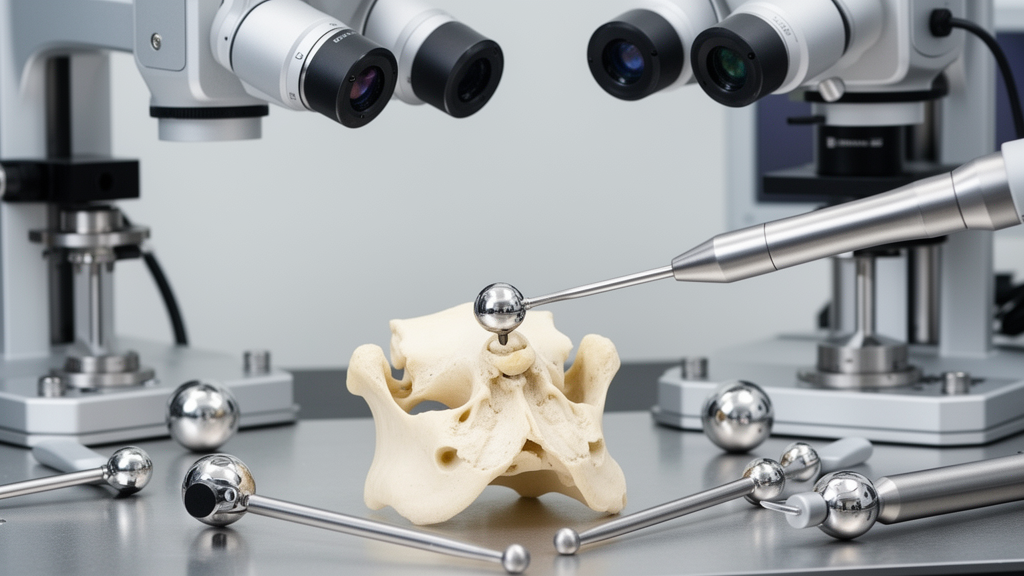
In a controlled bench-top evaluation using a two-dimensional phantom, researchers observed no visually detectable pointer deviation on the display of the NextAR surgical navigation system across tests utilizing C-arm, O-arm, and computed tomography imaging. The investigation, detailed in BMC Musculoskeletal Disorders by Richard Zaccaria and colleagues, evaluated whether an operator could identify an offset between the navigated pointer tip and fixed target points on the system’s three-dimensional display. The primary finding demonstrated an overall deviation rate of zero across thirty total registration trials, though the researchers emphasized that the endpoint was strictly visual rather than an independently measured metric.
The accuracy of surgical navigation systems remains critical for their safe and effective use during clinical procedures. For this investigation, the research team examined whether a positional deviation of the pointer tip from a one-millimetre target could be visually identified on the display of the NextAR navigation platform, manufactured by Medacta International SA. The experimental design specifically explored whether visual alignment varied when image-to-patient registration was performed using different imaging modalities, and whether any detectable error changed in relation to the distance between a fixed fiducial reference marker and the evaluated target.
To evaluate pointer alignment under controlled conditions, the researchers constructed a flat two-dimensional phantom consisting of millimetre graph paper mounted on a wooden board. The test grid featured two parallel rows containing twenty steel nails each, with every nail possessing a one-millimetre head. Adjacent nails along each row were positioned ten millimetres apart, while the two parallel rows were separated by a distance of one hundred and twenty millimetres. A fiducial reference marker was anchored midway between the two rows at the starting edge of the grid to define the coordinate origin for all subsequent measurements.
The experimental phantom was imaged across three distinct radiographic modalities: a Ziehm Vision RFD 3D C-arm, a Medtronic O-arm MVS O2, and a Siemens SOMATOM Drive computed tomography scanner. For each imaging modality, the team conducted ten separate image acquisitions, with each acquisition immediately followed by a new image-to-patient registration sequence. Within the reconstructed volume of each scan, the operator positioned the physical tip of the navigated pointer onto each nail head and visually inspected the NextAR three-dimensional display interface to determine whether any positional discrepancy appeared.
The primary study endpoint, defined as visually detectable pointer deviation, was characterized as a visible offset of the pointer tip from the centre of the nail head on the navigation screen. Because the NextAR system does not output a numerical deviation value during this process, the evaluation relied entirely on visual monitoring rather than an independently measured target registration error. No artificial registration error was introduced into the system, and the physical pointer tip was not tracked using external reference measurement instruments. The authors noted that the visual detection threshold was approximately one millimetre, constrained by the dimensions of the nail heads and the millimetre paper grid, and was neither calibrated nor verified independently.
Across all thirty conducted acquisitions, the operator detected zero instances of visible pointer offset on the system display. The observed rate of detectable deviation was zero out of ten acquisitions for each modality individually, corresponding to an exact two-sided Clopper–Pearson ninety-five percent confidence interval of 0 to 30.9 percent. Across the pooled thirty acquisitions, the overall rate of zero out of thirty yielded an exact ninety-five percent confidence interval of 0 to 11.6 percent under the fixed bench-top setup. The maximum fiducial-to-target distances assessed reached 143 millimetres with the C-arm, 152 millimetres with the O-arm, and 199 millimetres with computed tomography.
Despite the absence of visible deviations, the investigators noted essential constraints inherent to the bench-top setup. Because the evaluation relied exclusively on a visual observation threshold limited to approximately one millimetre without external reference validation, the findings do not establish submillimetre accuracy, demonstrate equivalence among the three imaging systems, confirm the absence of distance-related error effects, or guarantee clinical reliability. The authors concluded that thorough verification in anatomically representative cadaveric models and clinical surgical environments remains necessary before drawing conclusions regarding patient applications.
Subject of Research: Visual accuracy evaluation of the NextAR surgical navigation system
Article Title: Visually detectable pointer deviation of the nextar surgical navigation system with c-arm, o-arm and ct imaging: a bench-top study using a two-dimensional phantom
Article References: Zaccaria, R., Suero, E., Lampert, C., Simon, D., Neudeck, R., Hauck, S., Weigert, A., Reidler, P., Böcker, W., & Wegener, B. (2026). Visually detectable pointer deviation of the nextar surgical navigation system with c-arm, o-arm and ct imaging: a bench-top study using a two-dimensional phantom. BMC Musculoskeletal Disorders. https://doi.org/10.1186/s12891-026-10696-1
Image Credits: AI Generated
DOI: 10.1186/s12891-026-10696-1
Keywords: surgical navigation, NextAR, bench-top study, two-dimensional phantom, imaging modalities, accuracy assessment, computer-assisted surgery, fiducial registration, Visually, detectable, pointer, deviation
News Source: Ophelia Keating. (November 10, 2026). NextAR Surgical Navigation Shows No Visually Detectable Pointer Deviation in Bench Test. Scienmag.