Researchers utilizing a customized segmented diagnostic platform have mapped the spatial and dynamic mechanisms by which sodium ion contamination degrades proton exchange membrane electrolysis cells, defining a distinct three-stage poisoning sequence that culminates in substantial cell voltage spikes and internal transport disruption. Proton exchange membrane water electrolysis represents an essential electrochemical pathway for generating high-purity green hydrogen from renewable electricity, yet the intrusion of foreign metal cations such as sodium into the circulating feedwater severely compromises system durability and efficiency. By segmenting the cell structure into independent measurement zones, the investigation demonstrated that sodium ion contamination does not occur uniformly across the active area but instead initiates near the flow outlet before progressing toward the center of the anode catalyst layer. The accumulation of sodium ions steadily replaces functional protons within the ionomer and polymer electrolyte membrane, causing noticeable activation losses, non-uniform distributions of local current density and temperature, and delayed electrical dynamic response during operational current transitions.
The rapid advancement of water electrolysis technology is widely regarded as a foundational component in the international transition toward clean, sustainable, and low-carbon energy systems. Among the available electrolysis architectures, proton exchange membrane electrolysis cells offer distinctive operational advantages, including exceptional product gas purity, high operational current densities, elevated cathode delivery pressures, and rapid dynamic response capabilities that align effectively with intermittent renewable power inputs. However, sustaining these high performance levels traditionally requires continuous feeds of ultra-pure deionized water to prevent trace metal cations from entering and poisoning the membrane electrode assembly. In industrial and field settings, freshwater resources face severe geographic scarcity and unequal regional allocation, creating significant operational challenges. Furthermore, even closed-loop ultra-pure water circuits remain vulnerable to metal ion contamination resulting from system piping and component corrosion over extended operating cycles. While direct seawater electrolysis has emerged as an attractive alternative to bypass freshwater dependency, raw seawater contains roughly 480 millimolar sodium ions, presenting an extreme operational poisoning hazard.
Prior electrochemical investigations have established that foreign metal cations exert detrimental effects on catalyst activity, ionomer functionality, and proton exchange membrane structural integrity. Earlier studies by research teams led by Zhang and Tan examined sodium contamination under varying electrode configurations, showing that sodium ions replace active protons at reaction sites within both the ionomer and the solid polymer electrolyte. This cationic substitution depresses local proton concentrations, reduces ionic diffusion coefficients, alters electrode equilibrium potentials, and substantially elevates cell mass transport resistance. Similar investigations into other metallic contaminants have demonstrated that ferric ions catalyze destructive hydrogen peroxide formation that degrades Nafion membranes, calcium ions disrupt critical membrane water clusters by occupying sulfonic acid groups, and dissolved titanium ions migrate from porous transport layers to deposit onto platinum catalyst particles. Nevertheless, conventional analytical methodologies have relied predominantly on bulk polarization curves, electrochemical impedance spectroscopy, and long-term durability metrics, which fail to capture localized internal heat and mass transfer processes or reveal how contamination dynamically evolves across cell surfaces.
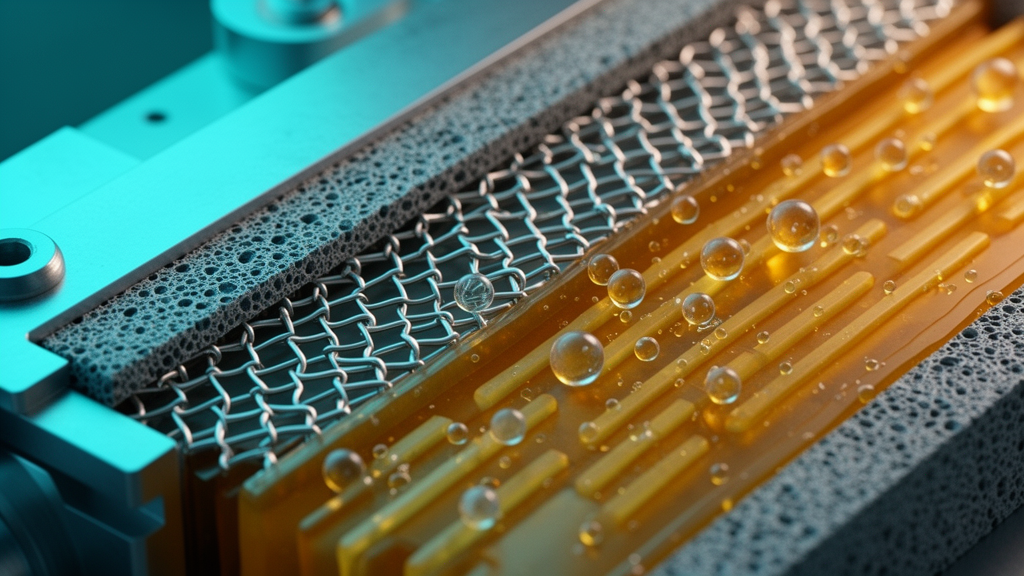
To overcome the limitations of aggregate cell diagnostics, the research team constructed an experimental segmented diagnostic testing apparatus designed to monitor local current densities and thermal gradients across a large-area cell without damaging its internal operational structure. The core architecture centered on a customized graphite cathode flow field plate with a reactive area of 108 square centimeters, divided into twenty-seven independent segments measuring two centimeters by two centimeters each. Adjacent graphite segments were electrically isolated using insulating epoxy resin fills within the inter-segment gaps. Beneath the flow plate, a printed circuit board was fabricated with twenty-seven matching gold-plated exposed copper pads, each providing an effective sensing area of 1.8 centimeters by 1.8 centimeters. Operating currents across individual segments were determined by measuring the precision voltage drops across dedicated circuit resistors and calculating local current densities through Ohm’s law. The complete experimental flow loop integrated a DC stabilized power supply, a multi-channel data acquisition system, a thermostatic water bath, a peristaltic delivery pump, and a real-time conductivity meter.
The dynamic progression of sodium poisoning was systematically analyzed through multi-cycle polarization tests using feedwater dosed with five parts per million of sodium ions, formulated by dissolving 0.0059 grams of anhydrous sodium sulfate per liter of deionized water. Because sulfate anions are electrochemically inert under anode operating conditions, observed degradations were isolated strictly to sodium cation activity. Each testing cycle incremented the operational current density from zero to 2.0 amperes per square centimeter in steps of 0.1 amperes per square centimeter, holding each step for one minute before stepping downward. Over successive cycles, cell overpotentials grew progressively larger until stabilizing at the eighth cycle, where the cell voltage at 2.0 amperes per square centimeter reached 2.26 volts, representing a substantial 274 millivolt increase over the uncontaminated baseline of 1.986 volts. Based on these voltage trajectories, the poisoning process was divided into three clear operational stages: an initial stage characterized by slight degradation at high current, a sustained stage exhibiting continuous voltage increases, and a final saturated stable stage.
Mapping the local current density distributions across the segmented electrode revealed that the spatial distribution of electrochemical activity shifts dramatically as sodium poisoning advances through its three defined stages. In the initial contamination stage, high catalytic activity remained concentrated across the central area of the catalyst layer, presenting an extensive high-current-density region under low operational current densities where sodium had only begun to infiltrate. However, as the operating current density was raised to 2.0 amperes per square centimeter, the active high-current zone contracted noticeably near the flow outlet, indicating that early sodium accumulation began near the downstream exit. As the cell entered the sustained contamination stage, the active central zone contracted further while a broad low-current-density region expanded across the center of the electrode. Scanning electron microscopy and energy-dispersive X-ray spectroscopy confirmed the presence of white sodium salt deposits across the anode catalyst layer, with elemental sodium mass fractions exhibiting a decreasing gradient along the fluid flow path from the inlet to the outlet.
Evaluating cell behavior across contamination levels of zero, five, and ten parts per million demonstrated that higher sodium concentrations drastically accelerate voltage penalties and destabilize the cell’s dynamic electrical response. Under ten parts per million of sodium ions, prepared with 0.0118 grams of anhydrous sodium sulfate per liter, cell voltage at 2.0 amperes per square centimeter climbed to 2.30 volts, reflecting a severe 314 millivolt penalty compared to the uncontaminated system. The voltage spike occurred at substantially lower current thresholds under ten parts per million than under five parts per million, indicating that elevated cationic presence forces earlier saturation of membrane sulfonic acid sites. Furthermore, time-resolved voltage measurements revealed significant dynamic voltage fluctuations during current switching, with transient voltage drops of 48.9 millivolts at five parts per million and 87.1 millivolts at ten parts per million under a current density of 0.5 amperes per square centimeter, driven by increased interfacial contact resistance, enlarged double-layer capacitance effects, and protracted charge-discharge cycles.
The experimental investigation also evaluated how physical operational variables, particularly the anode feedwater flow rate, alter the internal thermal environment and dictate electrolysis performance under persistent sodium contamination. When evaluating water delivery rates at high current densities of 1.6 amperes per square centimeter and above, decreasing the inlet flow rate unexpectedly improved overall cell performance under both five and ten parts per million sodium conditions. This counterintuitive enhancement occurs because lower fluid flow velocities reduce convective heat dissipation away from the cell, allowing the internal operating temperature to rise naturally and accelerate electrochemical reaction kinetics. However, at intermediate current densities between 0.4 and 0.8 amperes per square centimeter under five parts per million contamination, reduced water flow rates caused localized mass transport limitations as oxygen gas bubbles became trapped within the porous transport layer and catalyst layer. Thermal mapping confirmed that internal cell temperatures rose steadily along the flow path from inlet to outlet as flowing water carried reaction-generated heat downstream.
Thermal control experiments demonstrated that elevating the baseline cell operating temperature plays a critical role in mitigating the kinetic penalties imposed by sodium cation contamination within the catalyst layer. Polarization measurements conducted across temperatures of 50, 60, and 70 degrees Celsius under both five and ten parts per million sodium levels showed consistent reductions in total cell voltage as operating temperature increased. Higher thermal energy stimulates catalytic activity at reaction sites and promotes faster ionic transport, directly offsetting a portion of the ohmic and mass transfer resistances induced by sodium substitution. Segmented diagnostic data revealed that elevating the operating temperature from 50 to 70 degrees Celsius under ten parts per million contamination transformed an otherwise highly irregular current density distribution into a significantly more uniform active profile. Under five parts per million contamination, higher operating temperatures shrank the low-current region near the fluid inlet while substantially enlarging the high-current region near the outlet, confirming that thermal elevation enhances localized reactant transport and improves active site utilization.
To determine the reversibility of sodium poisoning, the research team conducted regeneration experiments by replacing contaminated feedwater with purified deionized water circulating through an integrated mixed-bed ion exchange resin bed. Using a resin ratio of 100 grams per liter to continuously strip residual sodium ions from the circulation loop, multi-cycle recovery tests demonstrated that flushing partially restores cell performance. At an operating current density of 2.0 amperes per square centimeter, the cell voltage dropped from 2.30 volts to 2.25 volts after three recovery cycles, achieving an overall voltage reduction of 2.17 percent. Segmented current mapping confirmed that high-current-density zones expanded and became more uniform following deionized water flushing. However, performance remained distinctly inferior to uncontaminated baseline levels because flushing only dissolves sodium salts physically adhered to the external surface of the catalyst layer. Sodium ions embedded deeply within the internal catalyst structure and membrane matrix persist, leaving the catalyst three-phase interface partially compromised and highlighting the necessity of combining localized monitoring with proactive water purification.
Subject of Research: Sodium ion contamination mechanisms in proton exchange membrane electrolysis cells
Article Title: Poisoning effects of sodium ion contamination in proton exchange membrane electrolysis cell based on segmented diagnostic method
Article References: Liu, Z., Hao, J., Yao, R., Yu, Z., Jiao, K., & Tian, Z. (2025). Poisoning effects of sodium ion contamination in proton exchange membrane electrolysis cell based on segmented diagnostic method. Carbon Neutrality, 4(1), Article 30. https://doi.org/10.1007/s43979-025-00148-5
Image Credits: AI Generated
DOI: 10.1007/s43979-025-00148-5
Keywords: Proton exchange membrane electrolysis, Sodium ion contamination, Segmented cell diagnostics, Green hydrogen production, Membrane degradation, Local current density, Water electrolysis, Electrocatalysis, Poisoning, effects, sodium, contamination
News Source: Ophelia Keating. (November 10, 2026). Segmented Diagnostic Method Maps Sodium Ion Poisoning in Proton Exchange Membrane Electrolyzers. Scienmag.